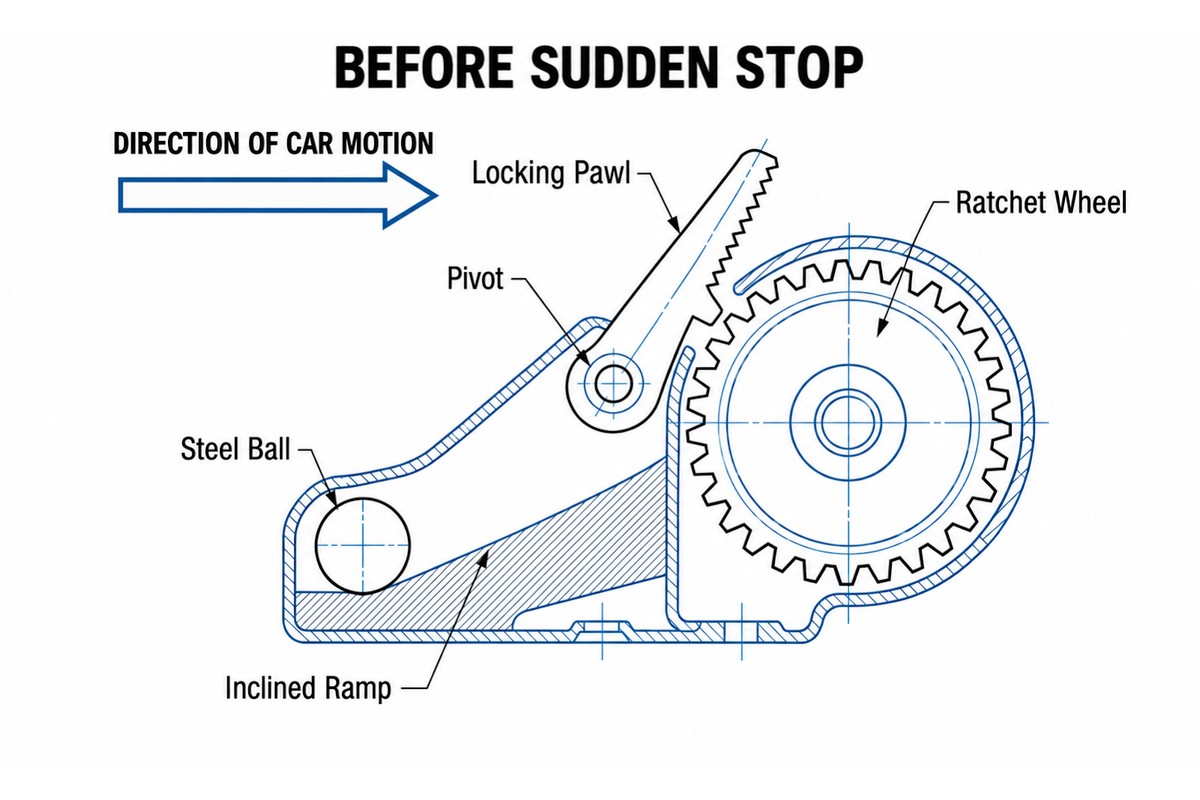
Newton's 2nd Law
A) 3 Laws of Motion - 1st Law - Law of Inertia Video Instruction
If $\Sigma F_{net} = 0$, then $a = $
Because
$\Sigma F_{net} = 0$ means that the object is at rest or moving with
Ex) Free Body Diagram - Block being pulled to the right at a constant velocity.
Draw all the forces:
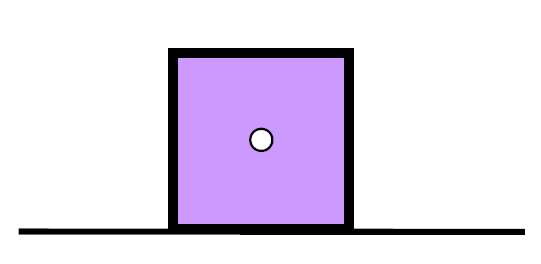
Claim $a = 0 \text{ m/s}^2$, and the force of friction is $12 \text{ N}$ to the left.
Evidence
Reasoning Per Newton's 1st Law, a constant velocity is a state of equilibrium. If the net force is zero, all opposing forces must balance. The applied force to the right must be exactly equaled in magnitude by the force of friction to the left.
A net force is not required
A 5.0 kg box is moved across a floor at constant velocity with a horizontal F of 12 N. What is the force of friction on the box?
3 questions on 1st Law Notes — pick an answer to check yourself.
1. A 5.0 kg box is pushed across a floor at constant velocity by a 12 N horizontal force. What is the friction force on the box?
2. If the net force on an object is zero, the object…
3. A hockey puck slides across frictionless ice at a steady 8 m/s. What horizontal force is needed to keep it moving at this speed?
$\Sigma F_{net} = $
Unbalanced forces cause objects to
$F_{net} = \text{Resultant}$

Ex) Mass M below is lifted up with an acceleration $a$. Find the tension in the string T
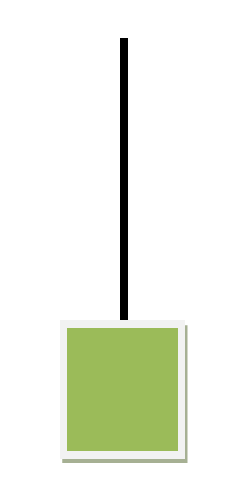
$\Sigma F_{net} = ma$ (up )
Claim Tension $T = M(g + a)$.
Evidence
Reasoning Because the object is accelerating upwards, the upward force (Tension) must be greater than the downward force (Gravity). The net force is the difference between the two, which equals mass times acceleration per Newton's Second Law.
If the String is Accelerated downward?
Claim Tension $T = M(g - a)$.
Evidence
Reasoning Because the object is accelerating downwards, the downward force (Gravity) must be greater than the upward force (Tension). We set the direction of acceleration as positive to simplify the math.

NYSSLS Reading Passage · Dynamics
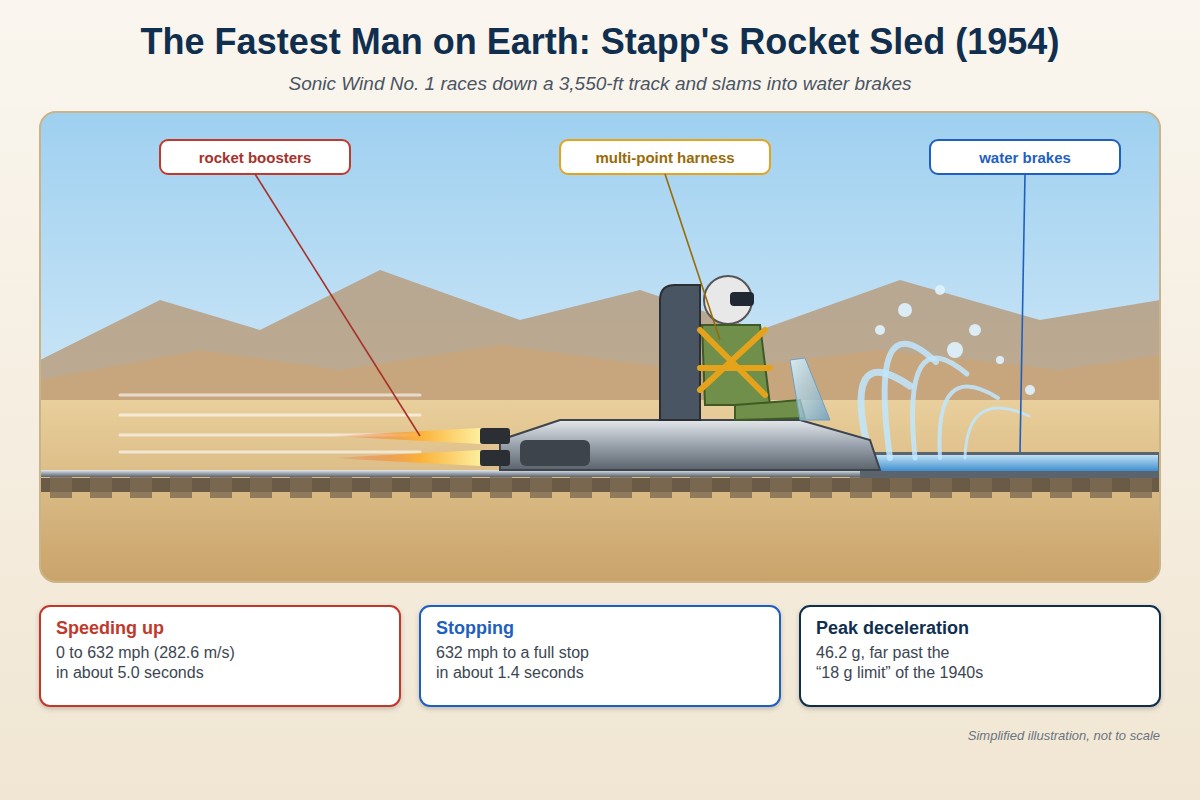
The Fastest Man on Earth: Physics of Crash Survival
Open Reading Passage →3 questions on 2nd Law Intro — pick an answer to check yourself.
1. A 2.0 kg mass is lifted by a string with an upward acceleration of 3.0 m/s². What is the tension? (g = 10 m/s²)
2. A mass hangs from a string and accelerates downward at a (less than g). The tension is…
3. A crate is raised by a cable at constant upward velocity. How does the cable tension compare to the crate's weight?
Two masses are connected by a string. Video Instruction p. 3 - 5
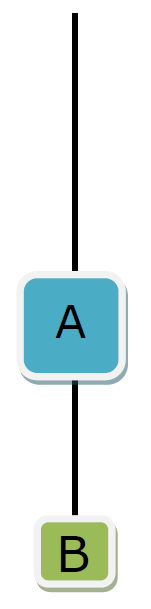
Ex 1) Two masses are connected by a string and remain at rest. Find tension force on top and bottom rope.
$\Sigma F = $
Top String Tension Force:
Bottom String Tension Force:
Claim $T_{bottom} = m_B (10 \text{ m/s}^2)$ and $T_{top} = (m_A + m_B)(10 \text{ m/s}^2)$.
Evidence
Reasoning In equilibrium, upward forces must balance downward forces. The bottom string only needs to support the weight of the bottom mass. The top string must support the weight of the entire system suspended below it.
Ex 2) Find the tension of the top and bottom string if objects accelerated upward.
Free body diagram B (easier) Sketch all forces on B
Sketch all forces on A
Claim $a = \frac{(M - m)g}{M + m}$. Assuming $g = 10 \text{ m/s}^2$, $a = \frac{(M - m) \cdot 10 \text{ m/s}^2}{M + m}$. Rule: One Tension.
Evidence
Reasoning Because the system is accelerating upwards, the tension forces must be greater than the gravitational forces they counteract to provide the necessary net upward force.
3 questions on Connected Masses — pick an answer to check yourself.
1. Mass A hangs from the ceiling by a top string, and mass B hangs below A by a bottom string. Everything is at rest. What is the top string's tension?
2. In that hanging setup, A = 2.0 kg (top) and B = 3.0 kg (bottom), at rest. Using g = 10 m/s², what is the tension in the top string?
3. The same pair (A = 2.0 kg top, B = 3.0 kg bottom) is now pulled upward with acceleration 2.0 m/s². Using g = 10 m/s², what is the bottom string's tension?
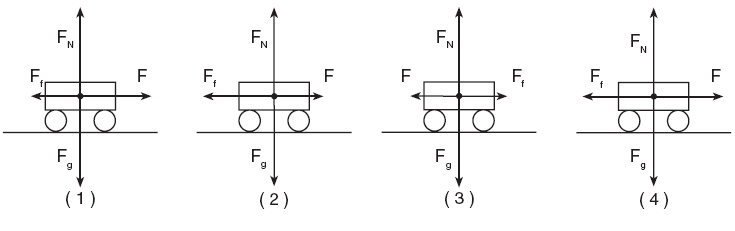
Which cart is slowing down as it travels to the right?
Describe the motion of the rest of the cars.
Claim Cart C is slowing down. Cart A is speeding up to the right, and Cart B moves to the right at constant velocity.
Evidence
Reasoning The cart travels right, but the net force (acceleration) points left. When velocity and acceleration are in opposite directions, the object slows down. When they are in the same direction, the object speeds up. When acceleration is zero, velocity is constant.
3 questions on Cart Motion — pick an answer to check yourself.
1. A cart moves to the right while its acceleration points to the left. What is the cart doing?
2. A 4.0 kg cart on a frictionless table is pulled by a string over a pulley to a hanging 1.0 kg mass. What is the acceleration? (g = 10 m/s²)
3. A cart rolls to the right at a constant velocity. What is the net force on it?
A cart moves along a straight horizontal track. To the right is the positive direction. For each situation, choose the sign of the cart's acceleration:
A. positive B. negative C. zero D. cannot be determined
| Situation | Choice |
|---|---|
| (a) Moving right and speeding up | |
| (b) Moving right and slowing down | |
| (c) Moving left and speeding up | |
| (d) Moving left and slowing down | |
| (e) Moving left at a constant 3 m/s | |
| (f) Rolled up a ramp that rises to the right, momentarily at rest at its highest point | |
| (g) At rest at one instant (no other information) |
Explain the rule you used. Does "negative acceleration" always mean "slowing down"?
More Kinematics Concept Challenges →
Resolving Weight force on Ramp
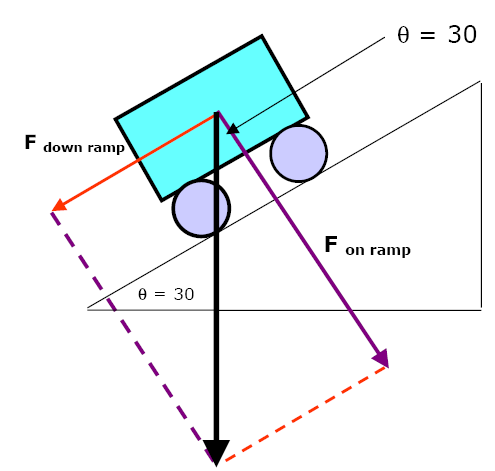
Label $F_g \sin \theta$ and $F_g \cos \theta$ (Parallel & perpendicular components)
Find (f) friction if the box is stationary. CAR at rest, Find $\mu_s$
Claim $a = g \sin \theta$. Assuming $g = 10 \text{ m/s}^2$, $a = (10 \text{ m/s}^2) \sin \theta$.
Evidence
Reasoning The component of gravity pulling the object down the ramp is balanced perfectly by static friction. The normal force is counteracted by the component of gravity perpendicular to the ramp. The ratio of these two components yields the tangent function, making the coefficient of static friction equal to the tangent of the critical angle.
The box rests on a ramp. What is T in terms of M, $\theta$
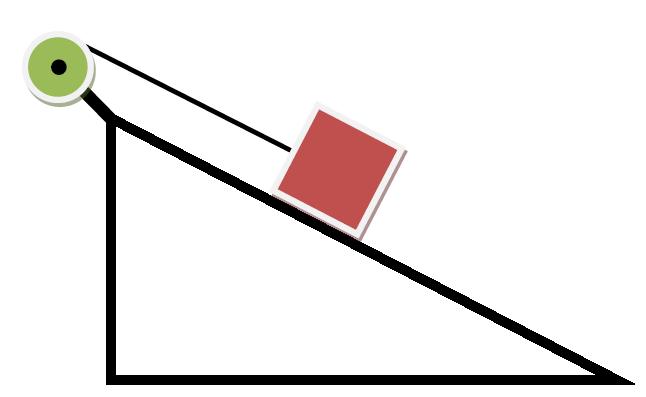
Claim $T = Mg \sin \theta$.
Evidence
Reasoning For the box to remain stationary on a frictionless ramp, the upward force provided by the string must exactly balance the component of the box's weight pulling it down the slope.
3 questions on Ramp Forces — pick an answer to check yourself.
1. A box is just on the verge of slipping on a ramp tilted at 30°. What is the coefficient of static friction?
2. A 4.0 kg box is held at rest on a frictionless 30° ramp by a string parallel to the ramp. What is the tension? (g = 10 m/s²)
3. A box sits motionless on a rough ramp of angle θ, not on the verge of slipping. The static friction force on it equals…
Assuming a frictionless, massless pulley, ... determine the acceleration of the blocks after the large block is released.
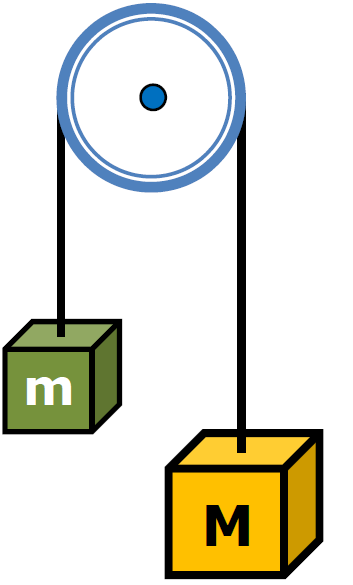
Force of the tension of the rope on mass m, M?
Claim $a = \frac{(M - m)g}{M + m}$. Assuming $g=10$, $a = \frac{(M - m) \cdot 10}{M + m}$. Rule: One Tension.
Evidence
Reasoning The net force driving the entire system is the difference in weight between the two masses ($Mg - mg$). This net force accelerates the total mass of the system ($M + m$). We treat the two masses as a single system connected by a single string with uniform tension.
3 questions on Weights on Pulley — pick an answer to check yourself.
1. Masses of 3.0 kg and 2.0 kg hang on opposite sides of a frictionless, massless pulley. What is their acceleration? (g = 10 m/s²)
2. In a two-mass Atwood machine (unequal masses, released from rest), the rope tension is…
3. An Atwood machine has masses 3 kg and 2 kg. If both masses are doubled to 6 kg and 4 kg, the acceleration…
Ex 1) Find acceleration for this system (frictionless table)
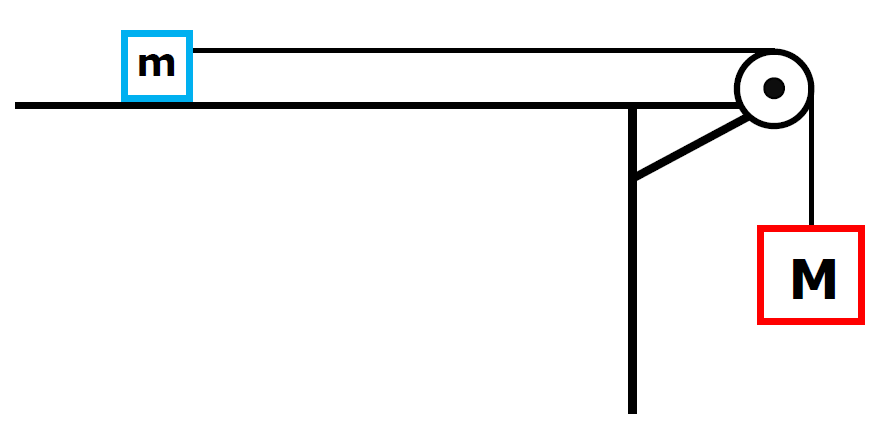
Two bodies move
$F_{net} = $
Claim $a = \frac{Mg}{M+m}$. Assuming $g=10$, $a = \frac{M(10)}{M+m}$.
Evidence
Reasoning The only external force causing the system to accelerate is the weight of the hanging mass ($Mg$). However, this force must accelerate the combined mass of the entire system ($M + m$). The normal force and weight of m cancel each other out vertically and don't contribute to acceleration.
Ex 1b) Find the tension of the string in terms of $m$, $M$ and $g$
Claim $T = \frac{Mmg}{M+m}$
Evidence
Reasoning The string only has to accelerate mass m, so $T = ma$. Since $\frac{m}{M+m} < 1$, the tension is always less than $Mg$ — the hanging mass accelerates downward, so the string cannot fully support its weight.
Ex 2) Acceleration if smaller mass was hanging?
Claim $a = \frac{mg}{M+m}$.
Evidence
Reasoning The logic remains identical to Example 1. The net driving force is the weight of whatever mass is hanging, and it must overcome the inertia of both masses combined.
3 questions on Table/Pulley System — pick an answer to check yourself.
1. Block M on a frictionless table is pulled by a string over a pulley attached to a hanging mass m. As the system accelerates, the string tension is…
2. A 3.0 kg block on a frictionless table is connected over a pulley to a 1.0 kg hanging mass. Using g = 10 m/s², what is the acceleration?
3. Now the masses are swapped: the 3.0 kg mass hangs and the 1.0 kg block is on the frictionless table. Using g = 10 m/s², what is the new acceleration?
Find the acceleration of the red box up the ramp (M)
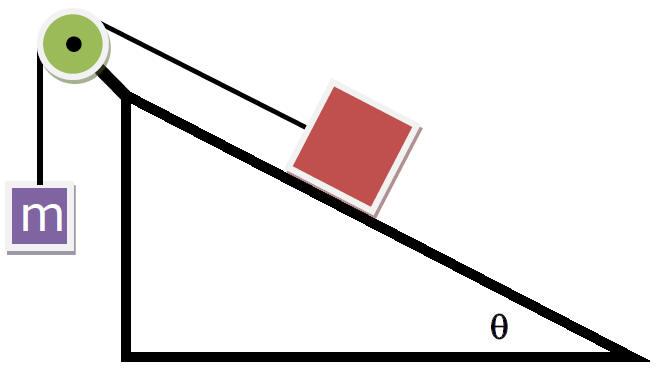
Masses move
Claim $a=0$ if $m_{hang}g = M_{ramp}g \sin \theta$, which simplifies to $m_{hang} = M_{ramp} \sin \theta$.
Evidence
Reasoning The system operates like a tug-of-war. Equilibrium is achieved when the effective pulling force on both sides of the pulley is perfectly balanced. If the parallel component of the ramp mass's weight exceeds the weight of the hanging mass, the system will move in the direction of the ramp.
3 questions on Ramp/Pulley System — pick an answer to check yourself.
1. A 10 kg box on a frictionless 30° ramp is tied over a top pulley to a hanging mass. What hanging mass makes the acceleration zero?
2. A 4.0 kg box on a frictionless 30° ramp is tied over a pulley to a hanging 3.0 kg mass. What is the acceleration? (g = 10 m/s²)
3. In a frictionless ramp–pulley system, when will the box on the ramp (mass M) accelerate down the ramp?
Finding Normal Force / Acceleration
$F_{net} = $
$m = $
Find the acceleration in each example. $\mu = 0.2$
Claim $a = g \sin \theta$. Assuming $g=10$, $a = (10 \text{ m/s}^2) \sin \theta$.
Evidence
Reasoning Gravity is the only unbalanced force acting along the plane of motion. The normal force perfectly cancels out the perpendicular component of gravity. Because mass appears on both sides of the $F=ma$ equation, it cancels out, demonstrating that acceleration down a frictionless incline depends only on gravity and the angle, not the mass of the object.
3 questions on No Friction Incline — pick an answer to check yourself.
1. A block slides down a frictionless incline. If the block's mass is doubled, its acceleration…
2. A block slides down a frictionless 30° ramp. What is its acceleration? (g = 10 m/s²)
3. A box weighing 50. N sits on a frictionless horizontal floor and is pulled by a 10. N horizontal force. What is its acceleration? (g = 10 m/s²)
1) A 10.-kg cement block is pulled to the right across a rough floor ($\mu \neq 0$) by a horizontal force of 40. N. If the cement block accelerates to the right at $1.0 \text{ m/s}^2$, what is the $\mu$ between the floor and the cement block?
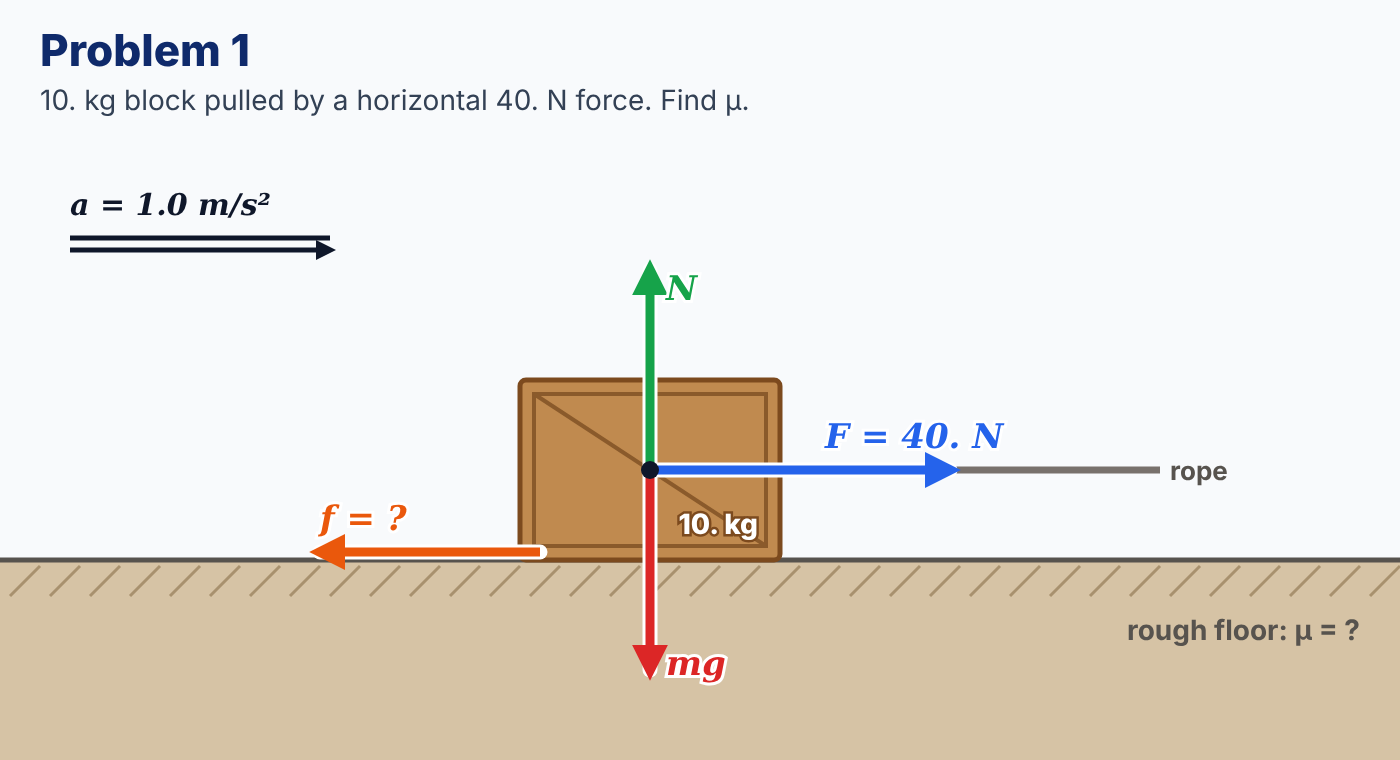
Claim $\mu = 0.30$.
Evidence
Reasoning The applied force must overcome friction to cause acceleration. The difference between the applied force and the actual net force required for the given acceleration gives us the force of friction. We then use the standard friction equation with the calculated normal force.
2) A horizontal force pushes a 20.-kg box to the right across a rough floor where $\mu = 0.50$. If the box accelerates to the right at $6.0 \text{ m/s}^2$, what is the magnitude of the horizontal push?
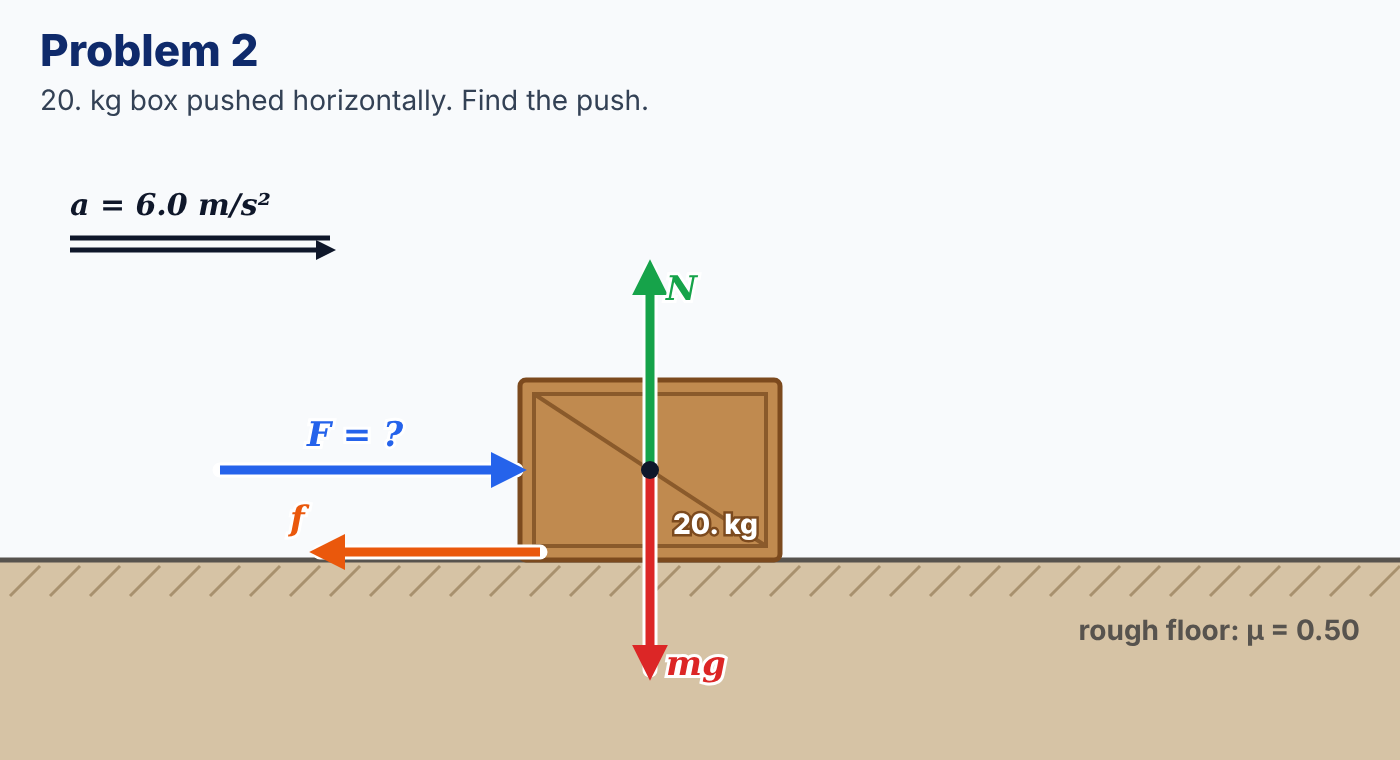
Claim $F_{push} = 220 \text{ N}$.
Evidence
Reasoning To accelerate the box, the push force must provide enough force to overcome kinetic friction AND provide the additional net force required to achieve an acceleration of $6.0 \text{ m/s}^2$. The total push is the sum of these two requirements.
3) A 40.0 -kg box is pulled to the right across a rough floor ($\mu \neq 0$) by a rope angled at $36.87^\circ$ above the horizontal. If the tension in the rope is 200. N and the box accelerates to the right at $2.50 \text{ m/s}^2$, what is the $\mu$ between the box and the floor?
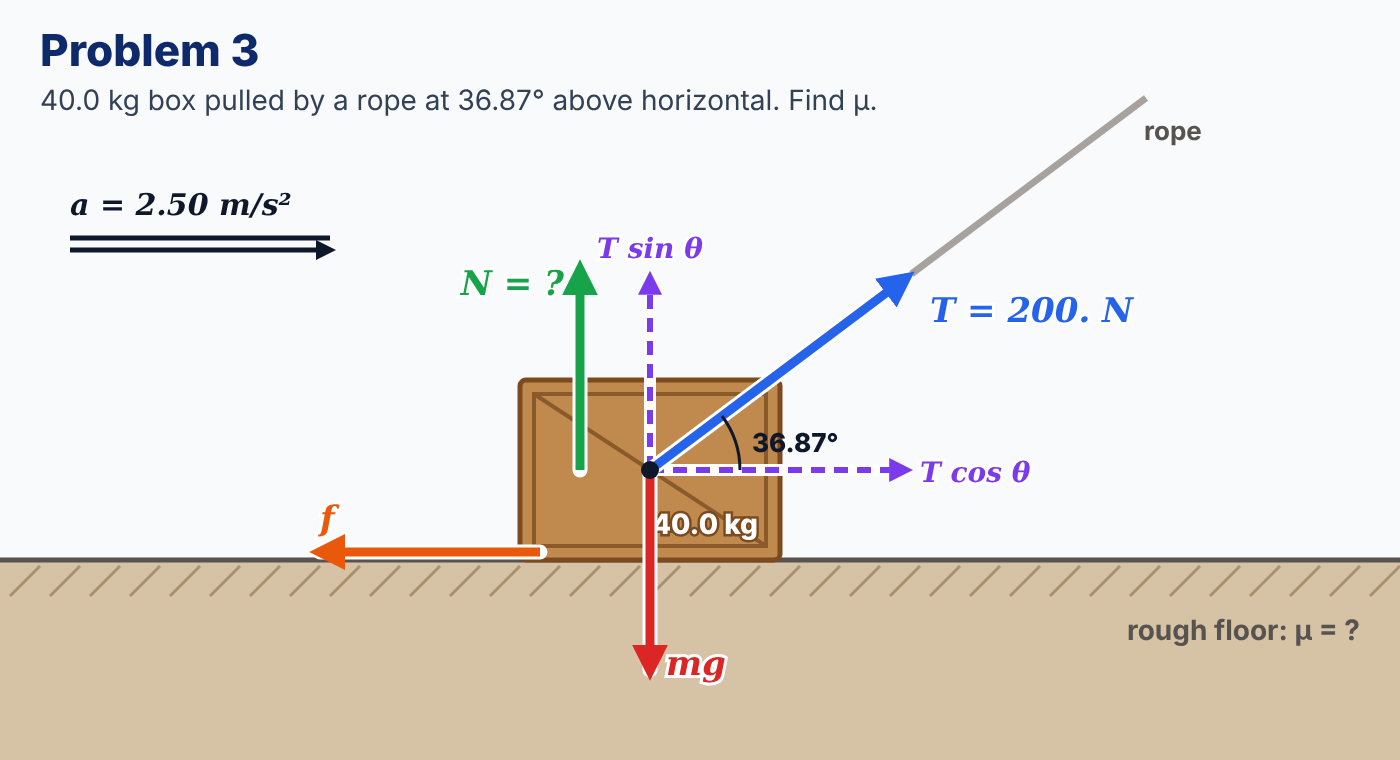
Claim $\mu \approx 0.21$.
Evidence
Reasoning Because the rope pulls upwards at an angle, it partially lifts the box, reducing the normal force (and thus friction) compared to a horizontal pull. We must separate the tension into $x$ (driving) and $y$ (lifting) components to solve for the true normal force and net driving force.
3 questions on Word Problems — pick an answer to check yourself.
1. A 10 kg block is pulled across a floor by a 40 N horizontal force and accelerates at 1.0 m/s². What is μ? (g = 10 m/s²)
2. A box is pulled by a rope angled above the horizontal. Compared with its weight mg, the normal force is…
3. A box slides at constant velocity across a floor while pushed with a 50 N horizontal force. What is the friction force?
1. How much tension must a steel cable withstand if it is used to accelerate a 1050 kilogram car horizontally at $1.20 \text{ m/s}^2$? Ignore friction.
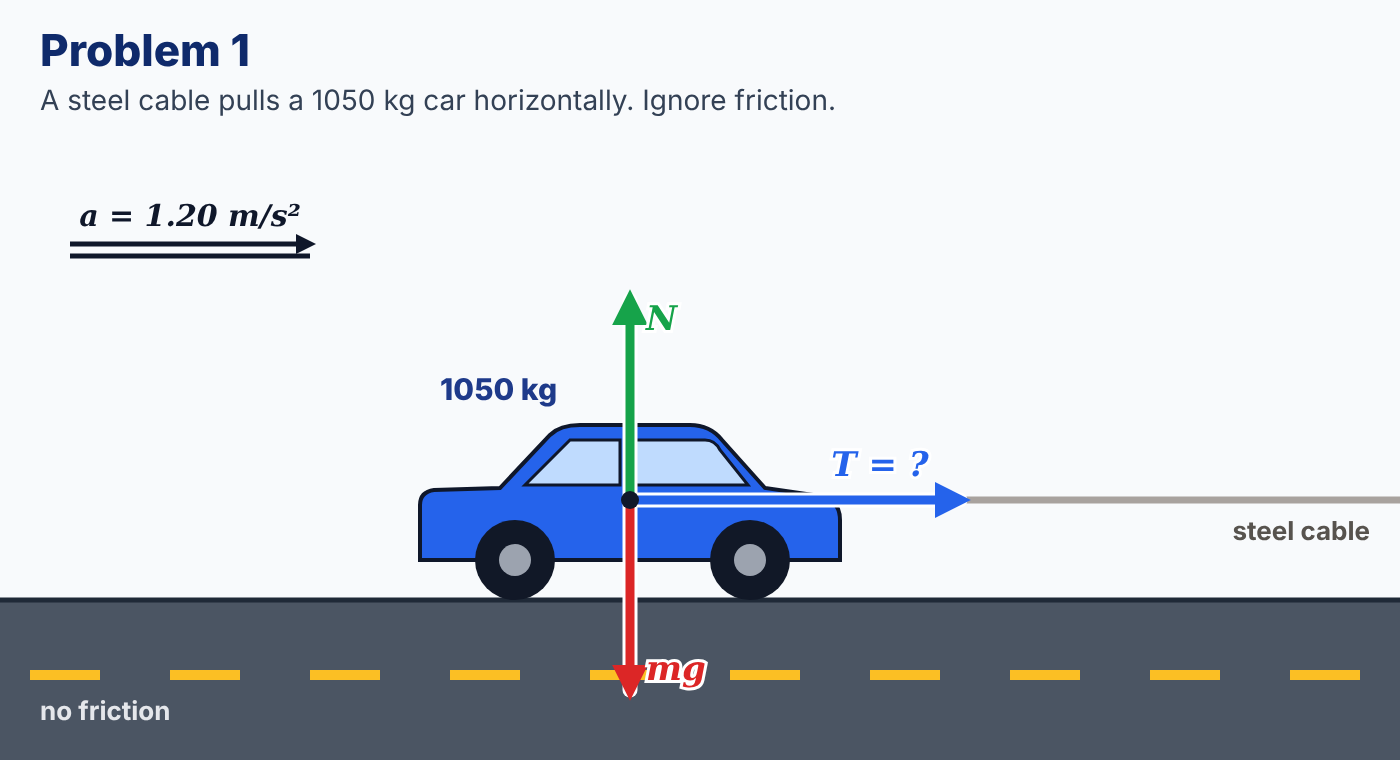
Claim $T = 1.26 \times 10^3 \text{ N}$.
Evidence
Reasoning With friction ignored, the cable's tension provides 100% of the net force required to accelerate the car's mass according to Newton's Second Law.
2. What average force is required to stop a 1100 kilogram car in 8.0 seconds if it is traveling at 90. km/hr?
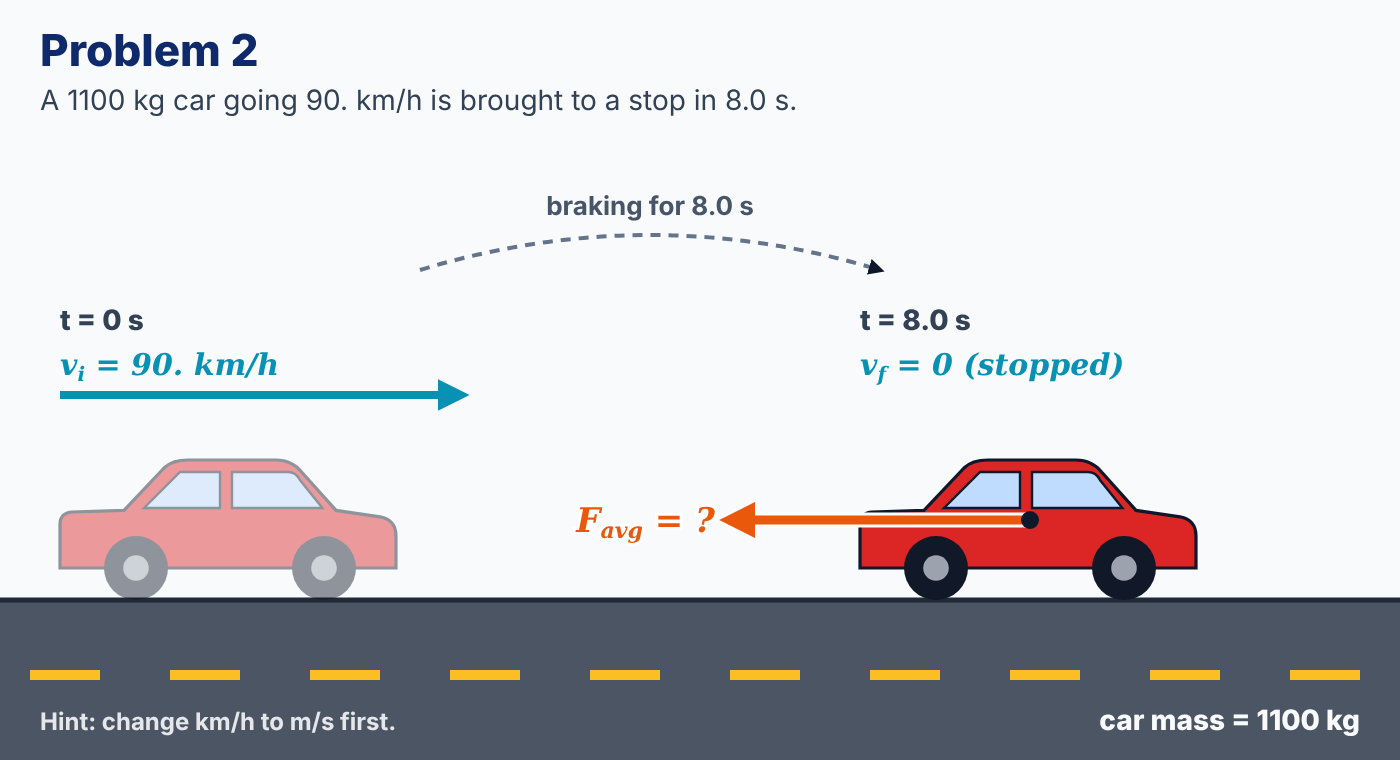
Claim Average Force $\approx -3437.5 \text{ N}$ (or $3437.5 \text{ N}$ opposing motion).
Evidence
Reasoning First, kinematics must be used to determine the rate of deceleration required to stop the car in the given timeframe. Once acceleration is known, Newton's Second Law gives the constant net force needed to achieve that deceleration.
3. How much tension must a steel cable withstand if it is used to accelerate a 1200. kilogram crate vertically upwards at $0.80 \text{ m/s}^2$? Ignore friction.
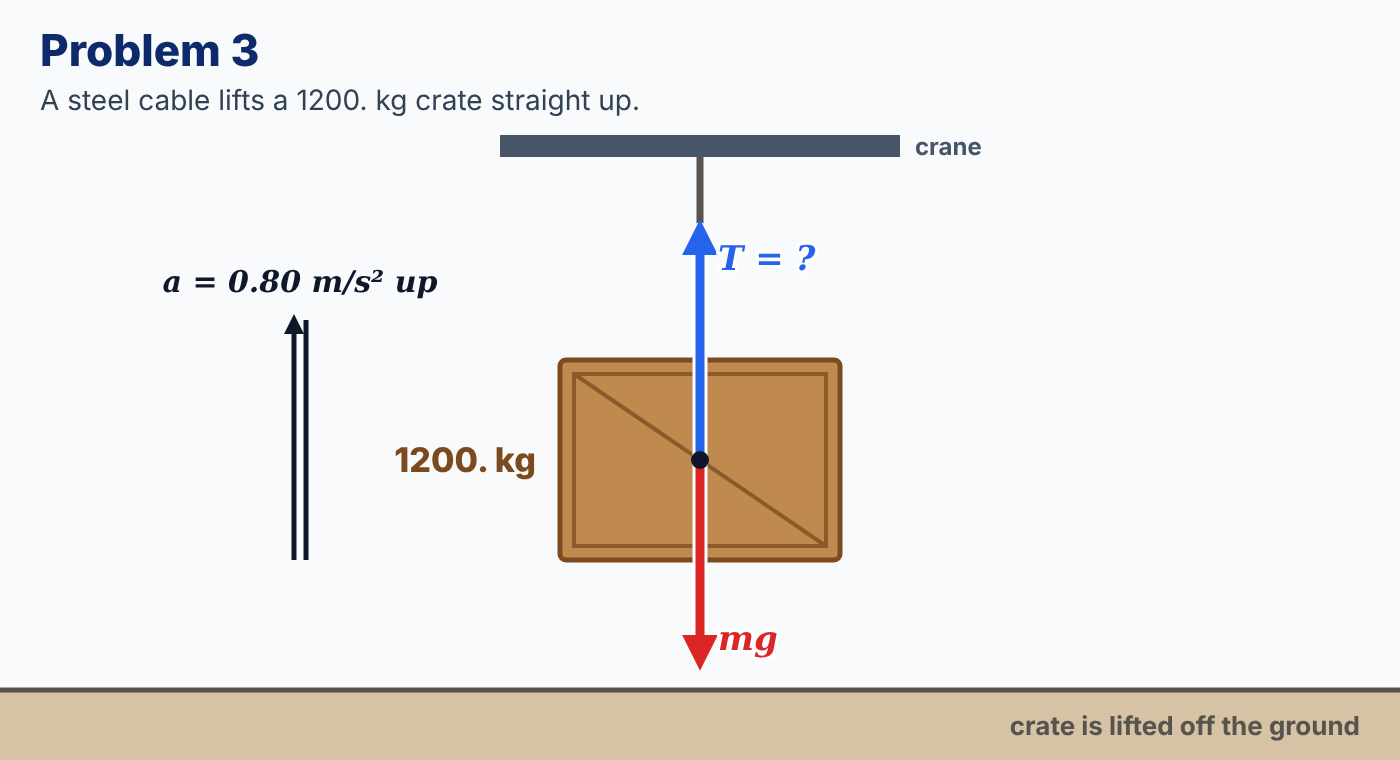
Claim $T = 12960 \text{ N}$.
Evidence
Reasoning To accelerate an object upwards, the lifting force (tension) must support the object's full weight ($mg$) PLUS provide the extra force ($ma$) needed for acceleration.
4. A 10.-kg bucket is lowered by a rope in which there is 63 N of tension. What is the acceleration of the bucket?
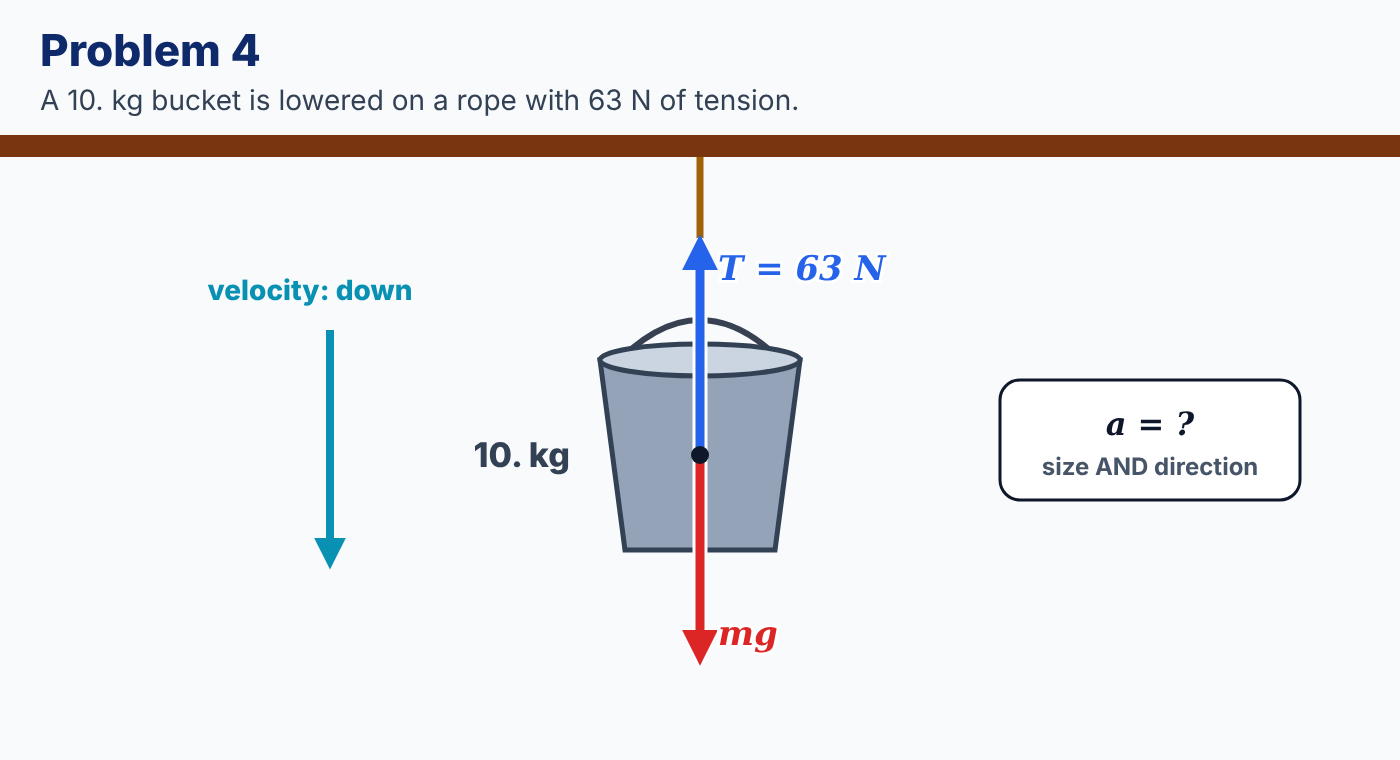
Claim $a = 3.7 \text{ m/s}^2$ downward.
Evidence
Reasoning The downward force of gravity is stronger than the upward tension force. This unbalanced force creates a net force downwards, causing the bucket to accelerate downward.
3 questions on Additional Q's — pick an answer to check yourself.
1. A cable lifts a crate straight up while the crate speeds up. How does the cable tension compare with the crate's weight?
2. A 10 kg bucket is lowered on a rope with 63 N of tension. Using g = 10 m/s², what is the bucket's acceleration?
3. What average force is needed to stop an 1100 kg car moving at 90 km/h (25 m/s) in 8.0 s?
Find all Unknown Tensions Instructional Video
Claim $a = 21 \text{ m/s}^2$. Tension between the 2.0 kg and 3.0 kg blocks: $T_1 = 42 \text{ N}$. Tension between the 3.0 kg and 5.0 kg blocks: $T_2 = 105 \text{ N}$.
Evidence
Reasoning With no friction, every block shares the same acceleration. Each string only has to accelerate the mass behind it, so tension grows from the back of the train (42 N) toward the front (105 N), and the pull P accelerates all 10 kg.
The masses are released from rest. Find the acceleration, then find the tension in the rope.
Claim $a = 6.0 \text{ m/s}^2$ (4.0 kg down, 1.0 kg up). Tension in the rope: $T = 16 \text{ N}$. Rule: One Tension.
Evidence
Reasoning One rope over a frictionless pulley has one tension on both sides. The tension must be more than the light mass's weight (10 N) to lift it, but less than the heavy mass's weight (40 N) so it can fall, and 16 N fits between them. The mount holding the pulley pulls up with $2T = 32 \text{ N}$, less than the 50 N total weight, because the system's center of mass is accelerating downward.
The tensions in the 2nd and 3rd ropes are measured. Find the acceleration, then find $T_1$ and the pull $P$.
Claim $a = 3.0 \text{ m/s}^2$. Tension between the 4.0 kg and 2.0 kg blocks: $T_1 = 12 \text{ N}$. Pull: $P = 30 \text{ N}$.
Evidence
Reasoning The block between two known tensions is the key: the difference between those tensions is the net force on that one block, which gives the acceleration. Since every block shares that same acceleration, each remaining tension is just the mass behind that rope times $a$.
Claim $a = 7.0 \text{ m/s}^2$ (1.0 kg slides up the ramp, 4.0 kg falls). Tension $T = 12 \text{ N}$.
Evidence
Reasoning Only the component of the block's weight parallel to the ramp opposes the motion; the perpendicular component is balanced by the normal force. Since 40 N is much larger than 5.0 N, the hanging mass wins and drags the block up the incline.
[8] Find the acceleration of this system.
![[8] A 2 kg block on a table with mu = 0.5, connected over pulleys at each edge to a hanging 5 kg mass on the left and a hanging 3 kg mass on the right](images/table_pulley_textbook.svg)
Claim $a = 1.0 \text{ m/s}^2$ toward the 5 kg side. Left tension $T_L = 45 \text{ N}$, right tension $T_R = 33 \text{ N}$.
Evidence
Reasoning The 20 N difference in hanging weights drives the system, but 10 N of it is used up overcoming friction on the table block, leaving 10 N to accelerate all 10 kg. The two strings have different tensions because the block between them has friction and mass that must be accelerated.
3 questions on Dragging Tensions — pick an answer to check yourself.
1. Boxes of 2.0, 3.0 and 5.0 kg are tied in a line on a frictionless floor and pulled by a 210 N force. What is their acceleration?
2. In that train (2.0 kg at the back, 3.0 kg middle, 5.0 kg front pulled by 210 N), what is the tension in the rope between the 3.0 kg and 5.0 kg boxes?
3. A 1.0 kg mass is lifted by a rope so it accelerates upward at 2.0 m/s². What is the rope tension? (g = 10 m/s²)
1. General Kinetic Friction Equation = f =
2. Normal force sitting on a ramp (Perpendicular component)
$F_n = $
3. Parallel component of the weight force
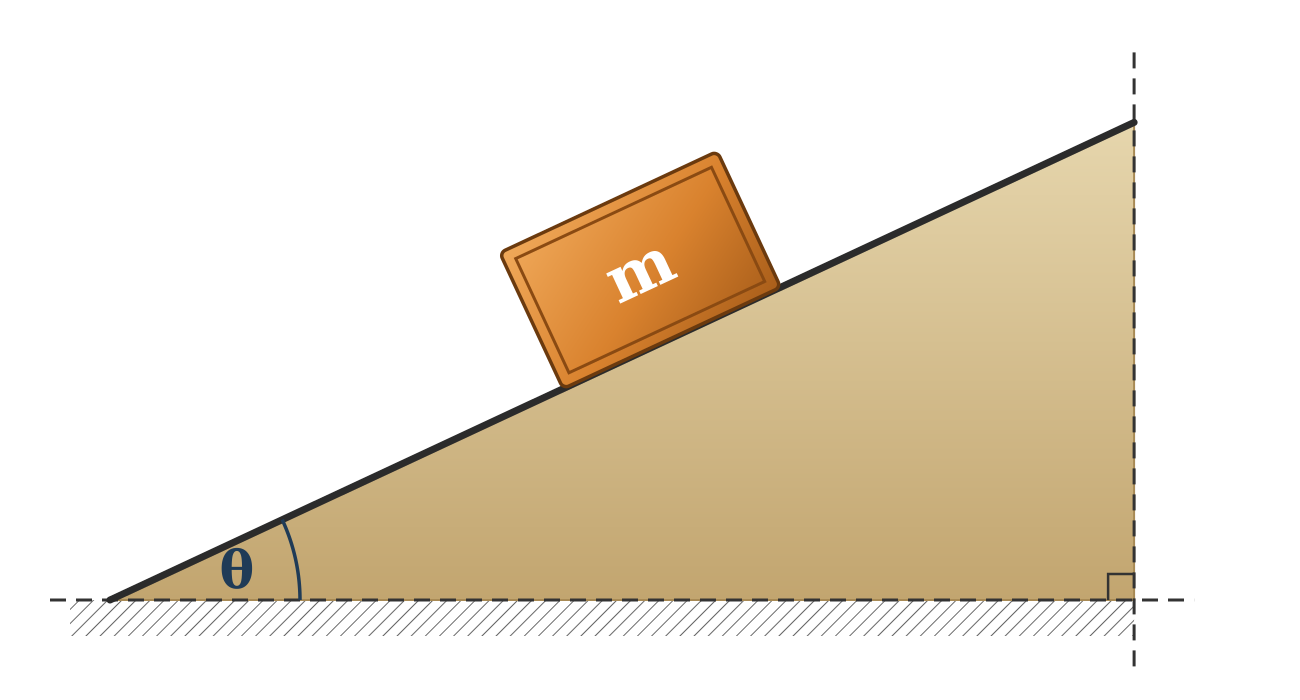
$F_{parallel} = mg$
4. Calculate acceleration of a frictionless block down a ramp.
Claim $a = g \sin \theta$. Assuming $g = 10 \text{ m/s}^2$, $a = (10 \text{ m/s}^2) \sin \theta$.
Evidence
Reasoning The acceleration down a frictionless plane depends solely on the angle of the incline and gravity, as the mass of the object factors out of the net force equation.
3 questions on Pre-Class Skills — pick an answer to check yourself.
1. A block of mass m rests on a ramp inclined at angle θ. The normal force on the block equals…
2. A 4.0 kg block slides across a level floor with μk = 0.25. What is the kinetic friction force? (g = 10 m/s²)
3. A ramp is made steeper, from 10° to 40°. What happens to the component of the block's weight pulling it down the ramp?
1. A 900. kg box slides down from rest along a wet slide inclined at an angle of 25 degrees to the horizontal. The coefficient of friction between the box and the slide is 0.0500. Find the acceleration.
Claim $a = 3.8 \text{ m/s}^2$.
Evidence
Reasoning The net force accelerating the box down the slide is the difference between the component of gravity pulling it down and the kinetic friction resisting its motion.
3 questions on Example Problem 1 — pick an answer to check yourself.
1. A box slides down a 37° incline with μk = 0.25. What is its acceleration? (g = 10 m/s², sin 37° = 0.60, cos 37° = 0.80)
2. A box slides down a rough incline. If its mass is doubled (same incline, same μ), its acceleration…
3. For a box sliding down a ramp of angle θ, the kinetic friction force equals…
2. Rather than taking the stairs, David likes to slide down the banister in his house. David has a mass of 20. kg, the banister has an angle of 30 degrees relative to the horizontal, and the coefficient of kinetic friction between David and the banister is 0.20. David begins his motion from rest.
a) What is the normal force between the banister and David?
b) What is the force of friction impeding his motion?
c) What is the net force on David?
d) How large is the acceleration as David slides down?
Claim
a) $F_N = 1.7 \times 10^2 \text{ N}$
b) $F_{friction} = 35 \text{ N}$
c) $F_{net} = 65 \text{ N}$
d) $a = 3.3 \text{ m/s}^2$
Evidence
Reasoning This problem sequentially breaks down the standard ramp problem process. First find the perpendicular force to determine friction, then find the parallel force to determine the net driving force, and finally use the net force to calculate acceleration.
NYSSLS Reading Passage · Dynamics
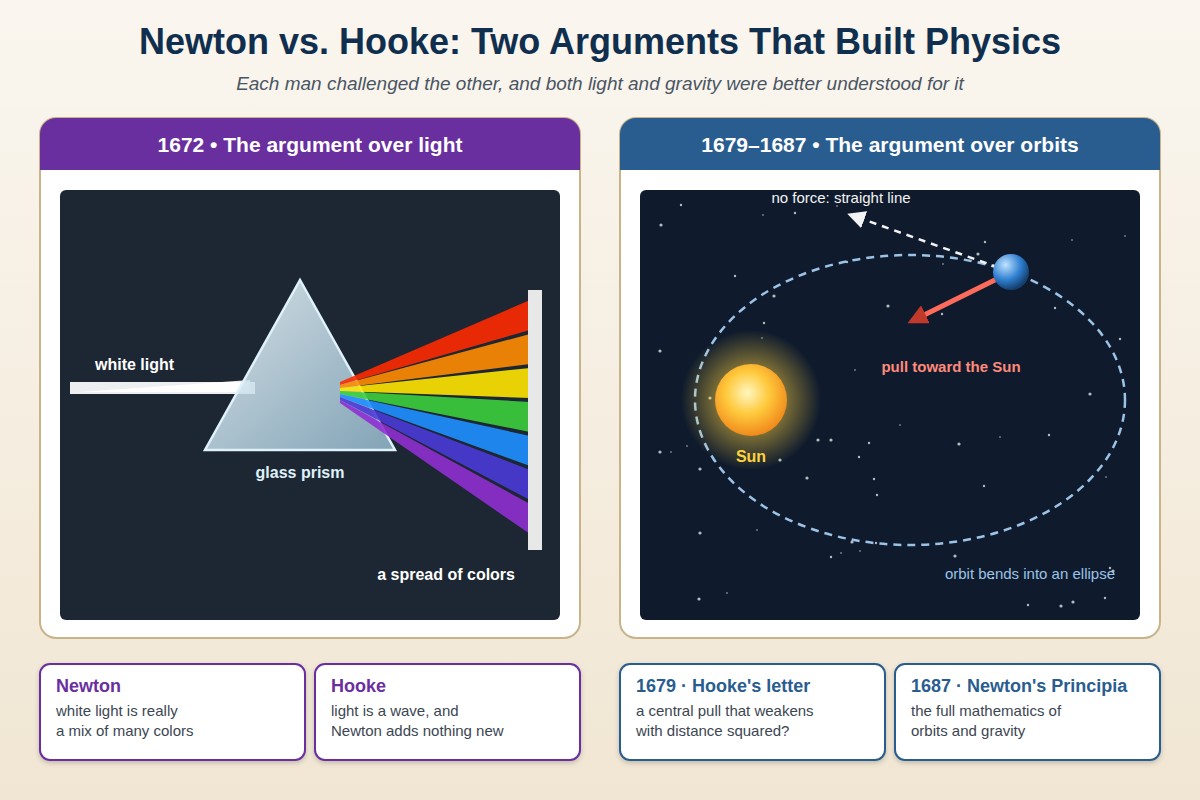
The Shoulders of Giants: Newton, Hooke, and the Rivalry That Forged Modern Physics
Open Reading Passage →5 quick questions — pick an answer to see if you’re right.
1. A 5.0 kg box is pushed across a floor at constant velocity with a horizontal force of 12 N. What is the force of friction on the box?
2. A 2.0 kg mass is lifted by a string with an upward acceleration of 2.0 m/s². Using g = 10 m/s², what is the tension in the string?
3. In an Atwood machine, a 3.0 kg mass and a 1.0 kg mass hang over a frictionless, massless pulley. Using g = 10 m/s², what is the acceleration?
4. A 4.0 kg cart on a frictionless table is pulled by a string over a pulley attached to a hanging 1.0 kg mass. Using g = 10 m/s², what is the acceleration?
5. A box sits on a ramp, just about to slip at angle θ. What is the coefficient of static friction μs?