AP Energy Notes
The Capacity to Do To Work

showmethephysics.com
The Capacity to Do To Work
showmethephysics.com
I. Energy – ______________________________ - Vector? Scalar?
A. Defined – ___________________________________________________
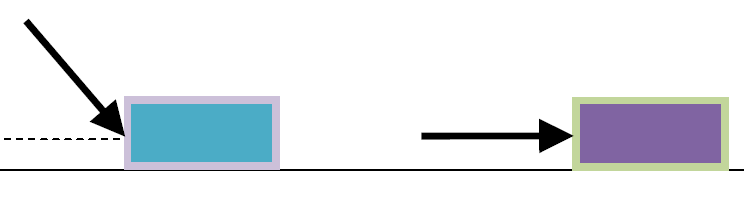
Challenge Question: Two people exert a 10 Newton force on a block for 2 meters. One person exerts her force at a 50-degree angle. (frictionless)
B. Equation: ______________________
$\theta$ - the angle between the ______ and ___________________
C. Positive and Negative Work
Work is negative when ________________________________
Work is positive when _________________________________
Work is 0 when ______________________________________
Examples of negative work ______________________________
Ex) A 5.0 N force pushes a box 3.0 m North and then 4.0 m east. Find the work done.
Ex 1) Object pushed at an angle, f≠0, Mass m, Force F, μ, Fn
Find the Net Work done on the mower in terms of the variables given
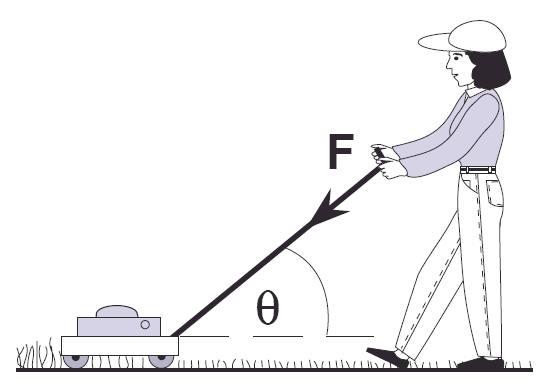
Ex 2) Find the minimum work needed to push a 950 kg car 810 m up a 9.0 deg incline,
Work is minimal when ______________________________________

a) no friction
b) friction μk = 0.25
Ex 3) Textbook p. 162) 8
330 kg piano, slides down 3.6 m, 28° incline / uk = .40. Man prevents the piano from accelerating down the incline

(a) Force exerted by the man?
(e) Net work done on the piano?
Ex 4)

W = _________________
Ex 5) p. 162) 14 a) Sketch the plot described below
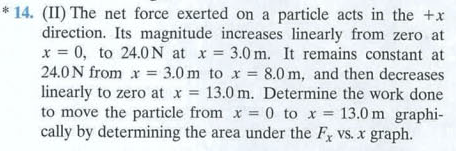
b) Find the work
Potential Energy – Stored energy due to _________________ or ______________
Ex 1) A 1.60 m person lifts a 2.10 kg book from the ground to 2.20 m above the ground. a) How much work was done lifting the book?
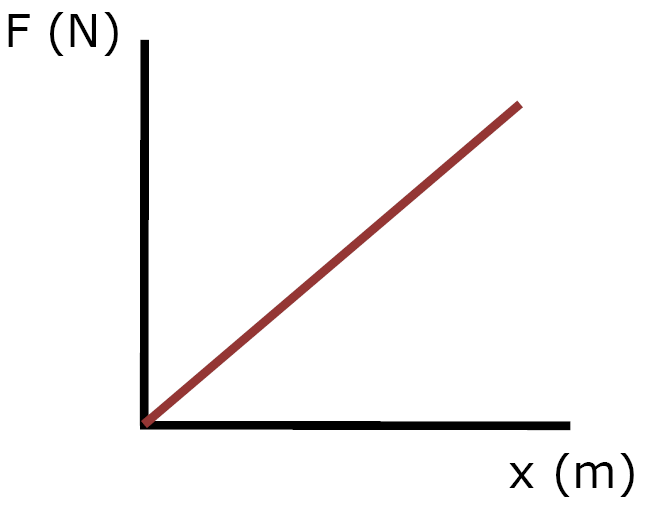
Spring Constant k = F/x
PE = [F/2]x = 1/2kx2
Ex 3) Find the Elastic PE when the spring is stretched 6 m
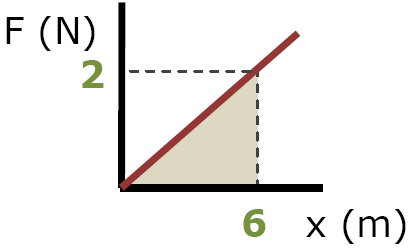
Ex 4) If 15. Joules of energy are stored in the stretched spring, what is the value of the spring constant?

Derive KE Equation
KE = W = Fd Where Vf = 0
KE = (ma)d
Ex 2) baseball (m = 140 g) traveling 32 m/s caught by a glove and moving the glove back 25 cm. Average F of the ball on the glove?
Ex 4) A 95 kg football player runs upstairs in 66 s. The stairs are 140 m long at an angle of 32° (constant V)
Ex 1) Fill in the missing energies
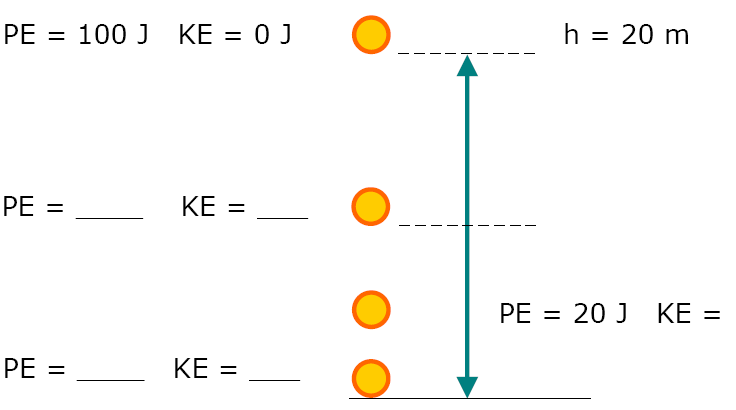
Ex 2) a) If friction is negligible when the RED ball is released, how high will it rise?
A B C D Cannot be determined
If KE at A is 0 J, find the KE and PE at each point (frictionless)
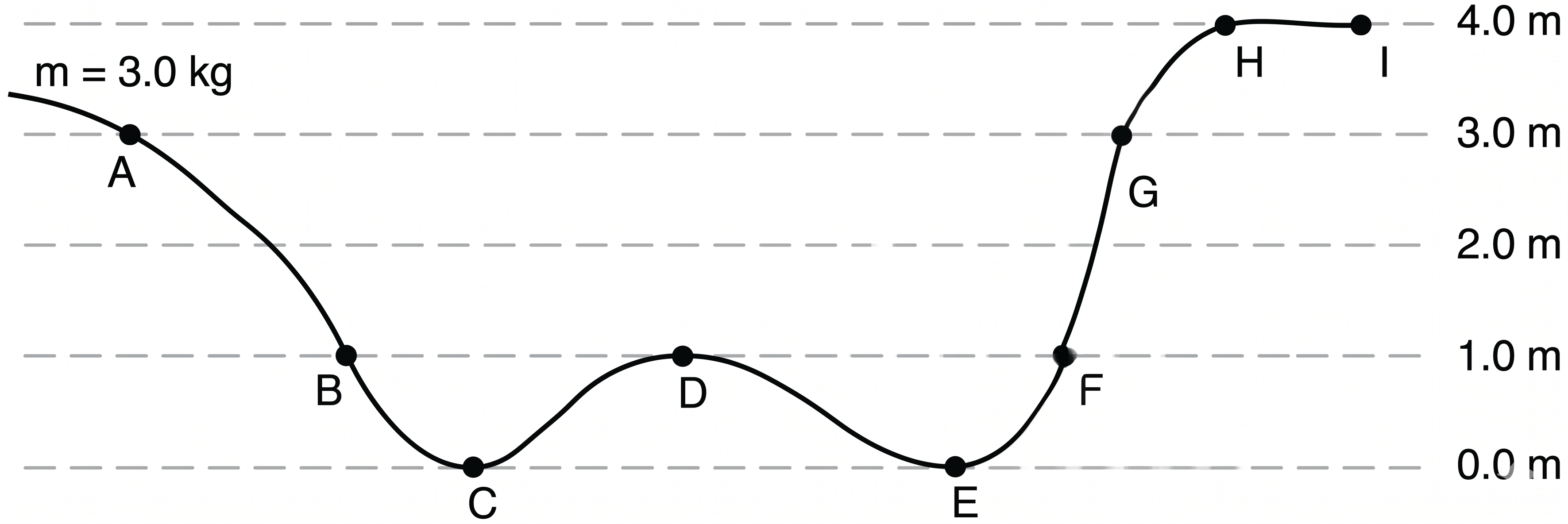
Ex 5) If PE at A = 10. J, KE = 0, and PE at C = 3.0 J, find the PE and KE at all other points
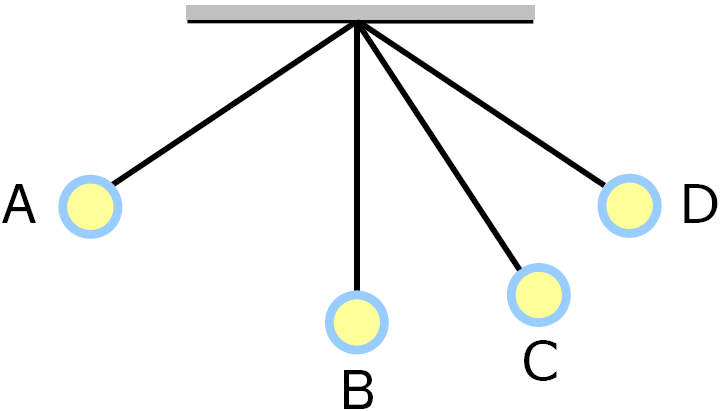
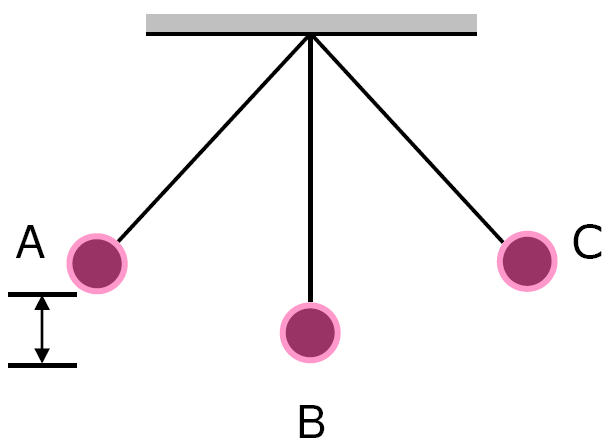
Ex 6) 1.0 kg pendulum swings to a height of .20 m above its lowest point. K.E. of the pendulum at the lowest point?
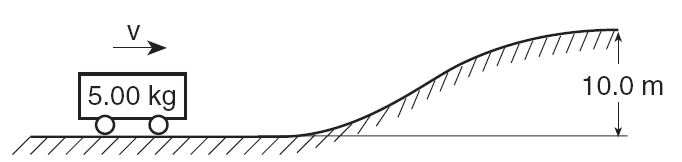
Ex 7) 5.00-kg cart at the foot of a hill 10.0 m high. For the cart to reach the top of the hill, what is the minimum KE of the cart in the position shown?
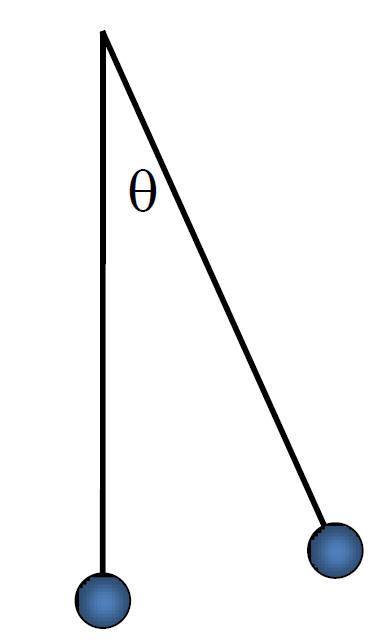
Ex 8) Find the height of the pendulum in terms of θ and L (pendulum length)
Relationship: $W = \Delta KE + \Delta PE + W_f$
1. Neglecting air resistance, how high will a 0.325-kilogram rock go if thrown straight up by someone who does 115 J of work on it?
2. A hammerhead with a mass of 2.0 kilogram is allowed to fall onto a nail from a height of 0.40 meters. What is the maximum amount of work it could do on the nail?
3. A 1,200-kilogram car traveling at 110 kilometers per hour (30.55 m/s) comes to a stop.
a. How much work (negative) was done on the car? Don’t solve, just show the equation.
b. Where does the car’s kinetic energy go?
4. A baseball (m = 0.140 kilograms) traveling 35 meters per second moves a fielder’s glove backward 0.25 meters when the ball is caught and brought to rest. What is the average force exerted by the ball on the glove?
5. In the high jump, the kinetic energy of an athlete is transformed into gravitational potential energy. With what minimum speed must the athlete leave the ground to lift her center of mass 2.10 meters across the bar at 0.70 meters per second?
6.
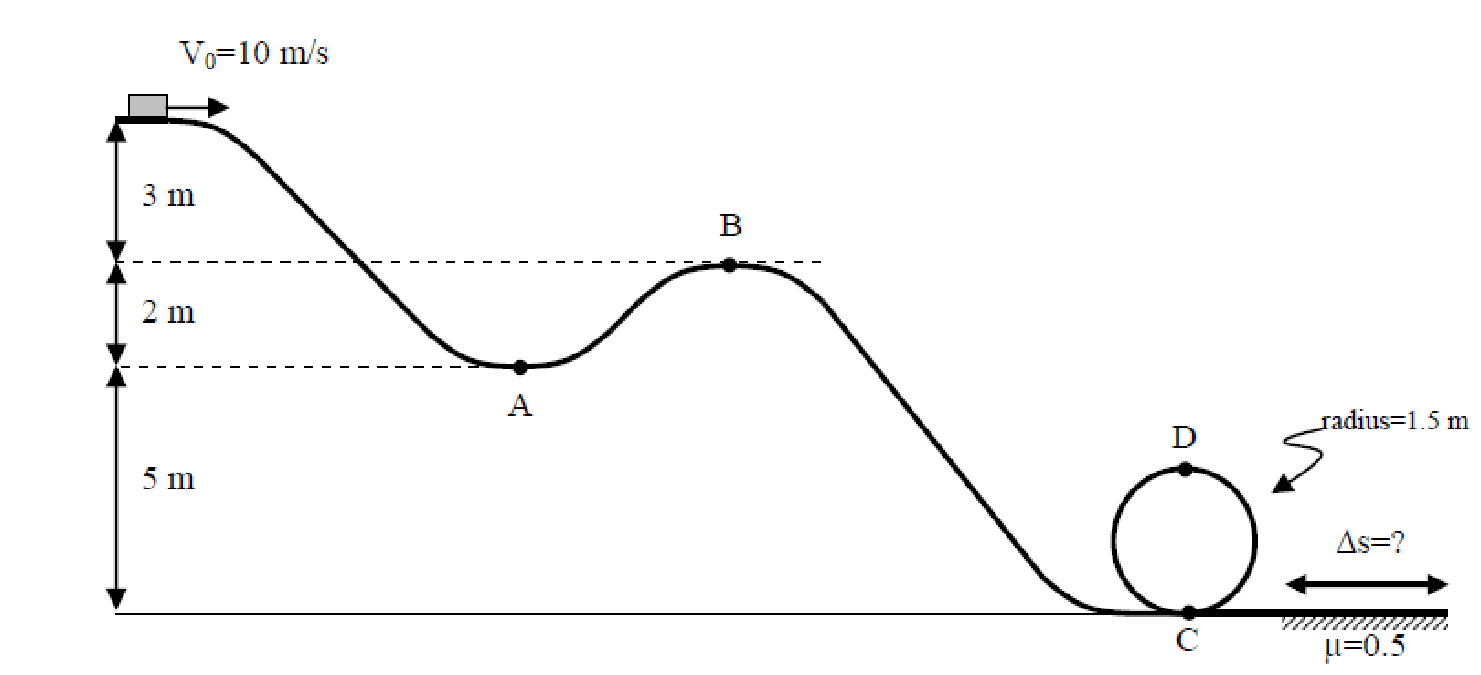
a. A 5.0-kg block starts at a speed of 10. m/s at the top of a “roller-coaster,” as shown above. What is its KE at the top?
b. What is its GPE at the top (relative to the ground)?
c. What is the block's total energy at the top?
2. If the track is entirely frictionless and there is no air resistance, the block will not lose any energy until it reaches the level surface where μ=0.5 and the frictional force “takes away” energy.
a. Find the GPE at point A and then calculate how much of the block’s total energy must be in the form of KE. Also, find the speed at point A.
b. Repeat the above for points B, C, and D.
3. After the block exits the loop-the-loop, it encounters a horizontal, rough surface (μ = 0.5) and comes to a stop.
a. How much total energy does the block have just as it exits the loop-the-loop?
b. How much energy does the frictional force “take away” in bringing the block to a stop?
c. How large is the frictional force acting on the block?
d. How far does the block slide before coming to a stop?
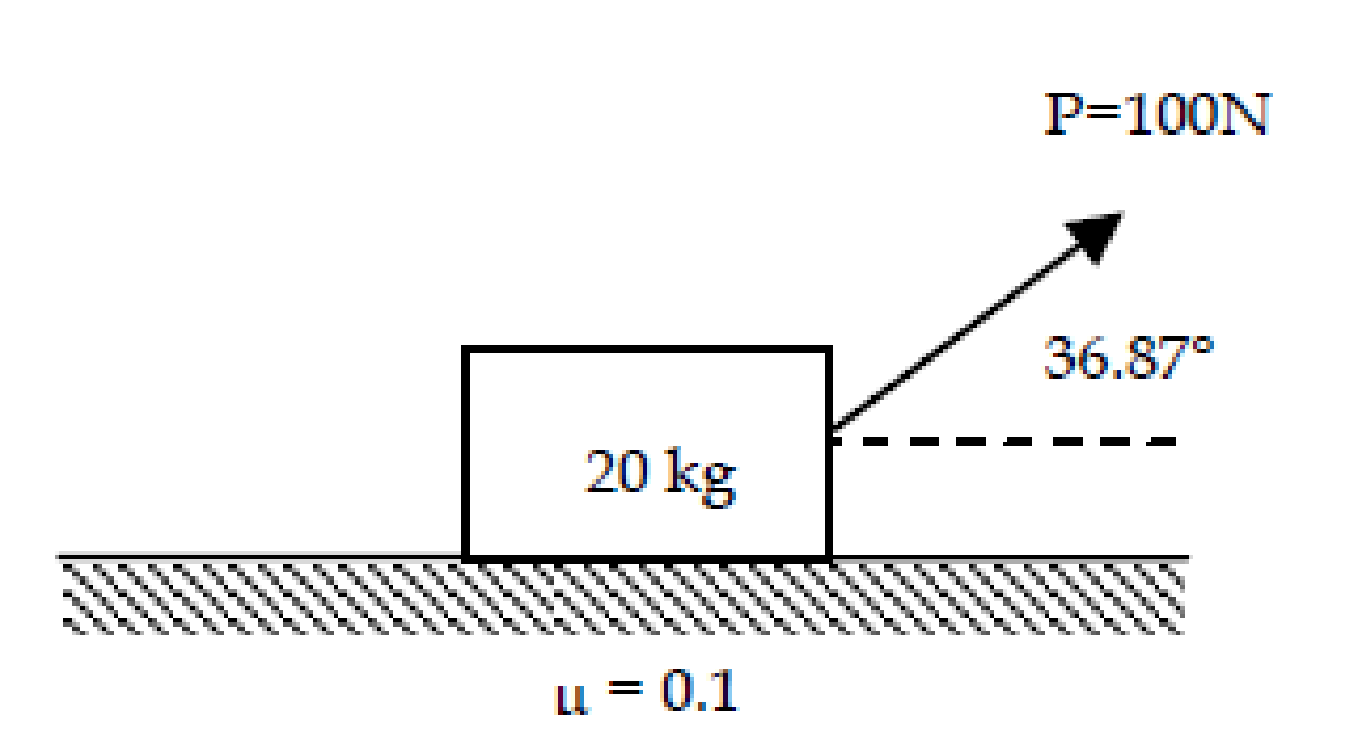
1. A 20. kg block, originally at rest, is pulled across a rough surface (μ = 0.10) by a 100. N force angled at 36.87° for 20. m. Find the speed of the block the instant it is 20. meters to the right of its starting position.
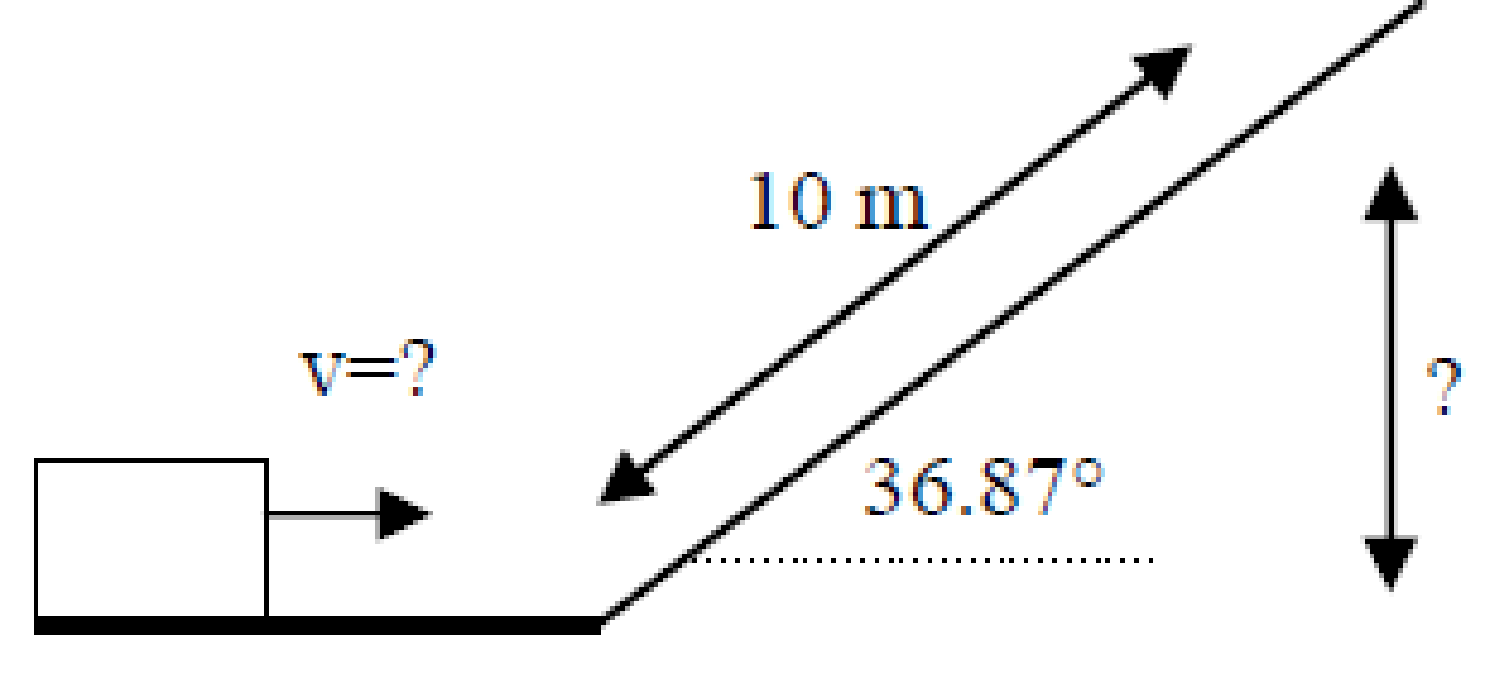
2. A 20.-kg block slides across a frictionless floor and then slides up 10. meter along a rough 36.87° incline (μ =0.20) until it comes to a brief stop. What is the initial speed of the block prior to sliding up the incline?
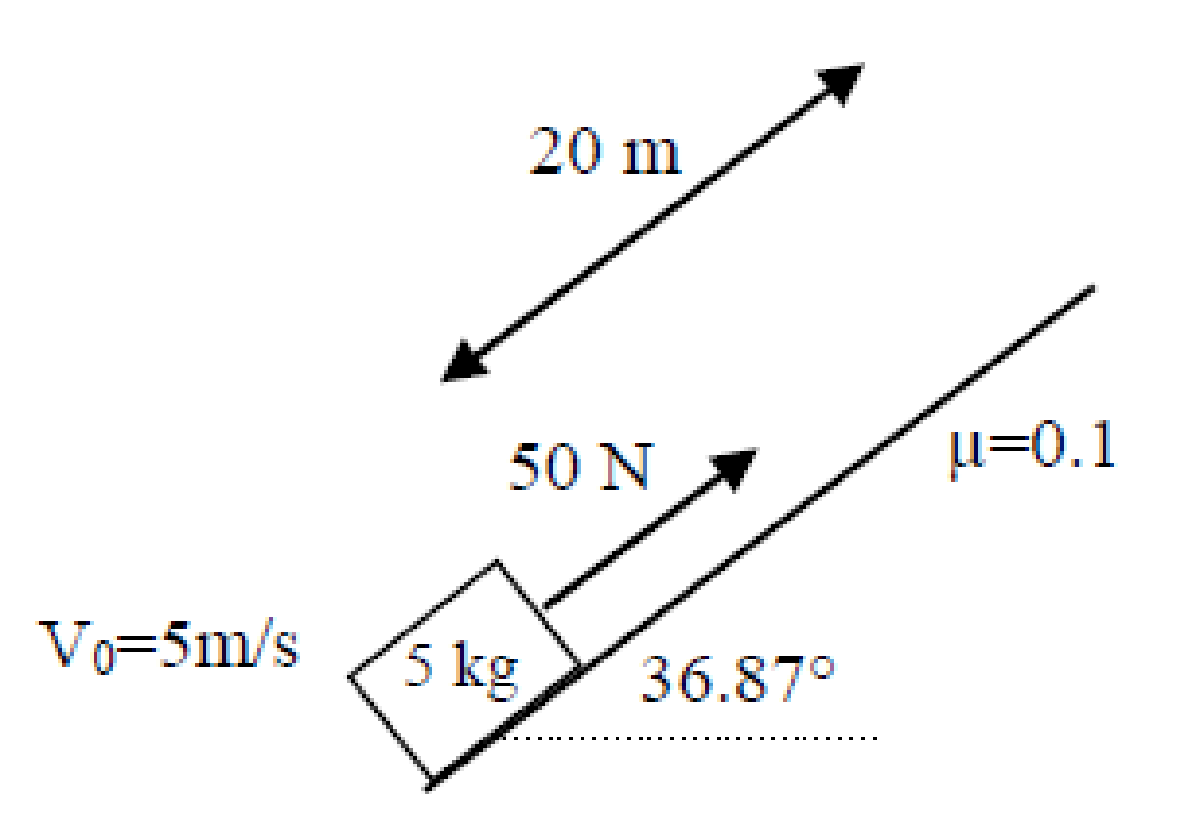
3. A 5.0 kg box is pulled up a rough (μ = 0.10) incline by a force of 50. N for a distance of 20. m. If the speed of the box is 5.0 m/s initially, what is its speed the instant it has traveled the 20. -m up the incline?
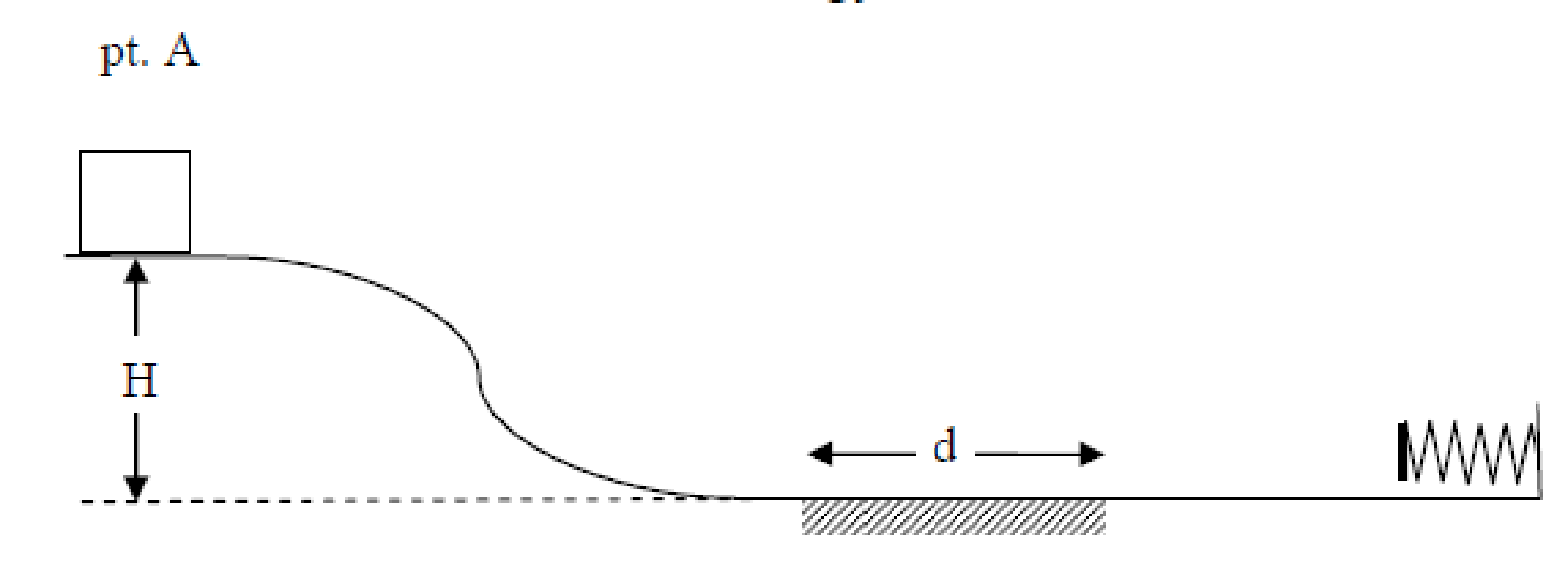
4. A 10.-kg box is released from rest and slides down an 800. cm tall incline and then compresses a spring (k = 50. N/m). What is the maximum spring compression before the box is pushed away?
5. A 10.-kg box is held against a spring, which is compressed 2.0 m as shown. If the box is moving at 10. m/s when it reaches the top of the incline, what is the spring constant (k)?

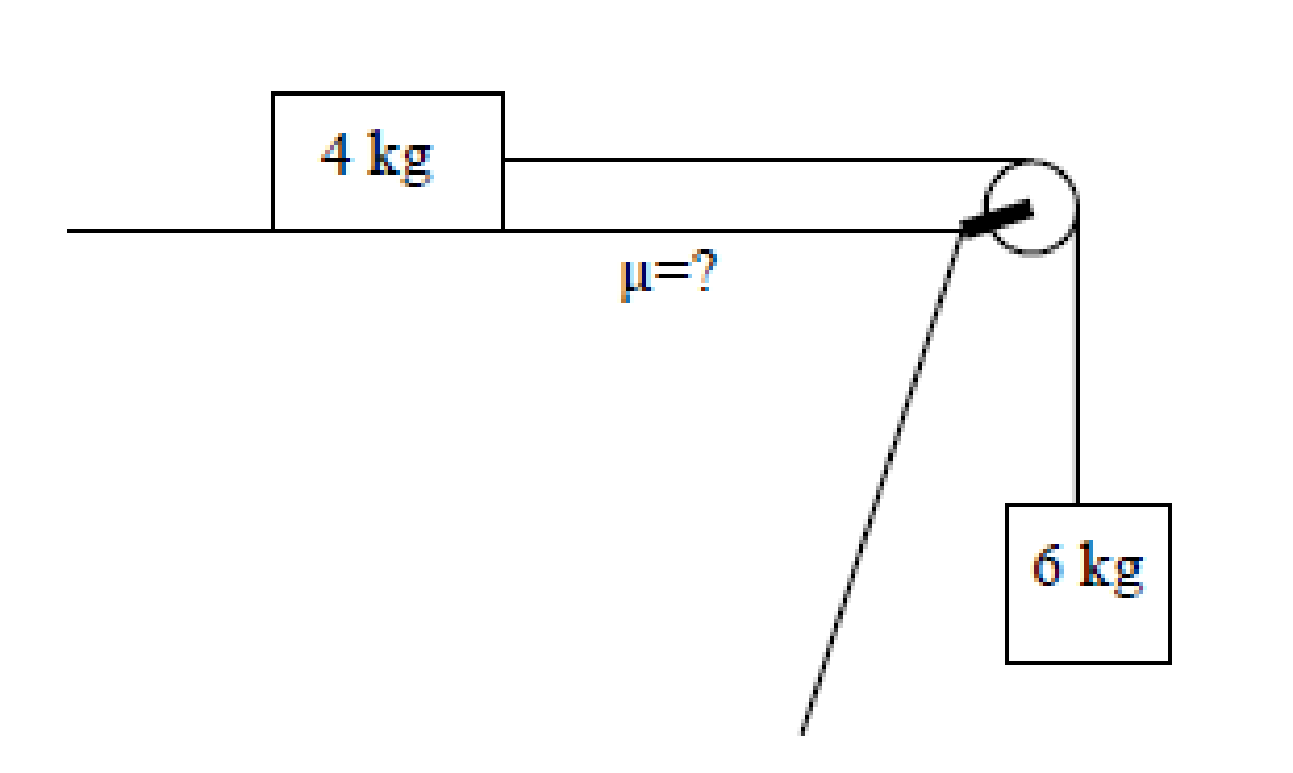
6. The system above is released from rest. The instance the suspended mass has fallen 8.0 meters, the blocks have speeds of 8.0 m/s. ($m_{susp} = 10.0 \, kg$, $m_{table} = 4.0 \, kg$). How much energy did friction take away?