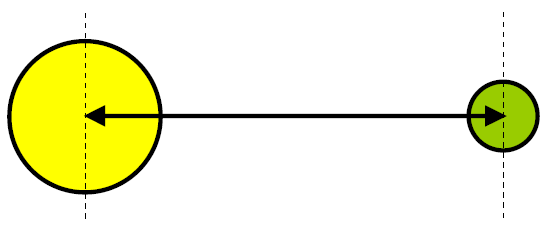
$m_1 \text{ and } m_2 \text{ – masses of the two attracting objects}$
r - The distance measured between the of the two objects.
B. Relationships
State the relationship between Gravitational Force (F) and distance (r): . What is the plot shape for this relationship?
If the distance between two objects is tripled, the gravitational force between them will change by a factor of
State the relationship between Gravitational Force (F) and mass (m): . What is the plot shape for this relationship?
Example 1: Two objects, with masses $m_1$ and $m_2$, are originally a distance r apart. The magnitude of the gravitational force between them is $F$. The masses are changed to $2m_1$ and $2m_2$, and the distance is changed to $4r$. What is the magnitude of the new gravitational force in terms of $F$?
Teacher Workspace: Deriving Ex 1
Module I Teacher Key
Claim:The magnitude of the new gravitational force is $F/4$.
Evidence:Substituting the variables into the formula: $F_{new} = G \frac{(2 m_1)(2 m_2)}{(4 r)^2} = \frac{4 G m_1 m_2}{16 r^2} = \frac{1}{4} \left( \frac{G m_1 m_2}{r^2} \right)$.
Reasoning:According to Newton's Law of Universal Gravitation, force is directly proportional to the product of masses and inversely proportional to the square of the distance. Doubling both masses increases the force by a factor of 4. Increasing the distance by a factor of 4 decreases the force by a factor of $4^2 = 16$. The net effect is $4/16$, resulting in $1/4$ the original force.
II. Satellite & Weight
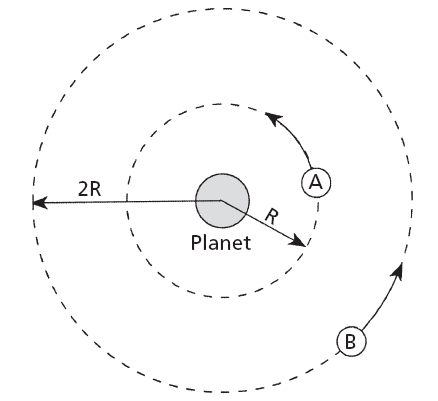
Example 2: Satellite A and Satellite B have the same mass and are orbiting the same planet. If the gravitational force on satellite A is 160,000 N and it is at a distance $R$ from the center, what is the gravitational force on satellite B if it is at a distance of $2R$?
Example 3: A rocket weighs 18,000 N at the Earth's surface. If the rocket rises to a height where its total distance from the center of the Earth is 3 Earth radii ($3R_e$), calculate its weight at that new location.
When an object is on the Earth, the net gravitational force on that object is defined as its weight ($F_g = mg$).
C. Weight – The net gravitational force exerted on an object by a celestial body.
Teacher Workspace: Weight and Radius Analysis
Module II Teacher Key
Claim:The rocket's weight at 3 Earth radii is 2,000 N.
Evidence:$F_g \propto 1/r^2$. The distance from the center of the Earth increases from $1R_e$ to $3R_e$.
Reasoning:Weight is the measure of the gravitational pull between the Earth and the object. Since the distance from the center of mass has tripled, the force of attraction must be divided by the square of the distance change ($3^2 = 9$). Therefore, $18,000 \text{ N} / 9 = 2,000 \text{ N}$.
III. Surface Gravity
Video will load when this section opens
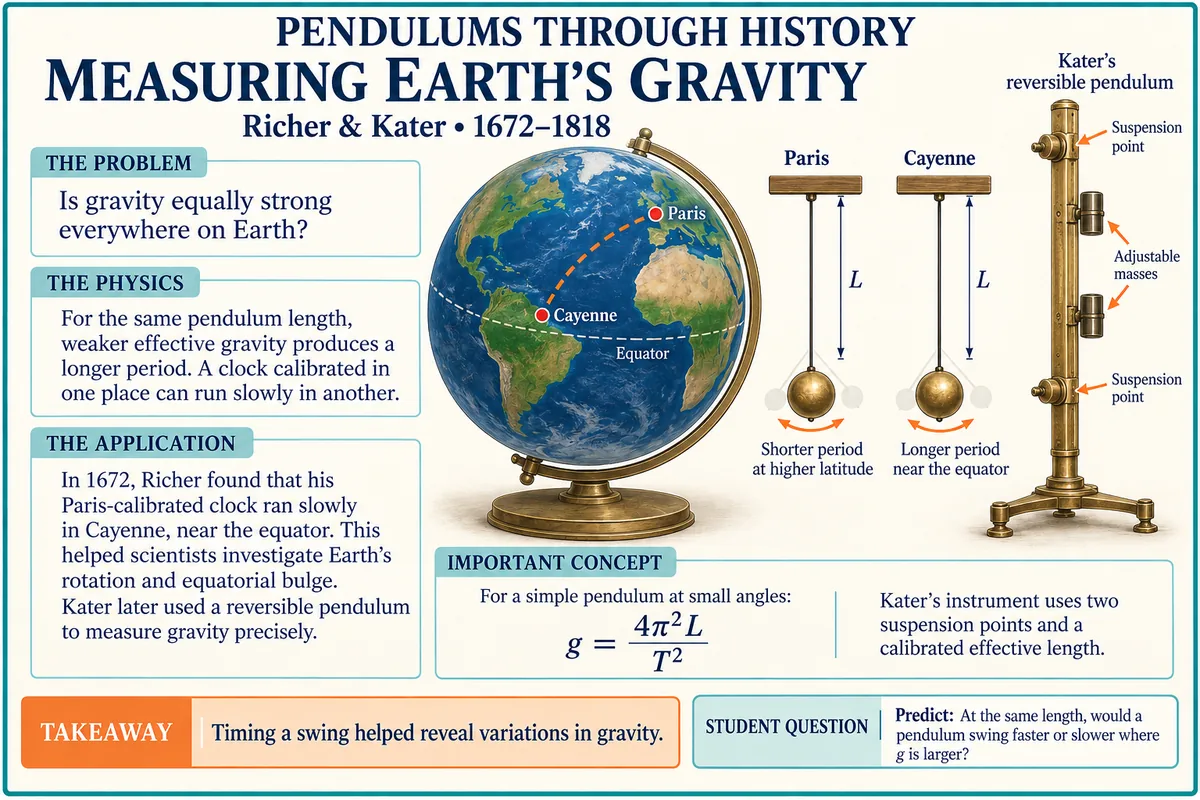
Variations in Gravity Near the Earth's Surface:
New York - 9.803 m/s² / Denver - 9.796 m/s² / North Pole - 9.832 m/s²
Based on the formula for gravitational acceleration, what physical factor explains the differences in $g$ at these locations?
This is exactly how these tiny differences in $g$ were first discovered: in 1672, Jean Richer noticed his pendulum clock ran slow near the equator — the same idea Henry Kater later refined into a precision instrument. Click the image for a larger view.
$$(Weight) \text{ } F_g = mg = \frac{G m m_e}{r^2}$$
Simplify the expression above to find the acceleration due to gravity $g$ on a planet's surface: $g = $
In this formula, $M_e$ represents the of the planet.
Example 4: Mars has a mass approximately 1/10 that of Earth and a diameter approximately 1/2 that of Earth. Based on this data, calculate the acceleration of a falling body near the surface of Mars in terms of $g$.
Giancoli p. 131 #28: A 2100-kg spacecraft is in a circular orbit at a distance of 2.0 Earth radii from the Earth's center. Calculate the magnitude of the force of gravity exerted on the spacecraft by the Earth.
Giancoli p. 131 #32: A hypothetical planet has a radius 1.5 times that of Earth, but has exactly the same mass as Earth. What is the value of the acceleration due to gravity on the surface of this hypothetical planet?
Teacher Workspace: Deriving Planetary g
Module III Teacher Key
Claim:The surface gravity of Mars is exactly $0.4g$.
Reasoning:The acceleration due to gravity on a planet's surface depends on the ratio of the planet's mass to its radius squared. Although Mars has 10 times less mass than Earth, its much smaller radius places the surface significantly closer to its center of mass, which increases the gravitational field strength by a factor of 4. The final result is a surface gravity that is 40% of Earth's value.
IV. Orbital Proofs
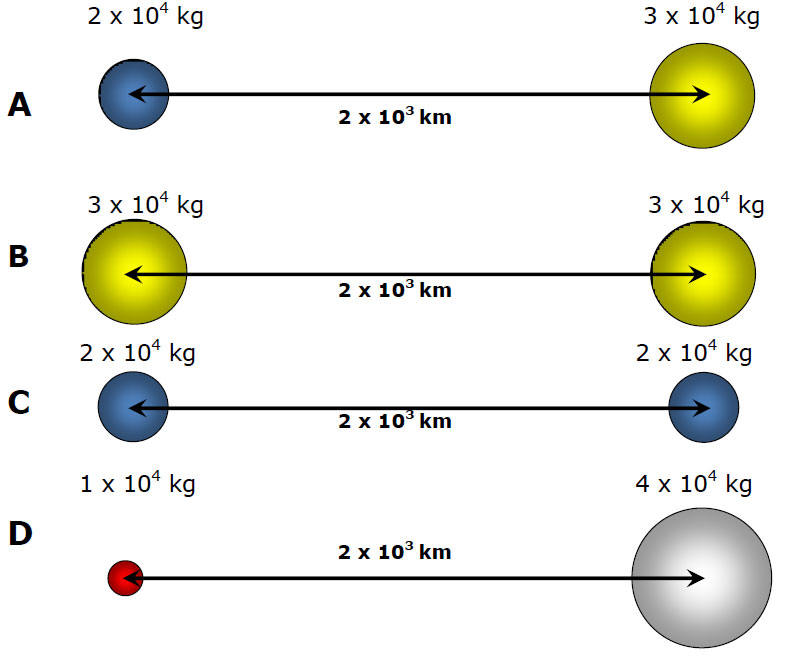
Rank the gravitational forces from greatest to smallest.
Example 5: Use the principles of circular motion and universal gravitation to prove that the orbital velocity of a satellite is independent of its own mass.
Teacher Workspace: $F_g = F_c$ Derivation
a) From your derivation, identify which two physical quantities determine the orbital velocity $v$ and the orbital period $T$:
b) How does decreasing the orbital radius affect the orbital velocity $v$ and the orbital period $T$ ?
Module IV Teacher Key
Claim:The mass of the orbiting satellite has no effect on the velocity required to maintain a stable circular orbit.
Reasoning:By setting the Gravitational Force equal to the Centripetal Force necessary for circular motion ($G \frac{M m_s}{r^2} = \frac{m_s v^2}{r}$), the mass of the satellite ($m_s$) appears on both sides of the equation and cancels out algebraically. This proves that any object, regardless of its mass, must travel at the same tangential speed to maintain a specific orbital radius around a central body.
V. Gravity Questions
Total Score: 0 / 37
VI. Extended Analysis (Free Response)
1. Lunar Eclipse Net Force: During a total lunar eclipse, the Moon, Earth, and Sun are aligned in a straight line, with the Earth positioned directly between the Moon and the Sun. Use the following data to solve:
Mass of the Moon ($m_m$) = $7.4 \times 10^{22} \text{ kg}$
Mass of the Earth ($M_e$) = $6.0 \times 10^{24} \text{ kg}$
Mass of the Sun ($M_s$) = $2.0 \times 10^{30} \text{ kg}$
Earth-Moon distance ($r_{em}$) = $3.8 \times 10^8 \text{ m}$
Earth-Sun distance ($r_{es}$) = $1.5 \times 10^{11} \text{ m}$
Calculate the magnitude of the gravitational force exerted on the Earth by the Moon.
Calculate the magnitude of the gravitational force exerted on the Earth by the Sun.
Calculate the magnitude and direction of the net gravitational force exerted on the Earth by both the Moon and the Sun during this alignment.
Teacher Workspace: Vector Calculations
2. 2.10-kg brass ball transported to Moon: A solid brass ball is manufactured with a mass of 2.10 kilograms. It is transported to the surface of the Moon.
Radius of the Moon = $1.74 \times 10^6$ meters
Mass of the Moon = $7.35 \times 10^{22}$ kilograms
Calculate the acceleration due to gravity on the lunar surface.
Compare the mass of the ball on Earth to its mass on the Moon. Explain any difference.
Calculate the weight of the ball when it is on the surface of the Earth.
Calculate the weight of the ball when it is on the surface of the Moon.
Teacher Workspace: Mass vs Weight Proof
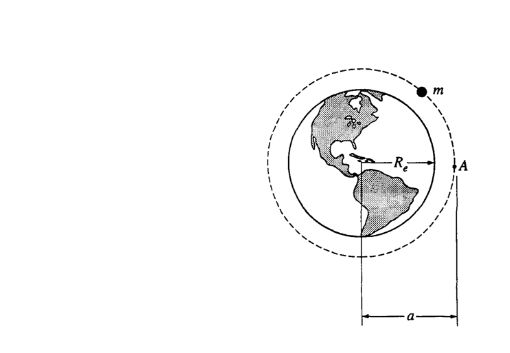
3. Earth Satellite Variable Derivation: A satellite of mass $m$ is placed in a stable circular orbit around the Earth. The Earth has a mass $M_e$ and a radius $R_e$. The satellite orbits at a distance $a$ measured from the center of the Earth. Express all algebraic answers strictly in terms of $a$, $m$, $M_e$, $R_e$, and $G$.
Derive the expression for the gravitational force acting on the satellite.
Derive the expression for the centripetal acceleration of the satellite.
Determine if the acceleration of the satellite in this orbit is greater than, less than, or equal to the acceleration $g$ at the surface of the Earth. Justify your answer.
Derive the expression for the tangential orbital velocity of the satellite.
How much work is done by the gravitational force on the satellite during one complete orbit? Justify your answer.
Derive the expression for the orbital period $T$ of the satellite.
Teacher Workspace: Algebraic Derivations
Module VI Teacher Key
Claim (Work):The work done by gravity on a satellite in a circular orbit is exactly zero Joules.
Evidence:Work is defined by the dot product $W = F \cdot d \cdot \cos\theta$. In a circular orbit, the gravitational force $F_g$ is always directed radially toward the center, while the displacement $d$ is always tangential to the path, meaning the angle $\theta = 90^\circ$.
Reasoning:Work is only performed when there is a component of force acting in the direction of the object's displacement. Since gravity acts perpendicularly to the satellite's motion at every point in a circular orbit, no energy is transferred to or from the satellite's kinetic energy. Gravity serves only to change the direction of the velocity, not its magnitude.
VII. Case Studies
4. Jupiter Satellite: A research satellite is in a stable circular orbit around Jupiter at a radius $R$. Jupiter has a mass $M_J = 1.90 \times 10^{27} \text{ kg}$ and a mean radius $R_J = 7.14 \times 10^7 \text{ m}$.
Starting from first principles ($F_g = F_c$), derive an expression for the orbital velocity of the satellite at a radius $R$ from Jupiter's center.
If the satellite were moved to a higher orbit with a larger radius, describe how its orbital velocity would change. Provide a physical explanation.
Derive an expression for the orbital period $T$ of the satellite.
Calculate the required orbital radius $R$ for a satellite that must have a period of exactly $3.55 \times 10^4 \text{ s}$.
Teacher Workspace: Jupiter Orbital Analysis
5. Sojourner Rover Case Study: The Pathfinder spacecraft successfully landed on the Martian surface on July 4, 1997. It deployed a small rover named Sojourner to explore the landing site. Use the planetary and rover data provided below to complete the following analysis.
Mars Planetary Data: Radius = $0.53 R_e$, Mass = $0.11 M_e$.
Sojourner Rover Data: Mass = $11.5 \text{ kg}$
Wheel diameter = $0.13 \text{ m}$
Stored Energy in Battery = $5.4 \times 10^5 \text{ J}$
Power consumption for driving = $10 \text{ W}$
Constant driving speed = $6.7 \times 10^{-3} \text{ m/s}$
Calculate the acceleration due to gravity at the surface of Mars expressed as a fraction of $g$ (Earth's surface gravity).
Calculate the weight of the Sojourner rover when it is on the surface of Mars.
To leave the lander, Sojourner must roll down a ramp inclined at 20° to the horizontal. Calculate the minimum normal force the ramp must provide to support the rover.
What is the magnitude of the net force acting on Sojourner as it travels across a level Martian surface at a constant velocity? Justify your answer.
Calculate the maximum total distance Sojourner can travel on a horizontal surface using only its stored battery energy.
If 0.010% of the driving power is used to overcome atmospheric drag on Mars, calculate the magnitude of the drag force acting on the rover.
Teacher Workspace: Sojourner Detailed Proofs
Module VII Teacher Key
Claim (Sojourner Net Force):The net force acting on the rover is exactly zero Newtons.
Reasoning:According to Newton's First Law of Motion, any object traveling at a constant velocity is in a state of dynamic equilibrium. This implies that the sum of all forces acting on the rover—including the driving force, friction, and atmospheric drag—must perfectly balance out, resulting in zero net acceleration and therefore zero net force.
Claim (Range):Based on the provided energy and power data, Sojourner can travel approximately 362 meters before exhausting its battery.