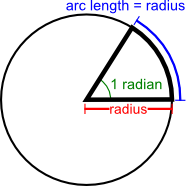
When an object is rotating, we measure its motion using radians
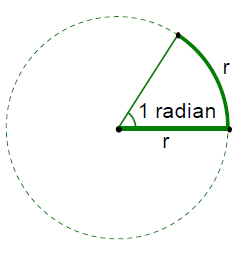
I. Radian = arc length that = radius of circle Video p. 1-3
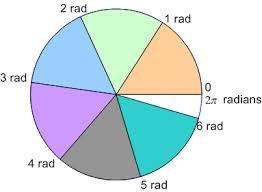
360 degrees - One full rotation of a sphere is radians
90 degrees = radians
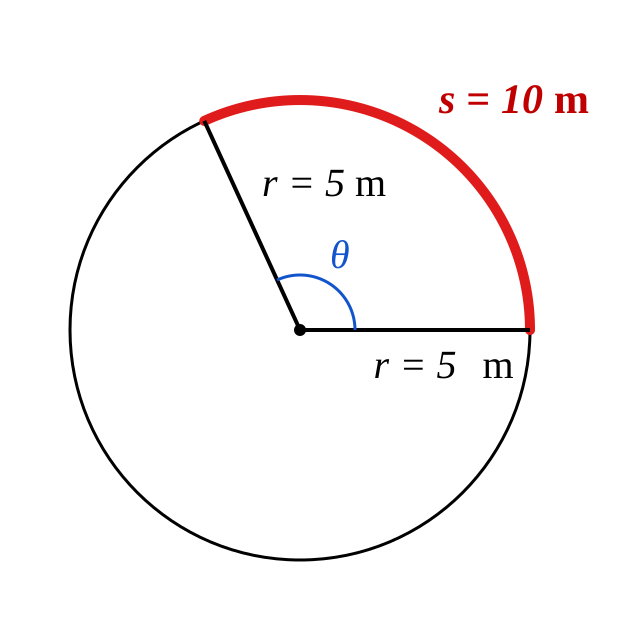
Ex 1) How many radians does the arc s represent?
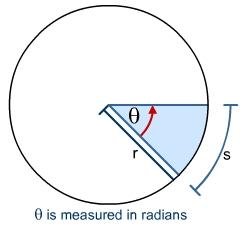
Number of radians $\theta = $
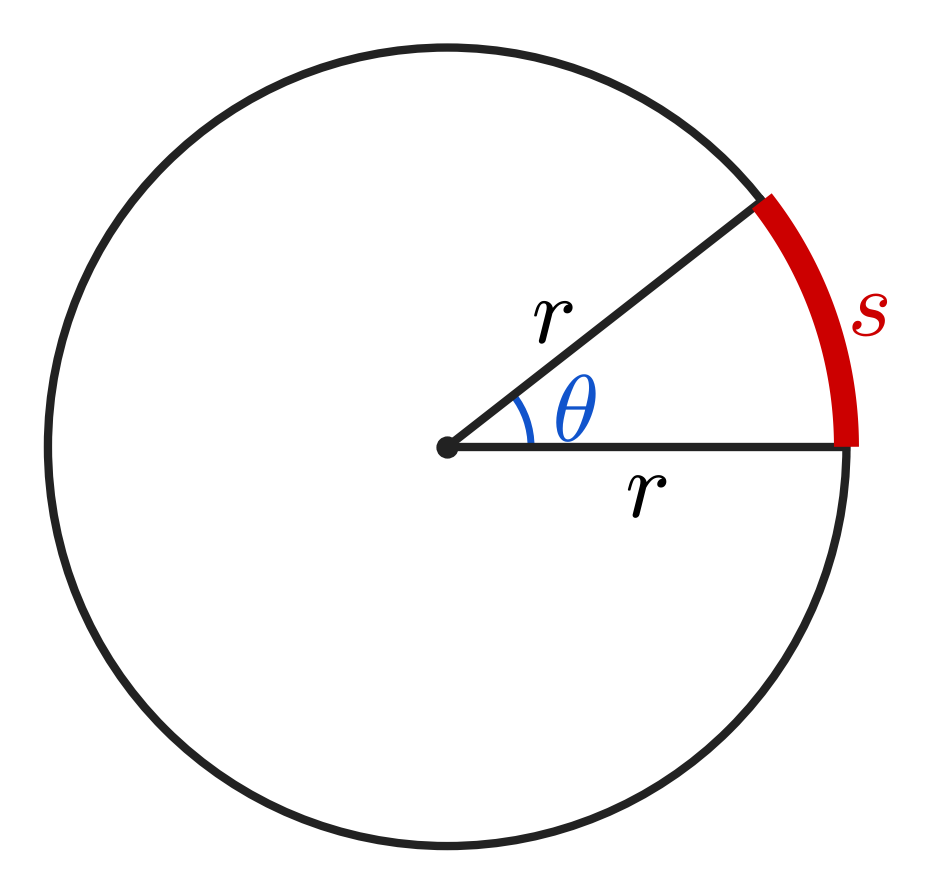
Equation: $\theta = \frac{s}{r}$
And $d = r\theta$
Ex 2) A wheel with a radius of 2.0 m rolls 5.0 m along the floor. Find the number of radians rotated through. $\theta = $
TEACHER CER KEY (EX 1 - 2)
Ex 1 Claim: The arc length $s$ is directly proportional to the angle $\theta$ in radians.
Line-by-Line explanation:1. Fundamental Law: $\theta$ $= \frac{\text{Arc Length } s}{\text{Radius } r}$2. If $s$ $= r$, then $\theta$ $= r/r$ $= 1\text{ radian}$.3. If $s$ $= 2r$, then $\theta$ $= 2r/r$ $= 2\text{ radians}$.4. One full circle is $s$ $= 2\pi r$, so $\theta$ $= 2\pi r / r$ $= 2\pi\text{ rad}$ $\approx 6.28\text{ rad}$.
Ex 2 Claim: The wheel rotates through an angle of $2.5\text{ rad}$.
Evidence: Path length $s = 5.0\text{ m}$; Radius $r = 2.0\text{ m}$.
Line-by-Line explanation:1. Select the formula: $\theta$ $= s/r$2. Substitution: $\theta$ $= (5.0\text{ m}) / (2.0\text{ m})$3. Mathematical evaluation: $5.0 / 2.0$ $= 2.5$4. Result: $2.5\text{ radians}$.
Quick Check
3 questions on I. Radian — pick an answer to check yourself.
1. How many radians are in 90°?
2. A wheel of radius 2.0 m rolls 5.0 m along the floor without slipping. Through how many radians does it rotate?
3. Two wheels each roll the same distance along the floor. Wheel B has twice the radius of wheel A. Compared with A, wheel B rotates through…
II. Angular Velocity: $\omega$ = radians/sec
Relating angular velocity to linear velocity
Ex 3) A ball with a radius of .50 m rolls with a velocity of 5.0 m/s. Find its angular velocity.
Angular velocity = radians/sec
Formula: $\omega = \frac{v}{r}$ or $v = r\omega$
TEACHER CER KEY (EX 3)
Ex 3 Claim: The ball rotates at an angular velocity of $10\text{ rad/s}$.
Evidence: Linear (tangential) velocity $v = 5.0\text{ m/s}$; Radius $r = 0.50\text{ m}$.
Line-by-Line explanation:1. Relationship: $v$ $= r\omega$2. Algebra: $\omega$ $= v/r$3. Data Plug-in: $\omega$ $= (5.0\text{ m/s}) / (0.50\text{ m})$4. Solve: $10\text{ rad/s}$.
Quick Check
3 questions on II. Angular Velocity — pick an answer to check yourself.
1. A ball of radius 0.25 m rolls without slipping at 3.0 m/s. What is its angular velocity?
2. Two kids ride a merry-go-round, one at radius r and one at 2r. Compared with the inner kid, the outer kid has…
3. A wheel spins at 2.0 revolutions per second. What is its angular velocity in rad/s?
Conflicting ContentionsNo calculator
Two Riders on a Merry-Go-Round
Maya sits close to the center of a merry-go-round and Leo sits at the outer edge. The merry-go-round turns counterclockwise at a constant rate. (Top view.)
Four students discuss the two riders:
Ava: "Leo has the larger angular speed, because he travels around a much bigger circle in the same time."
Ben: "They have the same angular speed, but Leo has the larger linear speed."
Cam: "They go around once in the same amount of time, so they have the same linear speed too."
Dee: "If the merry-go-round starts speeding up, Leo will have a bigger angular acceleration than Maya."
Which student(s), if any, do you agree with? Explain what is right or wrong about each statement.
Ex 4) A ball with a radius of .50 m rolls with a velocity of 5.0 m/s. Find a period of rotation.
$T = \frac{2\pi \text{ rad}}{\omega}$
IV. Frequency - Rotations Per Second
$$f = \frac{1}{T} = \frac{\omega}{2\pi}$$
Ex 5) A ball with a radius of .50 m rolls with a velocity of 5.0 m/s. Find frequency of rotation.
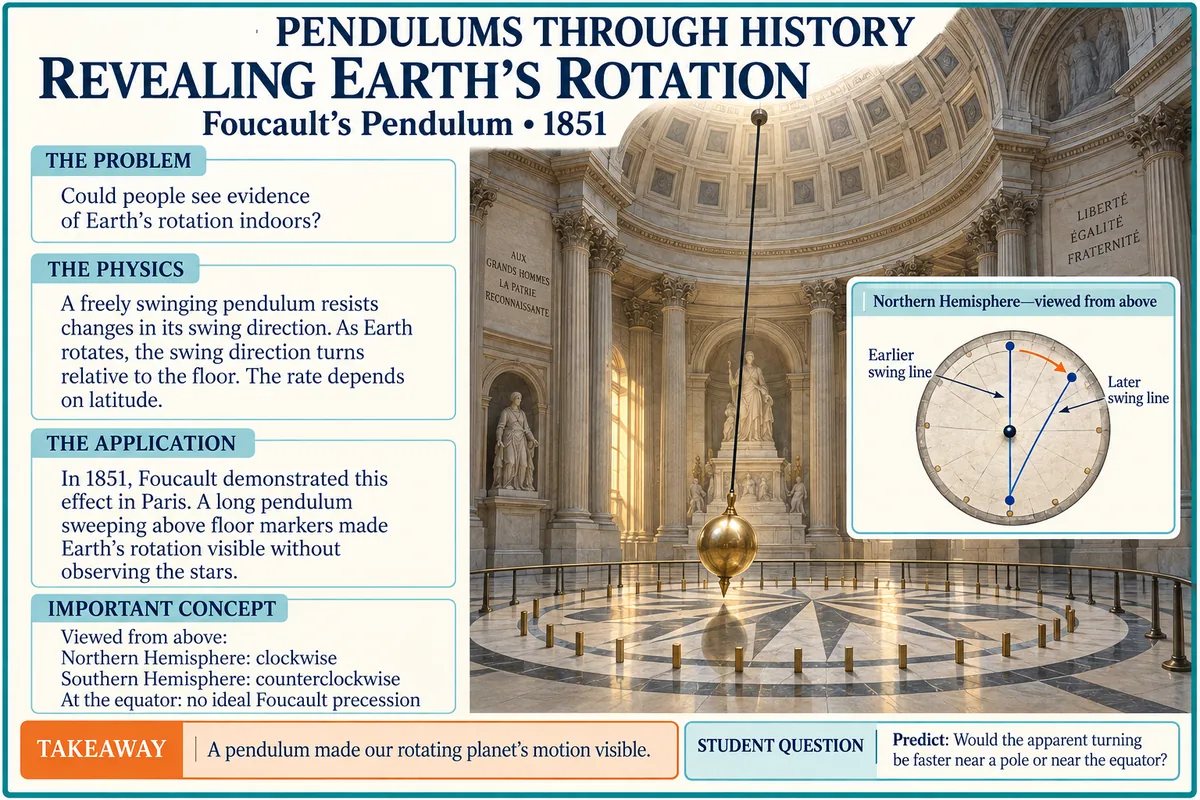
In 1851, Léon Foucault hung a 28 kg pendulum from the dome of the Panthéon in Paris. It kept swinging in the same plane while the building — and the Earth beneath it — slowly turned, giving the first direct proof of Earth's rotation. Click the image for a larger view.
Ex 7) A ball with a radius of .10 m starts from rest and accelerates down a 10. m incline and attains a velocity of 8.0 m/s. Find its ANGULAR acceleration.
A bicycle tire of radius 0.33 m moves forward, without slipping, for a distance of 0.27 m. How many radians does the wheel rotate?
A bicycle tire of radius 0.33 m moves forward, without slipping, for a distance of 0.27 m. How many degrees does the wheel rotate?
A flat disc rotates $1.5\pi$ rad in 12 s. What is its angular velocity?
An electric train rides a circular track of radius 0.39 m and its wheels rotate an arc length (linear distance) of 0.96 m in 4.0 s. What is the angular velocity of the wheels?
A boy pulls a wagon in a circle. The wagon starts from rest and accelerates to an angular velocity of 0.25 rad/s in 1.2 s. What is the wagon's angular acceleration?
A car tire rotating with an angular velocity of 42 rad/s accelerates at a constant rate to 51 rad/s in 3.0 s. What is its angular acceleration?
A bicycle has wheels with a radius of 0.25 m. The wheels are moving at a constant angular velocity of 3.1 rad/s. What is the linear velocity of the bicycle?
A motorbike has tires of a radius of 0.25 m. If the motorbike is traveling at 1.7 m/s, what is the angular velocity of the tires (assume the tires are rotating without slipping)?
A cyclist accelerates uniformly from rest to a linear velocity of 1.0 m/s in 0.75 s. The bicycle tires have a radius of 0.38 m.
What is the angular velocity of each bicycle tire at t = 0.75 s?
What is the angular acceleration of each tire?
What is the tangential acceleration of each tire at r = 0.38 m?
What is the centripetal (radial) acceleration of each tire at r = 0.38 m?
What is the total linear acceleration of each tire at t = 0.75 s?
What is the rotational frequency (f) of each tire?
Unlike record players which rotate at a constant angular velocity, the CD-ROM driver in a CD player rotates the CD at different angular velocities so that the optical head maintains a constant tangential velocity relative to the CD. Assume the CD has a diameter of 0.120 m and that the CD needs to move at a tangential velocity of 1.26 m/s relative to the optical head so the data (music) can be read correctly.
What is the angular velocity when the CD-ROM is reading data at the outer edge of the CD? Give the answer in rpm and rad/s.
At the inner edge of the CD, the CD-ROM rotates at 500. rpm. How far from the center of the CD is the inner edge ($v_{\text{tangential}} = 1.26 \text{ m/s}$)?
What is the centripetal (radial) acceleration at the outer edge of the CD?
What is the rotational frequency (f) of the CD when it is reading data at its outer edge?
3 questions on Practice II — pick an answer to check yourself.
1. A flat disc rotates through 1.5π rad in 12 s at a constant rate. What is its angular velocity?
2. A bicycle wheel of radius 0.25 m turns at a constant 3.1 rad/s without slipping. What is the bicycle's linear speed?
3. A CD player keeps the disc's tangential speed constant under the optical head. When reading near the inner edge (small r), the CD's angular velocity is…
A tricycle wheel of radius 0.11 m is at rest and is then accelerated at a rate of 2.3 rad/s$^2$ for a period of 8.6 s. What is the wheel's final angular velocity?
A tricycle wheel of radius 0.11 m is at rest and is then accelerated at a rate of 2.3 rad/s$^2$ for a period of 8.6 s. What is the wheel's final linear velocity?
A potter's wheel is rotating with an angular velocity of $\omega = 3.2$ rad/s. The potter applies a constant force, accelerating the wheel at 0.21 rad/s$^2$. What is the wheel's angular velocity after 6.4 s?
A potter's wheel is rotating with an angular velocity of $\omega = 3.2$ rad/s. The potter applies a constant force, accelerating the wheel at 0.21 rad/s$^2$. What is the wheel's angular displacement after 6.4 s?
A bicycle wheel with a radius of 0.38 m accelerates at a constant rate of 4.8 rad/s$^2$ for 9.2 s from rest. How many revolutions did it make during that time?
A bicycle wheel with a radius of 0.38 m accelerates at a constant rate of 4.8 rad/s$^2$ for 9.2 s from rest. What was its linear displacement during that time?
A Frisbee of radius 0.15 m is accelerating at a constant rate from 7.1 revolutions per second to 9.3 revolutions per second in 6.0 s. What is its angular acceleration?
A Frisbee of radius 0.15 m is accelerating at a constant rate from 7.1 revolutions per second to 9.3 revolutions per second in 6.0 s. What is its angular displacement during that time?
A record is rotating at 33 revolutions per minute. It accelerates uniformly to 78 revolutions per minute with an angular acceleration of 2.0 rad/s$^2$. Through what angular displacement does the record move during this period?
What is the angular acceleration of a record that slows uniformly from an angular speed of 45 revolutions per minute to 33 revolutions per minute in 3.1 s?
3 questions on Practice III — pick an answer to check yourself.
1. A wheel of radius 0.20 m starts from rest with angular acceleration 2.0 rad/s² for 5.0 s. What is the final linear speed of its rim?
2. A wheel starts from rest with constant angular acceleration. If it spins for twice as long, its angular displacement becomes…
3. A wheel turns through an angular displacement of 62.8 rad. How many revolutions is that?
Angular Review
A 60. cm diameter wheel rotates through 50. rad. What distance will it move?
How many times will the wheel rotate?
A saw blade is spinning at 2000. rpm. (rpm = revolutions/min) What is its angular velocity?
Through how many radians will it spin in 2.0 seconds?
How fast are the blade tips moving if the blade has a 30. cm diameter?
A rotating satellite has the same angular velocity as the Earth. If the satellite is $5.0 \times 10^7$ m from the center of the earth, what is its tangential velocity?
4. Find the moment of inertia of a 200.-gram saw blade that is 30. cm in diameter.
5. What angular acceleration will result if the blade in #4 is acted upon by a 10. Nm torque? How long will it take to spin the blade up to its operating speed of 3000 rad/sec?
6. A pitcher throws a ball by rotating his arm around his shoulder joint. If the ball is 0.05 kg and his arm is 5.0 kg and 0.8 m long, what torque is required of the shoulder to accelerate the arm at 25 rad/s$^2$? Assume the arm is a solid stick and the ball is a point mass.
7. A string is wound around the flywheel of a motor that is 20. cm in diameter. If a boy pulls the string with 40. N of force, what torque will he produce? b) What angular acceleration will he produce if the flywheel is a solid disc with mass = 2.0 kg?
5 quick questions — pick an answer to see if you’re right.
1. What is one radian?
2. A wheel of radius 2.0 m rolls 5.0 m along the floor. Through how many radians does it rotate?
3. A ball of radius 0.50 m rolls at 5.0 m/s without slipping. What is its angular velocity?
4. A wheel spins with angular velocity 10 rad/s. What is its period of rotation?
5. Which rotational quantity is the partner of linear acceleration a?
What, If Anything, Is Wrong?No calculator
Twice the Frequency
Two wheels have the same radius. Wheel A turns at 2 rev/s. Wheel B turns at 4 rev/s. A student compares them:
Student: "Wheel B spins at twice the frequency, so its period is twice as long. Since ω = 2π/T, a longer period means B has the smaller angular velocity. That also means a point on B's rim moves slower than a point on A's rim."
What, if anything, is wrong? If something is wrong, explain the error and fix it. If nothing is wrong, explain why it is correct.


 $= \Delta d / \Delta t$