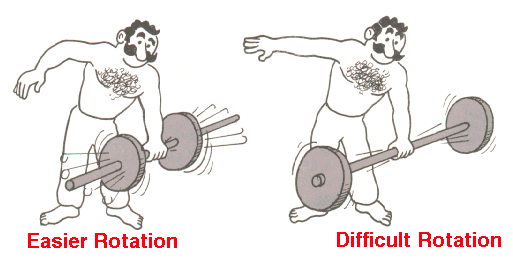
Both barbells have the same mass, why do they have a DIFFERENT moment of inertia?
The inertia of rotating objects depends on the object's mass AND the way that the mass is ___________________ around the _____________________________
Which would have a greater moment of inertia with a vertical axis of rotation?
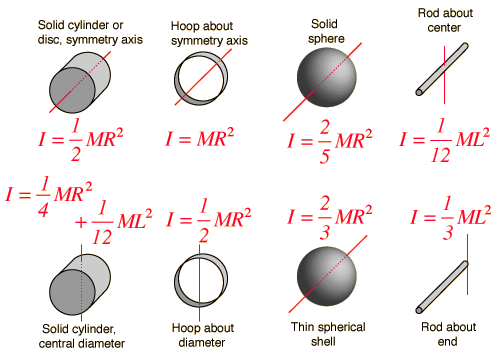
You won't have to memorize the moment of inertia equations for any shape or arrangement. It will be given.
Torque and Moment of Inertia
Torque = $\Sigma \tau = I\alpha$ [2nd Law]
$\alpha$ _____________ $I$ _____________
$\tau = F\sin\theta[r]$
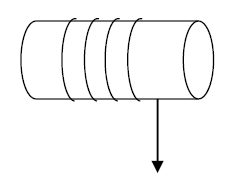
Ex 1) A string is wrapped around a 2.0 kg cylinder with a .10 m radius. A force of 20. N is applied down on the string. Find the angular acceleration of the cylinder.
The moment of inertia of a cylinder is $\frac{1}{2}mR^{2}$
EX 2 - AP DERIVATION:
1. Cylinder: $TR = I\alpha = (\frac{1}{2}MR^{2})(a/R) \implies T = \frac{1}{2}Ma$.
2. Hanging Mass: $mg - T = ma \implies mg - \frac{1}{2}Ma = ma$.
3. Solve for $a$: $mg = a(m + M/2) \implies a = \frac{(2)(9.8)}{2 + 1} = \mathbf{6.53\text{ m/s}^{2}}$.
Rotational Inertia 2
I.Rotational InertiaAKAMoment of Inertia
An object's resistance to a ______________________________
Rotational inertia depends on an object's _______________ and how the mass is distributed around the axis of ______________
Which mass distribution has the LARGER rotational inertia?
Symbol for the moment of inertia _____________
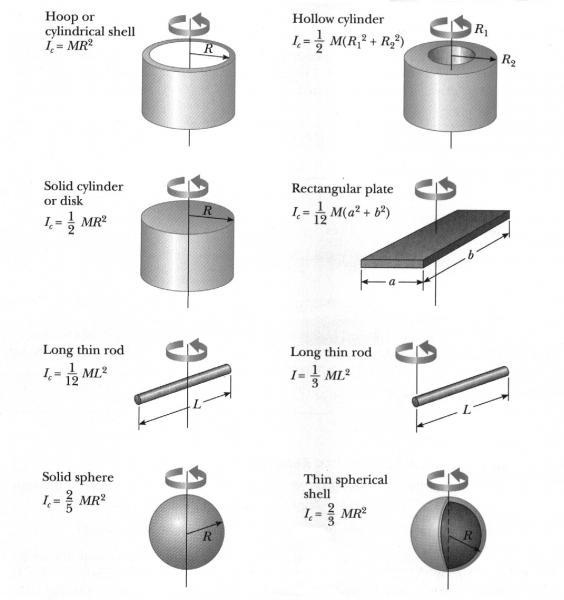
Common Moments of Inertia (You will be given)
Equation: $I = \sum mr^{2}$ m - _______ r - ________
Ex 1)
a) Find the moment of inertia of two 5.0 kg bowling balls joined by a meter-long rod of negligible mass when rotated about the center of the rod.
b) Find the moment of inertia of the object when it is rotated about one of the masses.
Ex 2) Two masses of 3.1 kg and 4.6 kg are attached to either end of a thin, light rod (assume massless) of length 1.8 m. Compute the moment of inertia for:
The rod is rotated about its midpoint.
The rod is rotated at a point 0.30 m from the 3.1 kg mass.
The rod is rotated about the 4.6 kg mass.
II.Newton's 2nd Law for Rotation
For Linear Acceleration $F = ma$
For Rotational acceleration $\tau_{\text{net}} = I\alpha$
What torque needs to be applied to an antique sewing machine spinning wheel of radius 0.28 m and mass 3.1 kg (model it as a hoop, with $I = MR^{2}$) to give it an angular acceleration of 4.8 rad/s$^{2}$?
What is the angular acceleration of a 75 g lug nut when a lug wrench applies a 135 N-m torque to it? Model the lug nut as a hollow cylinder of inner radius 0.85 cm and outer radius 1.0 cm ($I = \frac{1}{2}M(r_{1}^{2} + r_{2}^{2})$). What is the tangential acceleration at the outer surface? Why are these numbers so high – what factor was not considered?
A baseball player swings a bat, accelerating it uniformly from rest to 4.2 revolutions/second in 0.25 s. Assume the bat is modeled as a uniform rod ($I = 1/3 ML^{2}$), and has m = 0.91 kg and is 0.86 m long. Find the torque applied by the player to the bat.
A large pulley of mass 5.21 kg (its mass cannot be neglected) is rotated by a constant tension force of 19.6 N in the counterclockwise direction. The rotation is resisted by the frictional torque of the axle on the pulley. The frictional torque is a constant 1.86 N-m in the clockwise direction. The pulley accelerates from 0 to 27.2 rad/s in 4.11 s. Find the moment of inertia of the pulley.
A baton twirler has a baton of length 0.42 m with masses of 0.53 kg at each end. Assume the rod itself is massless. The rod is first rotated about its midpoint. It is then rotated about one of its ends, and in both cases uniformly accelerates from 0 rad/s to 1.8 rad/s in 3.0 s.
Find the torque exerted by the twirler on the baton when it is rotated about its middle.
Find the torque exerted by the twirler on the baton when it is rotated about its end.
What torque needs to be applied to a hula hoop of radius 0.58 m and mass 2.5 kg (model it as a hoop, with $I = MR^{2}$) to give it an angular acceleration of 6.8 rad/s$^{2}$?
A cricket batsman swings his bat, accelerating it uniformly from rest to 17.3 rad/s in 0.21 s. Assume the bat is modeled as a flat plate ($I = 1/3 Mh^{2} + 1/2 Mw^{2}$), and has m = 1.36 kg, h=0.97 m, and w = 0.11 m. Find the torque applied by the batsman to the bat.
Two masses of 4.2 kg and 5.8 kg are attached to either end of a thin, light rod (assume massless) of length 2.4 m. Compute the moment of inertia for:
The rod is rotated about its midpoint.
The rod is rotated at a point 0.50 m from the 4.2 kg mass.
The rod is rotated about the end where the 5.8 kg mass is located.
A large pulley of mass 6.91 kg (its mass cannot be neglected) is rotated by a constant torque of 22.3 Nm in the counterclockwise direction. The rotation is resisted by the frictional torque of the axle on the pulley. The frictional torque is a constant 2.12 N-m in the clockwise direction. The pulley accelerates from 0 to 31.2 rad/s in 5.63 s. Find the moment of inertia of the pulley.
A baton twirler has a baton of length 0.36 m with masses of 0.48 kg at each end. Assume the rod itself is massless. The rod is first rotated about its midpoint. It is then rotated about one of its ends, and in both cases uniformly accelerates from 0 rad/s to 2.4 rad/s in 3.6 s.
Find the torque exerted by the twirler on the baton when it is rotated about its middle.
Find the torque exerted by the twirler on the baton when it is rotated about its end.
Module 2: Teacher CER Key
LUG NUT (Q2) ANALYSIS:
1. $I = \frac{1}{2}(0.075\text{ kg})((0.0085\text{ m})^{2} + (0.01\text{ m})^{2}) = 6.46 \times 10^{-6}\text{ kg}\cdot\text{m}^{2}$.
2. $\alpha = \tau/I = 135\text{ Nm} / 6.46 \times 10^{-6} = \mathbf{2.09 \times 10^{7}\text{ rad/s}^{2}}$.
3. $a_{t} = \alpha R = (2.09 \times 10^{7})(0.01) = \mathbf{2.09 \times 10^{5}\text{ m/s}^{2}}$. Reasoning: These values are high because the model ignores the massive wrench's inertia and thread friction.
Advanced Rotation Problems
A very light cotton tape is wrapped around the outside surface of a uniform cylinder of mass M and radius R. The free end of the tape is attached to the ceiling. The cylinder is released from rest and as it descends it unravels from the tape without slipping. The moment of inertia of the cylinder about its center is $I = \frac{1}{2}MR^{2}$.
On the circle above, shows all the forces applied on the cylinder.
Find the acceleration of the center of the cylinder when it moves down.
Find the tension force in the tape.
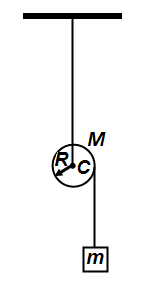
A uniform cylinder of mass M and radius R is fixed on a frictionless axle at point C. A block of mass m is suspended from a light cord wrapped around the cylinder and released from rest at time t = 0. The moment of inertia of the cylinder is $I = \frac{1}{2}MR^{2}$.
On the circle and the square above, show all the applied forces on the cylinder and the block.
Find the acceleration of the block as it moves down.
Find the tension in the lower cord.
Express the angular momentum of the cylinder as a function of time t.
A block, A of mass M, is suspended from a light string that passes over a pulley and is connected to block B of mass 2M. Block B sits on the surface of a smooth table. Block C, of mass 3M, sits on the top of block B. The surface between block C and block B is not frictionless. When the system of three blocks is released from rest, block A accelerates downward with a constant acceleration, a, and the two blocks on the table move relative to each other. The moment of inertia of the pulley is $I = 1.5 MR^{2}$. Present all results in terms of M, g, and a.
Find the tension force in the vertical section of the string.
Find the tension force in the horizontal section of the string.
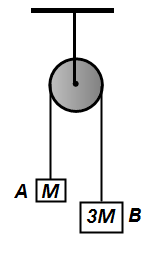
A pulley of radius, R, and moment of inertia, $I = 2 MR^{2}$ is mounted on an axle with negligible friction. Block A, with a mass M, and Block B, with a mass of 3M, are attached to a light string that passes over the pulley. Assuming that the string doesn't slip on the pulley, answer the following questions in terms of M, R, and fundamental constants.
What is the acceleration of the two blocks?
What is the tension force in the left section of the string?
What is the tension force in the right section of the string?
What is the angular acceleration of the pulley?
Module 3: Advanced CER Key
UNRAVELING CYLINDER:
1. Net Force: $Mg - T = Ma$.
2. Net Torque: $TR = I\alpha = (\frac{1}{2}MR^{2})(a/R) \implies T = \frac{1}{2}Ma$.
3. Substitute $T$: $Mg - \frac{1}{2}Ma = Ma \implies Mg = \frac{3}{2}Ma \implies \mathbf{a = \frac{2}{3}g}$.
4. Tension: $T = \frac{1}{2}M(\frac{2}{3}g) = \mathbf{\frac{1}{3}Mg}$.
Ramp Problems
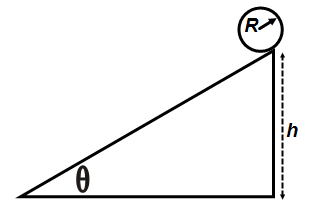
A solid uniform sphere of mass, M, and radius, R is placed on an inclined plane at a distance, h from the base of the incline. The inclined plane makes an angle, $\theta$ with the horizontal. The sphere is released from rest and rolls down the incline without slipping. The moment of inertia of the sphere is $I = \frac{2}{5} MR^{2}$.
Determine the translational kinetic energy of the sphere when it reaches the bottom of the inclined plane.
Determine the rotational kinetic energy of the sphere when it reaches the bottom of the inclined plane.
A solid uniform cylinder of mass M and radius R is placed on an inclined plane at a distance h from the base of the incline. The inclined plane makes an angle $\theta$ with the horizontal. The cylinder is released from rest and rolls down the incline without slipping. The moment of inertia of the cylinder is $I = \frac{1}{2} MR^{2}$.
Determine the translational kinetic energy of the cylinder when it reaches the bottom of the inclined plane.
Determine the rotational kinetic energy of the cylinder when it reaches the bottom of the inclined plane.
In a physics experiment, students made a lab cart of a wooden block of mass 5m and four wheels each of mass, m, and radius r. The moment of inertia of each wheel is $I = \frac{1}{2} mr^{2}$. The cart is released from rest and rolls without slipping from the top of an inclined plane of height h. After the cart reaches the bottom of the inclined plane, it collides with an elastic spring with negligible mass and a spring constant k.
Determine the moment of inertia of all four wheels.
Determine the speed of the cart at the bottom of the inclined plane.
If an object has translational and rotational KE, Its total KE is …. KE = $\frac{1}{2}mv^{2} + \frac{1}{2}I\omega^{2}$
A solid cylinder ($I = \frac{1}{2}MR^{2}$) of mass 0.56 kg and radius 0.042 m rolls, without slipping, down an incline of height 0.67 m. What is the speed of the cylinder at the bottom of the incline? Does its speed depend on the mass and radius of the cylinder?
Two uniform spheres ($I = \frac{2}{5}MR^{2}$) roll, without slipping, down an incline of height 0.72 m. Sphere 1 has a mass of 1.1 kg and a radius of 0.18 m and Sphere 2 has a mass of 1.8 kg and a radius of 0.14 m. Which sphere gets to the bottom of the incline quicker? What is the velocity of each sphere?
What is the rotational kinetic energy of a 0.82 kg sphere ($I = \frac{2}{5} MR^{2}$), with a radius of 0.058 m, rolling with an angular velocity of 5.2 rad/s?
A 0.36 kg, 0.11 m radius, thin hoop ($I = MR^{2}$) is rotating, without slipping, while moving linearly with an angular velocity of 4.8 rad/s along a path. What is its total kinetic energy (translational plus rotational)?
A solid cylinder rolls down a hill without slipping. How much work does the frictional force between the hill and the cylinder do on the cylinder as it is rolling? Why?
How much work is required to uniformly slow a merry-go-round of mass 1850 kg and a radius of 8.30 m from a rotational rate of 1 revolution per 7.40 s to a stop? Model the merry-go-round as a solid cylinder ($I = \frac{1}{2} MR^{2}$). If the merry-go-round is stopped in 7.40 s, what power is exerted?
A thin hoop ($I = MR^{2}$) of mass 0.56 kg and radius 0.042 m rolls, without slipping, down an incline of height 0.67 m. What is the speed of the hoop at the bottom of the incline? Does its speed depend on the mass and radius of the hoop?
Two solid cylinders ($I = \frac{1}{2}MR^{2}$) roll, without slipping, down an incline of height 0.85 m. Sphere 1 has a mass of 1.1 kg and a radius of 0.11 m, and Sphere 2 has a mass of 2.1 kg and a radius of 0.14 m. Which cylinder gets to the bottom of the incline quicker? What is the velocity of each cylinder?
What is the rotational kinetic energy of a 1.3 kg solid cylinder ($I = \frac{1}{2} MR^{2}$), with a radius of 0.043 m, rolling with an angular velocity of 4.9 rad/s?
A 0.42 kg, 0.09 m radius sphere ($I = \frac{2}{5} MR^{2}$) is rotating, without slipping, while moving linearly with an angular velocity of 5.2 rad/s along a path. What is its total kinetic energy (translational plus rotational)?
CYLINDER SPEED:
Total $KE = \frac{3}{4}Mv^{2}$. Energy Eq: $Mgh = \frac{3}{4}Mv^{2} \implies v = \sqrt{\frac{4}{3}gh}$.
Calculated $v = \sqrt{1.333 \times 9.8 \times 0.67} = \mathbf{2.96\text{ m/s}}$. Reasoning: Mass and radius cancel out in the energy conservation equation, so final speed depends only on height and shape.
Equation: L = __________ in terms of v, L = ___________________
Units _________
Rotational Momentum is _______________ during interactions
You spin a ball of mass 0.18 kg that is attached to a string of length 0.98 m at $\omega$ = 5.2 rad/s in a circle. What is the ball's angular momentum? Answer 0.90 kgm$^{2}$/s
A student is standing, with her arms outstretched, on a platform that is rotating at 1.6 rev/s. She pulls her arms in and the platform now rotates at 2.2 rev/s. What is her final moment of inertia (I) in terms of her original moment of inertia ($I_{0}$)? Answer: I = 0.73$I_{0}$
An LP record is spinning on an old-fashioned record player with an angular velocity of $\omega$. The record changer drops an identical record on top of the spinning record. What is the new angular velocity of both records? Answer $\omega = \omega_{0}/2$
Calculate the angular momentum of a ballet dancer who is spinning at 1.5 rev/sec. Model the dancer as a cylinder ($I = \frac{1}{2} MR^{2}$) with a mass of 62 kg, a height of 1.6 m, and a radius of 0.16 m. Answer 7.5 kgm$^{2}$/s
A student of mass 42 kg is standing at the center of a merry-go-round of radius 3.4 m and a moment of inertia of 840 kg-m$^{2}$ that is rotating at $\omega$ = 1.8 rad/s. The student walks to the outer edge of the merry-go-round. What is the angular velocity of the merry-go-round when he reaches the edge? Answer: 1.1 rad/s
A ball of mass 0.14 kg attached to a string of length 0.64 m is spun in a circle with $\omega$ = 4.9 rad/s. What is the ball's angular momentum? Answer: 0.28 kgm$^{2}$/s
A platform is rotating at 2.2 rev/s and a student is standing in the middle of it with his arms at his side. He extends his arms straight out and the platform now rotates at 1.4 rev/s. What is his final moment of inertia (I) in terms of his original moment of inertia ($I_{0}$)? Answer: I = 1.6$I_{0}$
A potter spins his wheel at 0.98 rev/s. The wheel has a mass of 4.2 kg and a radius of 0.35 m. He drops a chunk of clay of 2.9 kg directly onto the middle of the wheel. The clay is in the shape of a pancake and has a radius of 0.19 m. Assume both the wheel and the chunk of clay can be modeled as solid cylinders ($I = \frac{1}{2} MR^{2}$). What is the new tangential velocity of the wheel and the clay? Answer: 1.8 m/s
What is the angular momentum of a roller skater who is spinning at 1.5 rev/seconds? Model the skater as a cylinder ($I = \frac{1}{2} MR^{2}$) with a mass of 81 kg, a height of 1.8 m, and a radius of 0.18 m. Answer: 12 kgm$^{2}$/s
A student of mass 59 kg is standing at the edge of a merry-go-round of radius 4.2 m and a moment of inertia of 990 kg-m$^{2}$ that is rotating at $\omega$ = 2.1 rad/s. The student walks to the middle of the merry-go-round. What is the angular velocity of the merry-go-round when he reaches the middle? Answer: 4.3 rad/s