Show Me The Physics
Torque & Statics
Unit: Rotational Dynamics

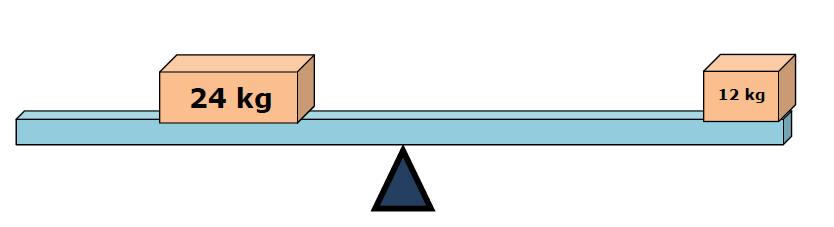
Under what conditions can a $24 \text{ kg}$ box balance a $12 \text{ kg}$ box?
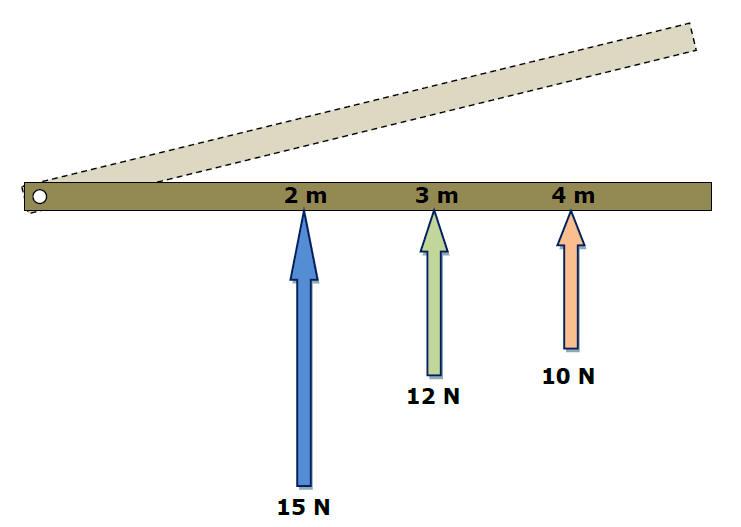
A) Rotating force. Which torque below is the greatest?
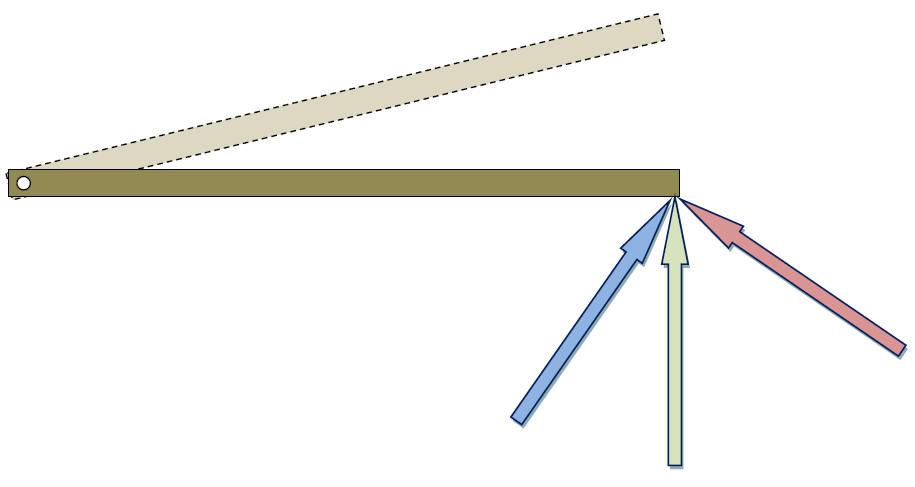
B) depends on and to pivot point
C) The distance between the Force and the pivot point is called the
________________ or ________________________
D) Maximum when Force is degrees to the lever arm
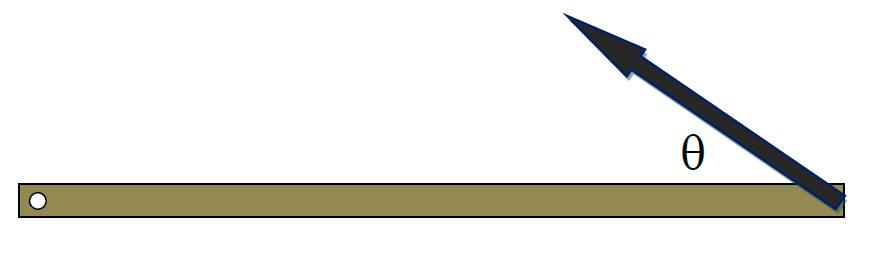
E) $\tau = d[F \sin \theta]$ units (mN)
F) Units -
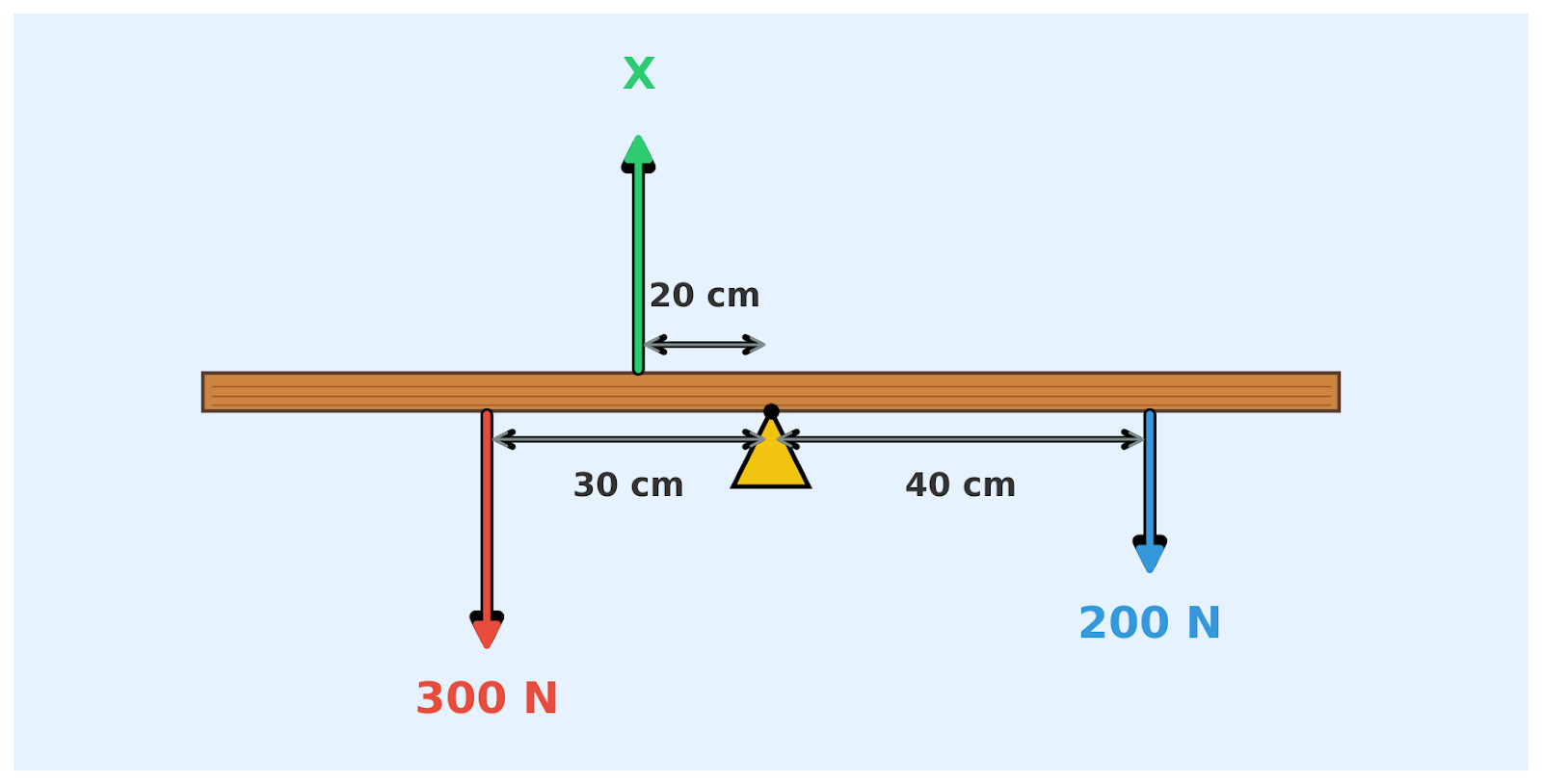
1. A uniform meter stick is balanced at its midpoint with several forces applied, as shown below. If the stick is in equilibrium, the magnitude of the force $X$ in newtons (N) is...
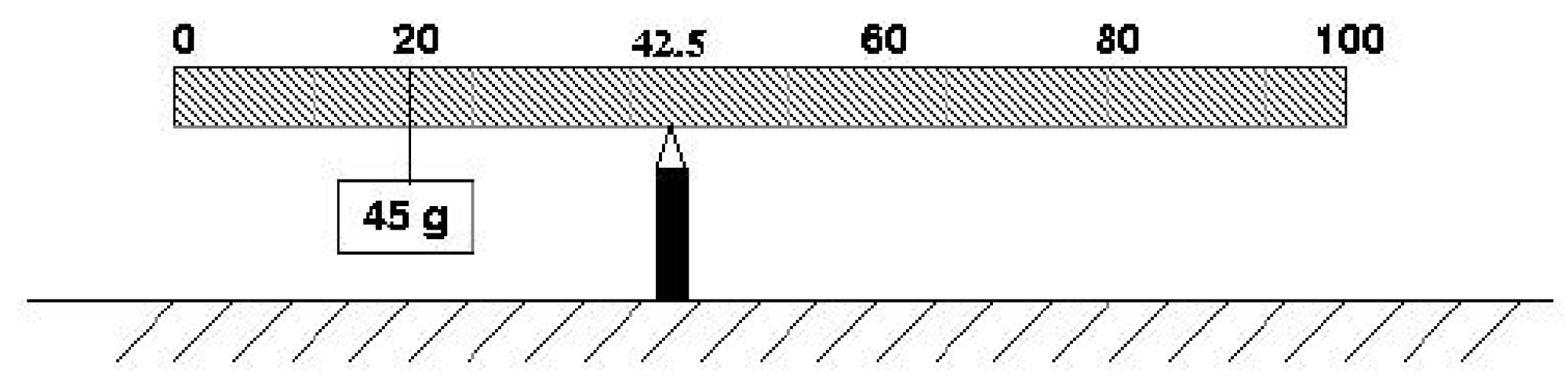
2. A uniform meter stick has a $45.0 \text{ g}$ mass placed at the $20 \text{ cm}$ mark as shown in the figure. If a pivot is placed at the $42.5 \text{ cm}$ mark and the meter stick remains horizontal in static equilibrium, what is the mass of the meter stick?
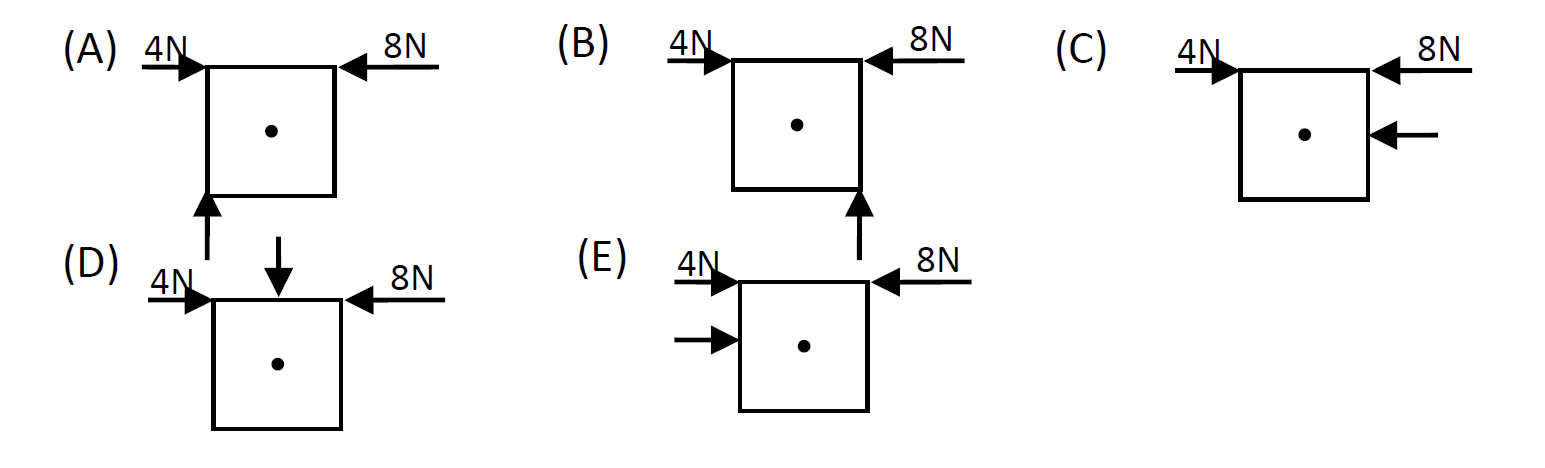
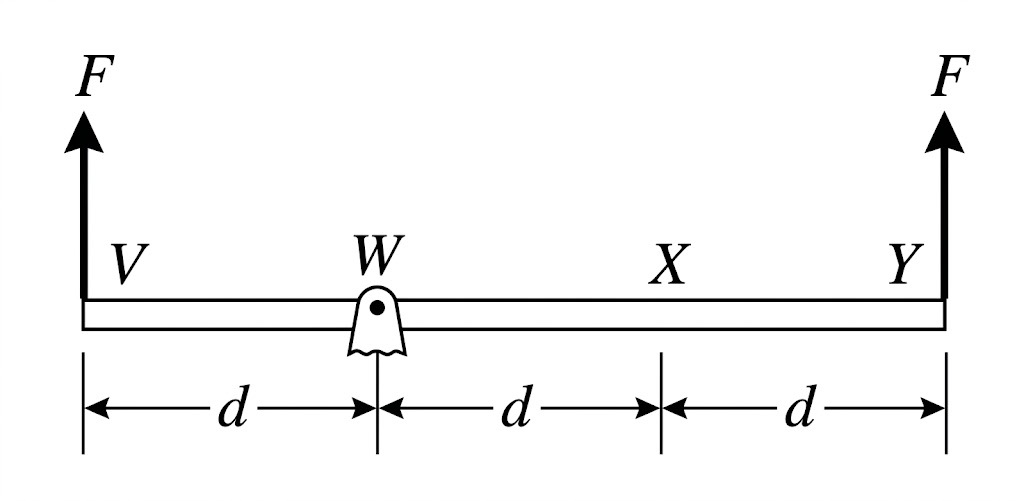
3. A massless rigid rod of length $3d$ is pivoted at a fixed point $W$, and two forces each of magnitude $F$ are applied vertically upward as shown. A third vertical force of magnitude $F$ may be applied, either upward or downward, at one of the labeled points. With the proper choice of direction at each point, the rod can be in equilibrium if the third force of magnitude $F$ is applied at point:
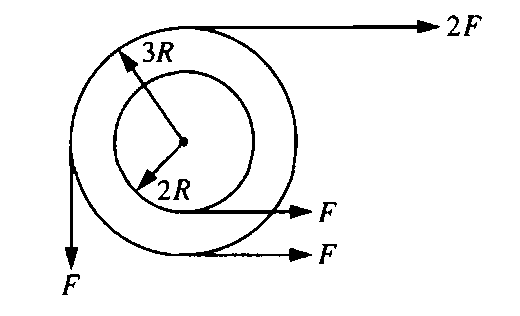
4. A system of two wheels fixed to each other is free to rotate about a frictionless axis through the common center of the wheels and perpendicular to the page. Four forces are exerted tangentially to the rims of the wheels, as shown. The magnitude of the net torque on the system about the axis is
5. A meter stick of negligible mass is placed on a fulcrum at the $0.60 \text{ m}$ mark, with a $2.0 \text{ kg}$ mass hung at the $0 \text{ m}$ mark and a $1.0 \text{ kg}$ mass hung at the $1.0 \text{ m}$ mark. The meterstick is released from rest in a horizontal position. Immediately after release, the magnitude of the net torque on the meterstick about the fulcrum is most nearly
Ex 1) Mass Safe = $15,000. \text{ kg}$ Mass Beam = $1500. \text{ kg}$
Find $F_A$ (force of left leg on the table) and $F_B$ (force of right leg on the table)
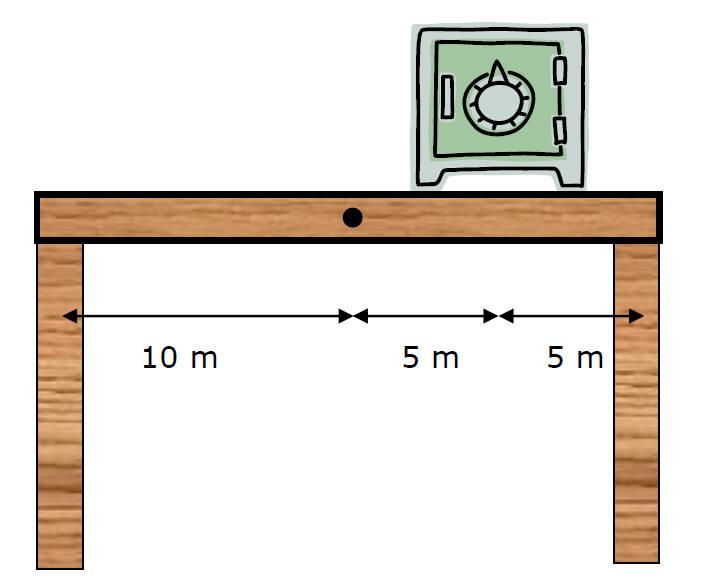
$\Sigma \tau = 0$
Find Net Torque, Both Forces = $50. \text{ N}$, $r_1 = 30. \text{ cm}$, $r_2 = 50. \text{ cm}$
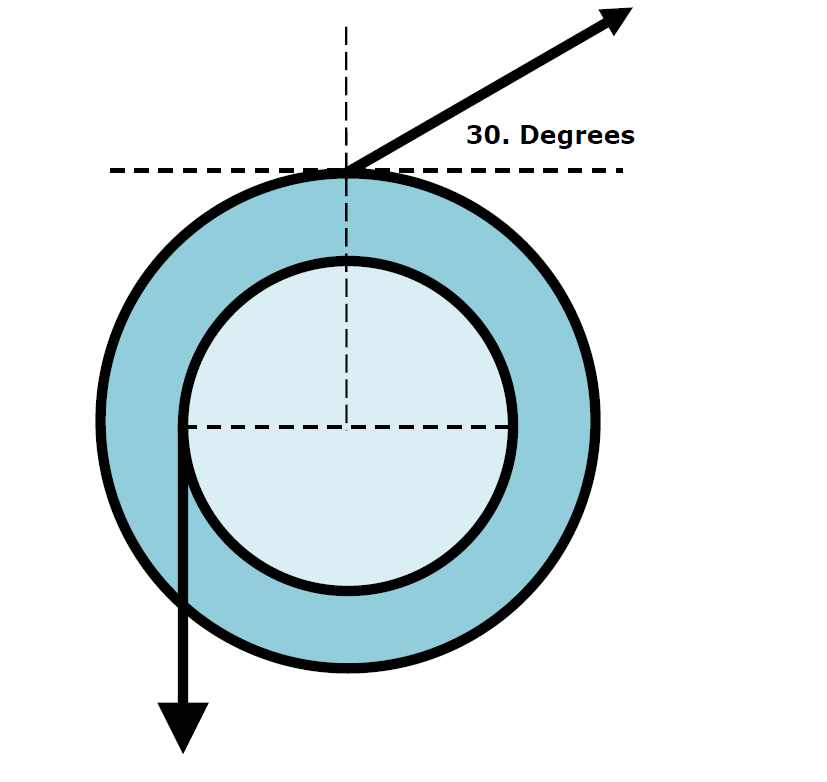
A $30. \text{ cm}$ disk and a $50. \text{ cm}$ disk are attached to an axle that passes through their centers. If a $50. \text{ N}$ force hangs from the $30. \text{ cm}$ disk and a $50. \text{ N}$ force is applied to the $50. \text{ cm}$ disk as shown above. What is the net torque on the compound wheel?
CW negative CCW positive
A $2.20 \text{ m}$ uniform beam with a mass of $25.0 \text{ kg}$ has a $28.0 \text{ kg}$ sign attached to it. Find all the forces on the beam.
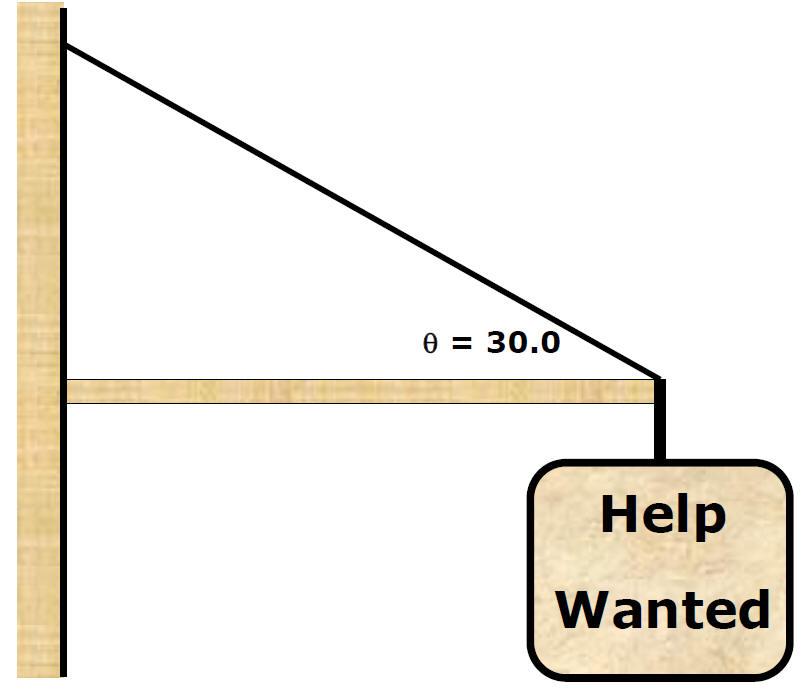
Find the tension on cable $T$ and the components of the wall's force on the beam. Find a) $F_{wall y}$, $F_{wall x}$ and b) Cable Tension.
$\Sigma \tau = 0$ (Use the wall as a pivot point)
b) Find $F_{wall y}$ & $F_{wall x}$
$\Sigma F = 0$ & $\Sigma \tau = 0$
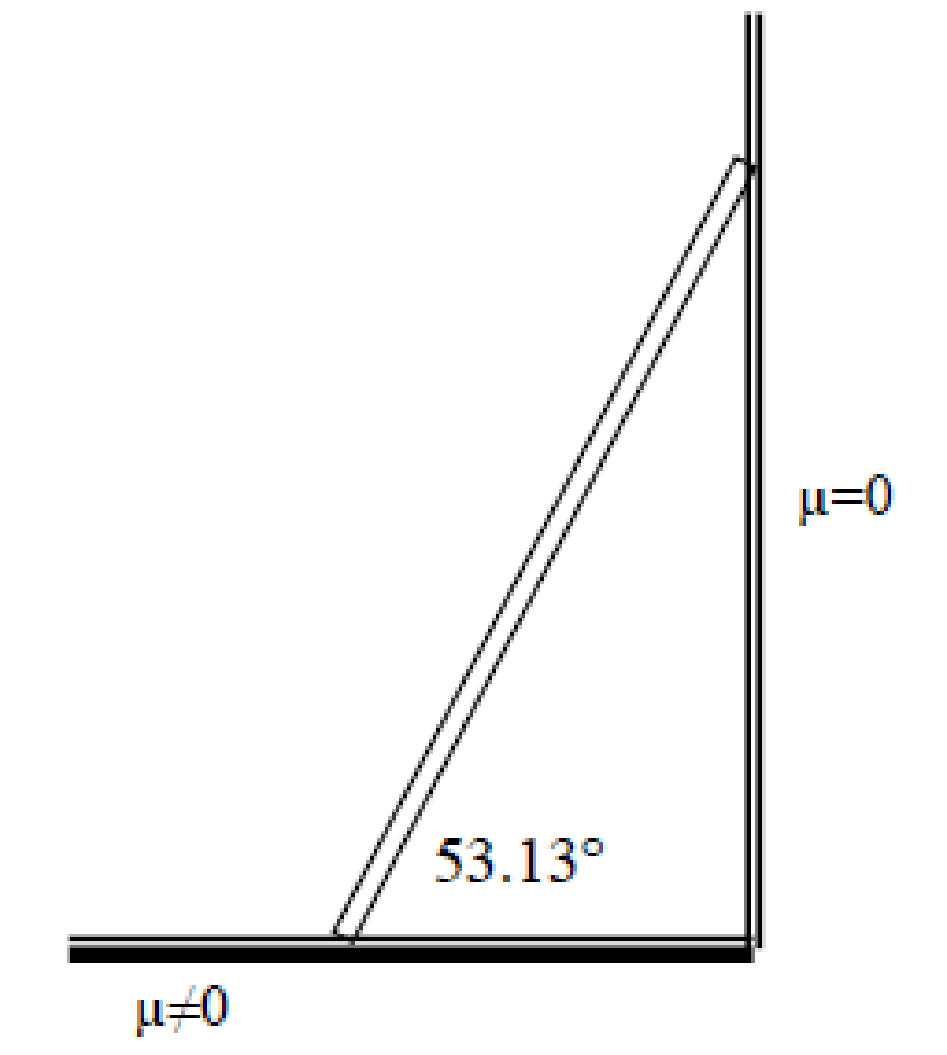
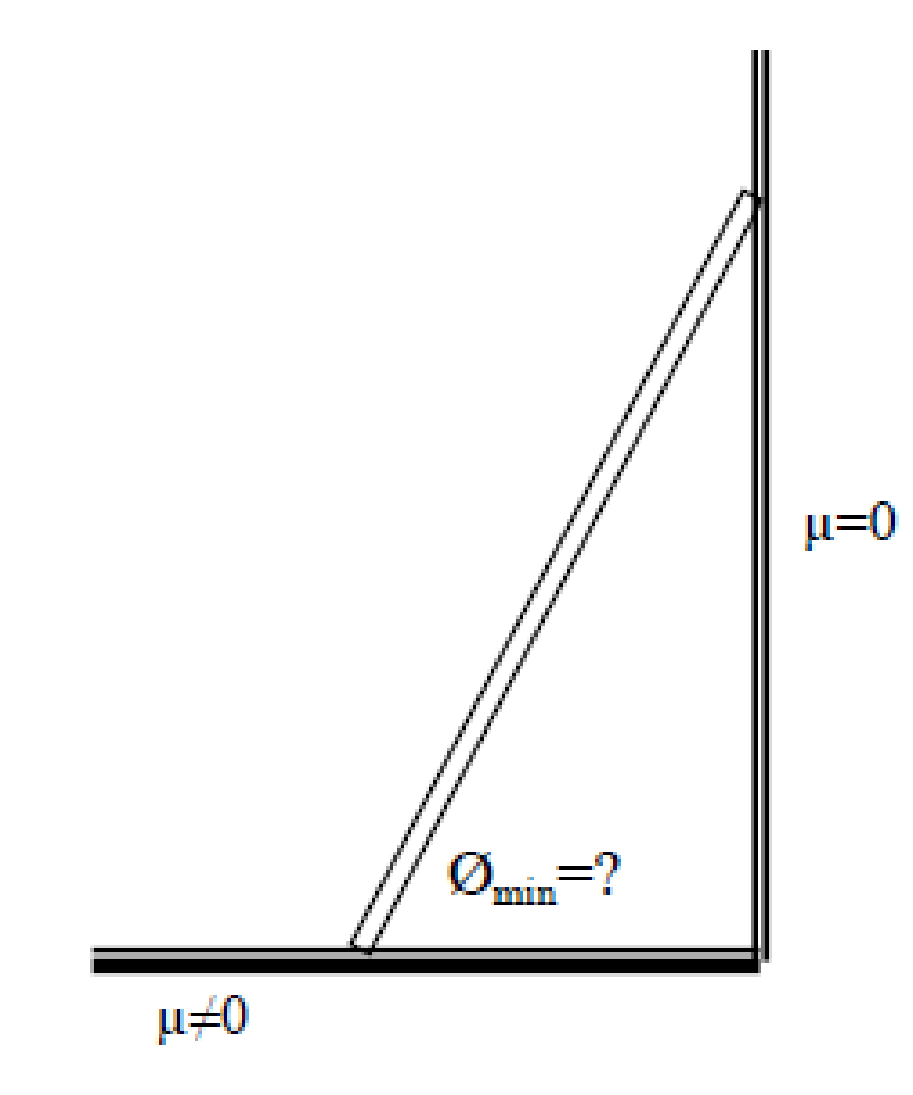
Note: all walls are frictionless ($\mu=0$), and all floors are rough ($\mu \neq 0$), unless otherwise indicated.
[1] A $10 \text{-meter-long}$ ladder leans against the wall, as shown. If the ladder weighs $100. \text{ N}$, what is $\mu_{min}$?
[2] A $10 \text{-meter-long}$ ladder leans against the wall as shown. If the ladder weighs $200. \text{ N}$ and there is just enough frictional force to allow an $800. \text{ N}$ person to climb to the top safely, what is $\theta_{min}$? Note: $\mu_{Floor}=0.675$.
3. A uniform $250.0 \text{ N}$ ladder that is $12.0 \text{ m}$ long rests against a frictionless wall at an angle of $58.0 \text{ degrees}$, the ladder just keeps from slipping.
Draw the ladder's FBD.
(a) What forces act on the bottom of the ladder?
(b) What is the coefficient of friction of the bottom of the ladder with the ground?
1. If the force is $10. \text{ N}$ and the box is $4.0 \text{ m}$ by $4.0 \text{ m}$, what is the torque?
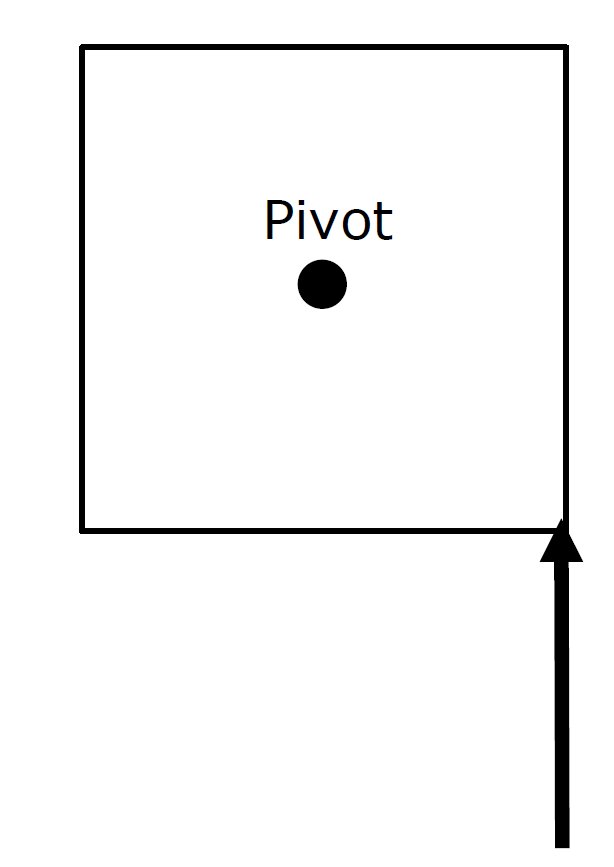
A wooden square of side length $2.0 \text{ m}$ is on a horizontal tabletop and is free to rotate about its center axis. The square is subject to two forces and rotates.
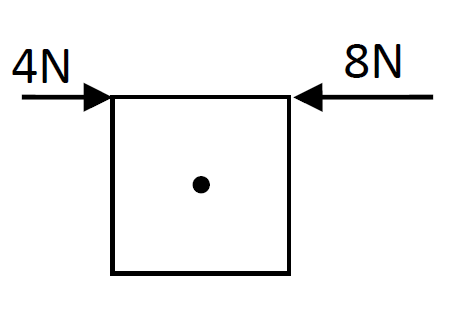
4. Where should another $4.0 \text{ N}$ force be applied to place the block in an equilibrium state?
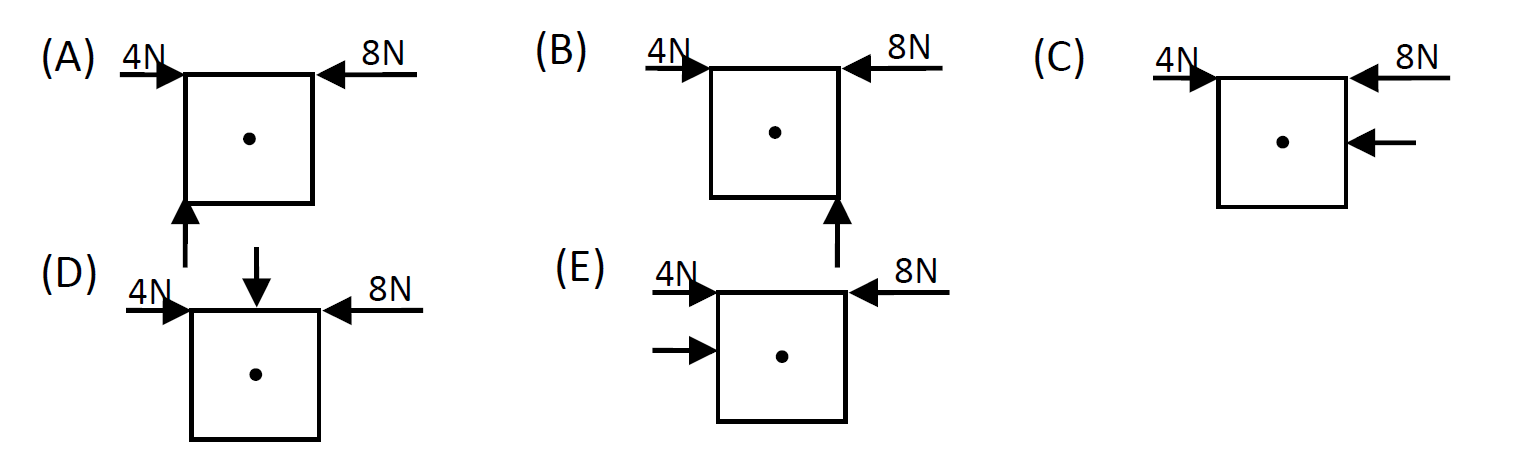
5. Where should another $4 \text{ N}$ force be applied to maximize its torque?