Projectile Fired at an Angle - Problems
Practice Problems: Horizontal & Vertical Components at an Angle

Projectile Fired at an Angle — word problems combining horizontal and vertical motion
Which velocity, Vx or Vy, is constant
for a projectile?


Sample Projectile
Vix = 25 m/s | Viy = 40 m/s
| t (sec) | Vx (m/s) | Vy (m/s) |
|---|---|---|
| 0 | 25 | 40 |
| 1 | 25 | 30 |
| 2 | 25 | 20 |
| 3 | 25 | 10 |
| 4 | 25 | 0 (peak) |
| 5 | 25 | -10 |
| 6 | 25 | -20 |
| 7 | 25 | -30 |
| 8 | 25 | -40 |
Word Problems
Example — Running Long Jump
An athlete doing a running jump leaves the ground at an angle of 25.° and a velocity of 10. m/s.
Part (a)
Angle = 25.°, Velocity = 10. m/s
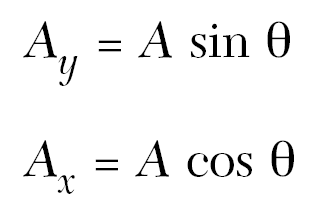
Find: (a) the initial vertical component (Viy) of the athlete's velocity.
Part (b)
Viy = 4.2 m/s (from part a)
Find: (b) how long does it take for the athlete to reach her maximum height?
| X | Y |
|---|---|
| t = ? | Viy = 4.2 m/s (from before) |
| t = ? | |
| Vfy = 0 (peak) | |
| ay = -9.8 m/s2 |
Part (c) — Total Time
Peak time = .43 sec, on level ground
Find: (c) how long did it take for the athlete to complete the entire jump?
On level ground: Total time = double peak time

Part (c) — Distance
dx = ?, t = .86 sec
Find: (c) how far did she jump?
Check Your Understanding
5 quick questions — pick an answer to see if you’re right.
1. For a projectile with no air friction, which velocity component stays constant?
2. A projectile has Vix = 25 m/s and Viy = 40 m/s. Using g = 10 m/s², what is Vy at t = 6 s?
3. An athlete leaves the ground with Viy = 4.9 m/s up. How long does she take to reach her maximum height? (g = 9.8 m/s²)
4. A long jumper on level ground has Vx = 8.0 m/s and reaches her peak 0.40 s after takeoff. How far does she jump?
5. A ball is launched at 20. m/s at 30.° above horizontal. What is its initial vertical velocity?
Analyzing a Long Jump
Video analysis shows that a long jumper leaves the ground at 9.0 m/s at an angle of 20.° above the horizontal. Treat the jumper as a projectile that lands at the same height it took off, and neglect air resistance. (sin 20.° ≈ 0.34, cos 20.° ≈ 0.94)
About how long is the jump?
▶ Want a challenge? Open 6 more Regents-style questions (harder · mixed formats)
Challenge score: 0 / 6
C1. How high does the jumper’s center of mass rise above its takeoff height?
C2. The jumper runs to the right. Choose the direction of the jumper’s velocity at the highest point of the jump, and determine its magnitude.
●
C3. Substitute numerical values into a mathematical representation that can be used to determine the total time the jumper is in the air. Then calculate the time.
C4. A student makes the following claim.
Place a check mark in either the Support or Refute box. Justify your response using a mathematical relationship.
C5. A coach wants a longer jump. Real jumpers cannot keep their full running speed at large takeoff angles. Which change, if possible, would increase the range the most?
C6. The model predicts the longest jump at 45°, but elite long jumpers take off at about 20.°. Explain this difference between the model and real jumpers.