Gravity
Newton's Law of Universal Gravitation
Gravity - mutual force of attraction between any two objects in the universe
Fill In The Blank Notes
C) Universal Law of Gravity


Moon Has An Unbalanced Force On It!
G = Gravitational constant = 6.67 × 10⁻¹¹ Nm2/kg2


| Fg | m1 | m2 |
|---|---|---|
| 100 N | x | y |
| 200 N | 2x | y |
| 600 N | 2x | 3y |
| 400 N | x | 4y |
| 150 N | 1/2x | 3y |


Gravity, Newton, and Hooke - The Bitter Rivalry
| Fg | r |
|---|---|
| x1/4 | x2 |
| x1/9 | x3 |
| x1/16 | x4 |
| x9 | x1/3 |
| x16 | x1/4 |

Ex) If the gravitational force on satellite A is 160,000 N, what is the gravitational force on satellite B?
Fluids in Micro-Gravity
Ranking Task
Rank the gravitational forces from greatest to smallest.

Enrichment

How do we measure very tiny gravitational forces?
Determining G, Cavendish
Dark Matter

NYSSLS Reading Passage · Dynamics
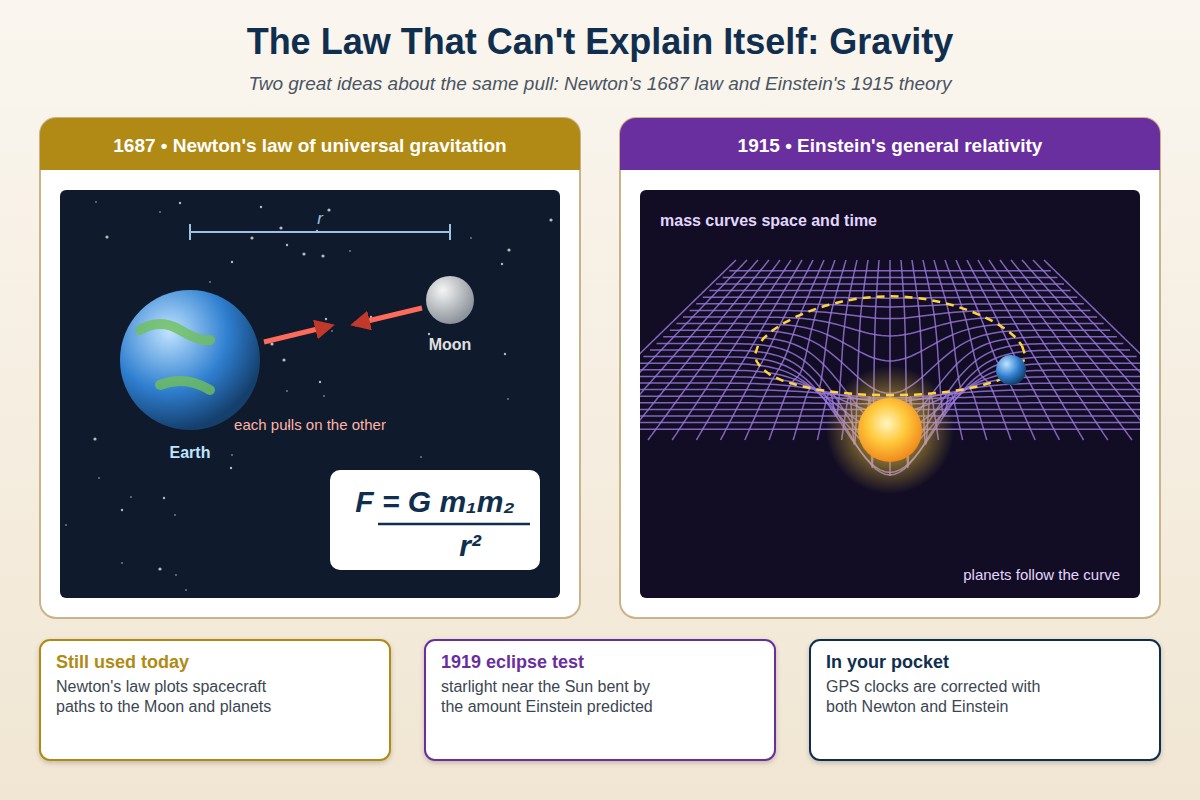
The Law That Can't Explain Itself: Gravity and the Biggest Myth in Science
Open Reading Passage → Regents Practice Version →Check Your Understanding
5 quick questions — pick an answer to see if you’re right.
1. What is gravity?
2. In F = Gm₁m₂/r², what does r represent?
3. If the distance between two objects is tripled, the gravitational force between them becomes…
4. Two masses attract with a force of 100 N. If one mass is doubled and the other is tripled (same distance), what is the new force?
5. The gravitational force on satellite A is 160,000 N. Identical satellite B orbits at twice the distance from Earth's center. What force acts on B?
Floating on the Space Station
The International Space Station (ISS) orbits about 400 km above Earth’s surface, or about 6.8 × 10⁶ m from Earth’s center. Earth’s radius is about 6.4 × 10⁶ m. Astronauts aboard the ISS appear to float.
Which statement best explains why astronauts float aboard the ISS?
▶ Want a challenge? Open 6 more Regents-style questions (harder · mixed formats)
Challenge score: 0 / 6
C1. How does the gravitational force Earth exerts on the Moon compare with the force the Moon exerts on Earth?
C2. Using g = 9.8 m/s² at Earth’s surface, substitute numerical values into a mathematical representation that can be used to determine the gravitational field strength at the ISS. Then calculate it.
C3. Gravity at the ISS is about 8.7 m/s². Determine the magnitude of the gravitational force on a 70.-kg astronaut aboard the ISS.
C4. A student makes the following claim.
Place a check mark in either the Support or Refute box. Justify your response using a mathematical relationship.
C5. Which graph best represents the gravitational force between two objects versus the distance between their centers?
C6. Gravity at the ISS is about 89% as strong as at Earth’s surface, yet astronauts float. Identify the evidence that gravity still acts on the ISS, and explain why astronauts nevertheless feel weightless.