Increasing Magnetic Field Strength
How turns, current, and core material change a solenoid's magnetic field
|
Strength of a magnetic field
1) Increasing or decreasing the number of turns? (of wire)
Increasing
2) Increasing or decreasing current?
Increasing
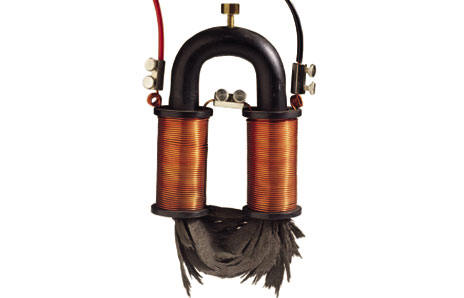
3) inserting a highly permeable core (increases flux density)
high permeable cores
- Nickel, Iron, Cobalt,
These materials tighten existing flux lines, do not increase # of flux lines
Drag each metal to the magnet
Identify the low permeable materials 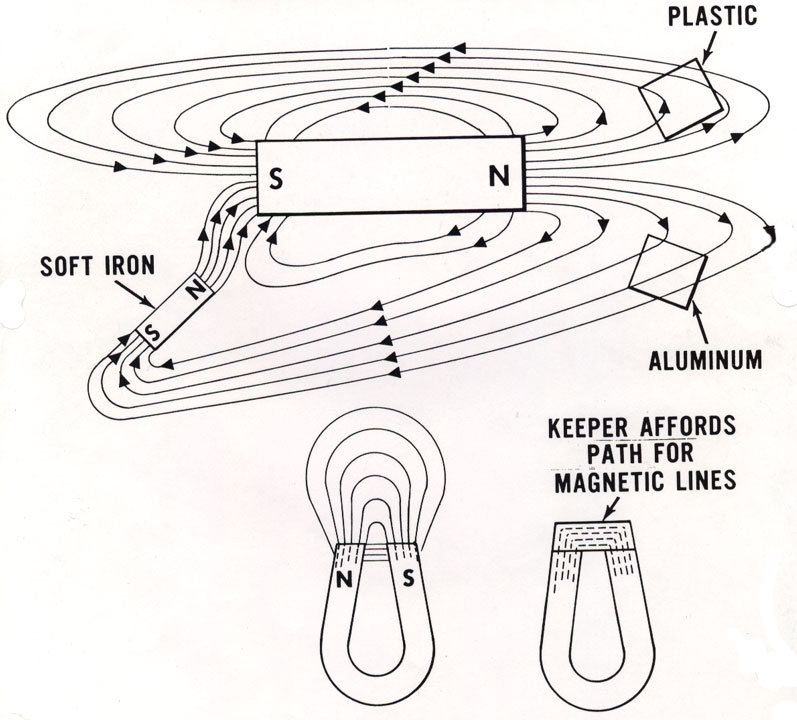
low permeable cores
- air (Pulling out the core)
Review
- Is the North Pole
|
|

Check Your Understanding
5 quick questions — pick an answer to see if you’re right.
1. Which change would INCREASE the magnetic field strength of a solenoid?
2. Which group of metals makes good highly permeable cores for electromagnets?
3. How does an iron core make a solenoid's field stronger?
4. A student pulls the iron core out of an electromagnet, leaving only air inside. The magnetic field:
5. A crane electromagnet can't lift a heavy load of scrap iron. Which fix would help?
Building a Stronger Electromagnet
Students wrapped insulated wire around an iron nail and connected it to a power supply. They counted how many paper clips the electromagnet could lift under different conditions.
Table 1: Electromagnet Trials
| Trial | Turns of Wire | Current (A) | Core | Paper Clips Lifted |
|---|---|---|---|---|
| 1 | 20 | 1.0 | Iron | 6 |
| 2 | 40 | 1.0 | Iron | 12 |
| 3 | 20 | 2.0 | Iron | 12 |
| 4 | 20 | 1.0 | None (air) | 1 |
Which conclusion is supported by the data?
▶ Want a challenge? Open 6 more Regents-style questions (harder · mixed formats)
Challenge score: 0 / 6
C1. Which two trials should be compared to test the effect of current?
C2. Assume the number of paper clips lifted is directly proportional to both the number of turns and the current, as shown by Trials 1–3. Predict the number of paper clips the iron-core electromagnet could lift with 60 turns and a current of 1.5 A.
C3. A student makes the following claim.
Place a check mark in either the Support or Refute box. Justify your response using evidence from Table 1.
C4. When comparing Trials 1 and 4 to test the effect of the core, place a check mark in two boxes to indicate the variables that were correctly held constant.
C5. What is one advantage of an electromagnet over a permanent magnet in a scrap-yard crane?
C6. A scrap-yard engineer wants the crane’s electromagnet to lift heavier loads by greatly increasing the current. Using evidence from Table 1, identify one benefit and one drawback of this design change.