Coulomb’s Law
How charge and separation determine the electric force between particles
|
Coulombs Law
Show Me The Physics Did you know lightning Lightning
captured
| Onsite Version |
Coulombs Law Notes
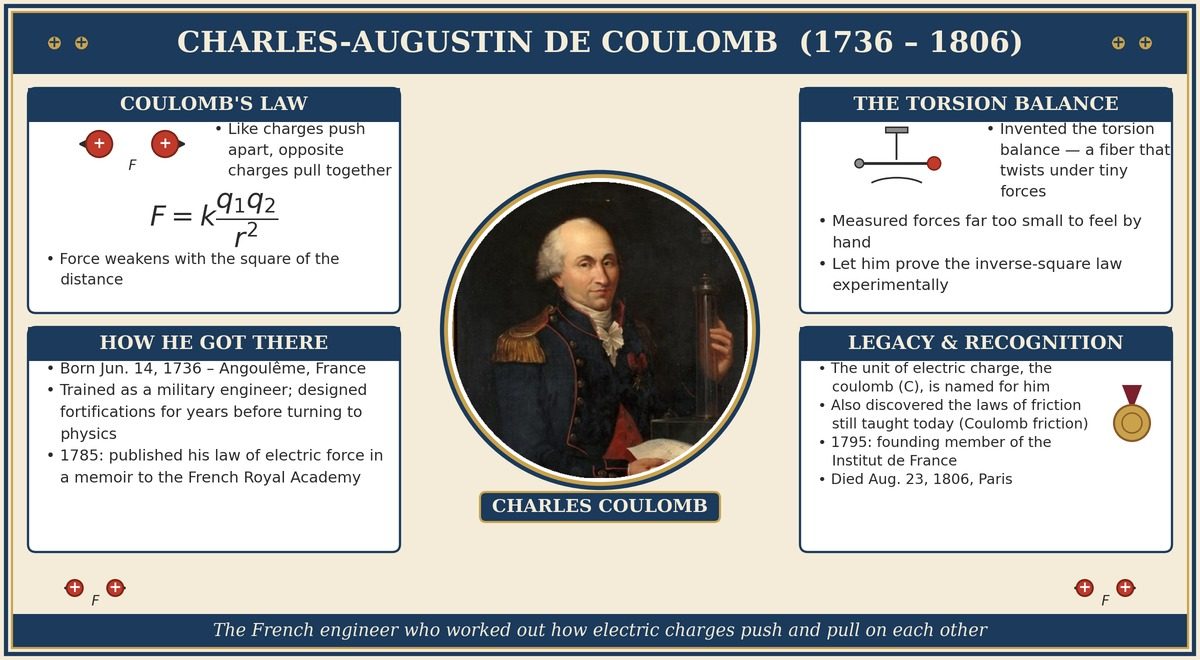
Meet Charles-Augustin de Coulomb — the physicist behind this law
F) Coulomb's Law for two fixed point charges
r = distance between charges
F - mutual force of attraction
or repulsion q - charge of each object k - electrostatic constant - 8.99 x 10⁹
Nm2/C2
AP Physics
AP Physics Giancoli p. 465) 12 12.
Ex) What is the electrical force between 2 very small objects located .50 m apart when the charge on one object is 4.0 x 10⁻⁸ C and the charge on the second object is 6.0 x 10⁻⁵ C
Ex) What is the electrical force between 2 very small objects located .50 m apart when the charge on one object is 4.0 x 10⁻⁸ C and the charge on the second object is 6.0 x 10⁻⁵ C
r = .50 meters q1 = 4.0 x 10⁻⁸ C q2 = 6.0 x 10⁻⁵ C k = 8.99 x 10⁹ Nm2/C2
F = 8.6 x 10⁻² Newtons
Relationships
F,r
Inverse Square
Relationship between F and r?
How would doubling the distance between the charges change the force between them?
F would be 1/4 as great
F,q?
Direct
Two charges attract each other with a force of F. If one charged was doubled and the other charge was tripled, how would that change the attractive force between these charges?
Force increases 6 times
Charged
Water Drop
|
||||||||||||||||||||||||||||||||||||||||




Check Your Understanding
5 quick questions — pick an answer to see if you’re right.
1. A +5 C charge exerts a 12 N force on a +25 C charge. What force does the +25 C charge exert on the +5 C charge?
2. Two point charges are moved twice as far apart. What happens to the electric force between them?
3. Two charges attract with force F. One charge is doubled and the other is tripled. What is the new force?
4. Two charges of 1.0 × 10⁻⁵ C each are 0.50 m apart. What is the force between them? (k = 8.99 × 10⁹ N·m²/C²)
5. Two negative point charges are placed near each other. The electric force between them is
Repelling Balloons
Two balloons, each with a charge of −2.0 × 10⁻⁷ C, hang 0.30 m apart (center to center). Use k = 8.99 × 10⁹ N·m²/C².
What is the magnitude of the electrostatic force between the balloons?
▶ Want a challenge? Open 6 more Regents-style questions (harder · mixed formats)
Challenge score: 0 / 6
C1. The balloons are moved to 0.60 m apart. What is the new force?
C2. A student makes the following claim.
Place a check mark in either the Support or Refute box. Justify your response using a mathematical relationship.
C3. The balloons are moved closer, to 0.20 m apart (center to center). Substitute numerical values into a mathematical representation that can be used to determine the magnitude of the electrostatic force between them. Then calculate the force.
C4. Balloon B hangs to the right of balloon A, 0.30 m away. Balloon B is replaced by a balloon with a charge of +3.0 × 10⁻⁷ C; balloon A still has −2.0 × 10⁻⁷ C. Choose the direction of the electrostatic force that A exerts on the new balloon B, and determine its magnitude.
●
C5. One balloon has twice the charge of the other. How do the forces they exert on each other compare?
C6. Students want to use charged balloons and a sensitive force sensor to test whether the electrostatic force follows an inverse-square relationship with distance. Describe a procedure, identifying the independent variable, the dependent variable, and one variable that must be kept constant. Then describe the data pattern that would support the inverse-square law.