Energy
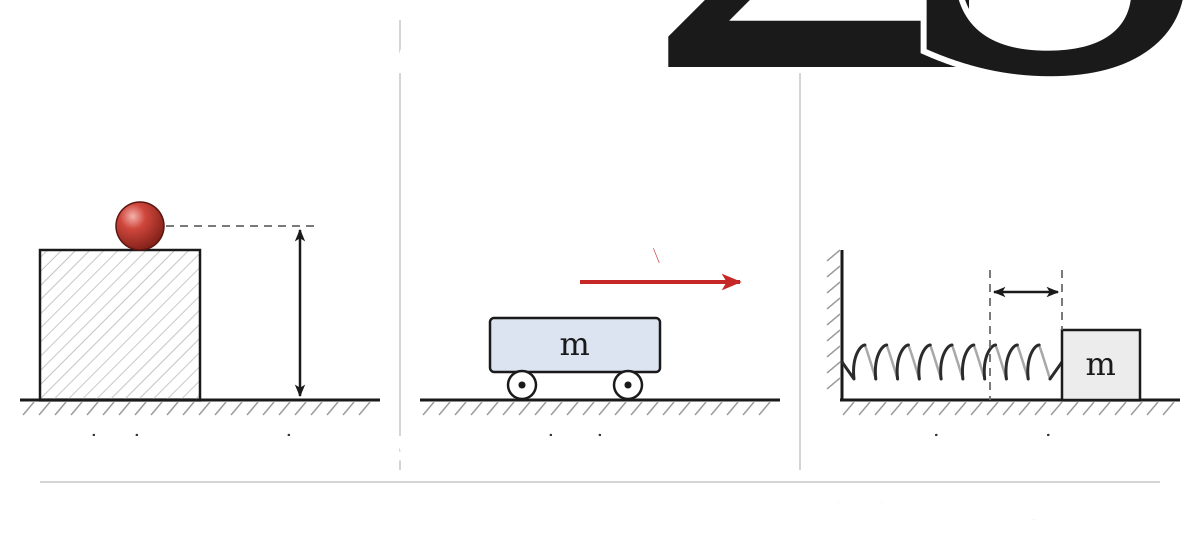
Capacity to do work — introduction to work and energy

“If a man will begin with certainties, he shall end in doubts; but if he will be content to begin with doubts, he shall end in certainties.”
— Francis Bacon, The Advancement of Learning
What happens to the speed of the particles in the balloon when it enters the liquid nitrogen?
Flowers in Liquid Nitrogen
Light can be converted to heat energy which can apply a force and make something move.
Radiometer
Gasoline is a form of energy because it can do work.
Car Engine — by Don Ion
Levers give you a ‘mechanical advantage’
[ Flash ]

Work always involves some tradeoff. Name 2 ways 1st gear is different than 10th gear.
1st gear requires a small force and a lot of pedaling,
while 10th gear requires little pedaling but a larger force.
I) Work
when a F acts to the motion of an object .
Work is positive when the force acts in the same direction as the object’s motion…
(When the weight is lifted up)

…and negative if the force acts opposite to the direction of the object’s motion.
(When the weight is brought down)

A) Equation
Fm – force acting the motion
d – displacement (N·m) = (N)(m)
Other units for work () or
Challenge Question
Two people exert a 10. Newton force on a block for 2.0 meters. One person exerts her force at a 50-degree angle. If the surface is frictionless… Did both people do the same work???
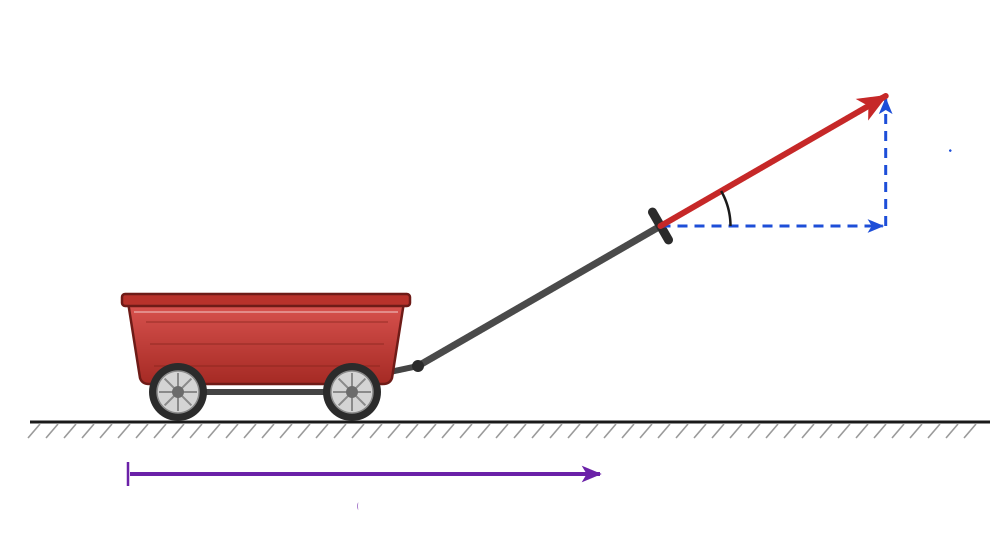
Try It: Pulling a Wagon
A student pulls a wagon with a 50. N force at 30° above the horizontal for 30. meters. How much work is done on the wagon?
B) Work and F vs. displacement diagram
under a Force vs. displacement plot is equal to
Check Your Understanding
5 quick questions — pick an answer to see if you’re right.
1. Which statement best defines energy?
2. A student pushes a box with a 20. N force parallel to the floor for 3.0 m. How much work does she do?
3. Which unit is equivalent to a joule, the unit of work and energy?
4. A weightlifter slowly lowers a barbell to the floor. The work done by the lifter on the barbell is
5. Compared with 10th gear, riding a bike in 1st gear requires
Designing a Wheelchair Ramp
A school is adding a wheelchair ramp to an entrance 0.75 m above the sidewalk. A person and wheelchair have a combined weight of 880 N. Building codes call for a ramp at least 9.0 m long. Assume the ramp is frictionless.
Which statement correctly compares pushing the wheelchair up the 9.0-m ramp with lifting it straight up 0.75 m?
▶ Want a challenge? Open 6 more Regents-style questions (harder · mixed formats)
Challenge score: 0 / 6
C1. Substitute numerical values into a mathematical representation that can be used to determine the force that must be applied parallel to the 9.0-m frictionless ramp to push the wheelchair up at constant speed. Then calculate the force.
C2. A real ramp has friction. How does this change the work the person must do?
C3. A student makes the following claim.
Place a check mark in either the Support or Refute box. Justify your response using a mathematical relationship.
C4. Place a check mark in three boxes to indicate the situations in which a person does positive work on an object.
C5. A lever is used to lift a heavy rock. Compared with lifting the rock directly, which is true for an ideal lever?
C6. The architect considers making the ramp 12 m long instead of the 9.0-m minimum. Identify one benefit and one drawback of this design change.