Object Propelled Horizontally
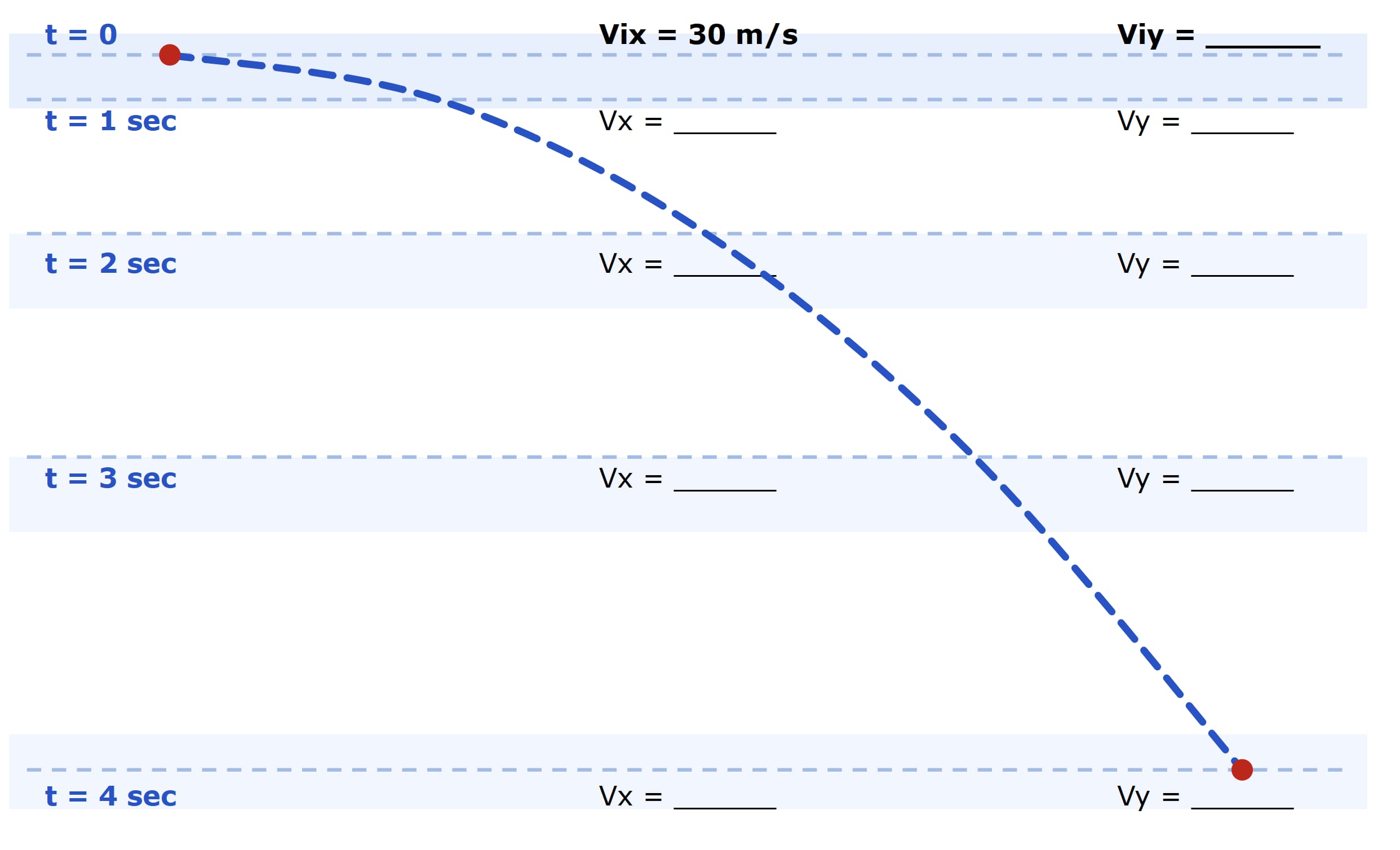
Horizontal Launches — Constant Vx, Accelerating Vy

Objects launched horizontally undergo projectile motion: a constant horizontal velocity and an accelerating vertical velocity, acting completely independently of each other.
A 10 kg object is dropped from the same height as a 20 kg object. Compare the time they take to hit the ground.
Object Thrown Horizontally
[ Flash ]
How many velocities?
[ Flash ]
2 velocities
Horizontal velocity — Determined by thrower
Vertical velocity — ??????
…acceleration due to gravity
b. Objects Propelled Horizontally

- have 2 velocities Vx, Vy
- Vx is determined by thrower
- Vx constant (neglect friction)
- Viy = 0 (initial vert. vel.)
- Vy changed by … force of gravity
Ex) Object Thrown Horizontally at 4 m/s
| time (sec) | Vx (m/s) | Vy (m/s) |
|---|---|---|
| 0 | 4 | 0 |
| 1 | 4 | 10 |
| 2 | 4 | 20 |
| 3 | 4 | 30 |
Object Dropped / Object Thrown Horizontally

Same:
a) ay (+10 m/s2)
b) vertical drop — dy
c) time in air
d) same Vy
Compare each sphere's:
A) height above the ground
B) time in the air
| Flash |
Show Me The Physics Website
Compare the time it takes for the marbles to hit the ground.

Ex 1a
A rock is thrown horizontally from the top of a cliff @ 150 m/s.
a) How long does it take the rock to fall 45 m vertically?
| Horizontal | Vertical |
|---|---|
| Vx = 150 m/s | Viy = 0 (thrown horizontally) |
| t = ? | ay = +9.8 m/s2 |
| dy = 45 m | |
| t = ? |

Ex 1b
Same rock, thrown horizontally from the top of a cliff @ 150 m/s.
b) Find the rock's vertical velocity at 45 meters.
| Horizontal Info | Vertical Info |
|---|---|
| Vx = 150 m/s | Viy = 0 (thrown horizontally) |
| ay = +9.8 m/s2 | |
| dy = 45 m | |
| Vfy = ? |

Only X Equation
** dx = Vxt ** (from Vx = dx/t)


dx - Horizontal distance
Vx - horizontal velocity
Ex 1c
Same rock, thrown horizontally from the top of a cliff @ 150 m/s.
c) What was the rock's horizontal displacement (dx, a.k.a. Range) after 3.0 seconds?
| Horizontal | Vertical |
|---|---|
| Vx = 150 m/s | Viy = 0 (thrown horizontally) |
| t = 3.0 sec | ay = 9.8 m/s2 |
| dx = ? | dy = 45 m |
| t = 3.0 sec |
Check Your Understanding
5 quick questions — pick an answer to see if you’re right.
1. Ignoring air friction, what happens to the horizontal velocity of an object thrown horizontally?
2. From the same height, a 10 kg ball is dropped while a 20 kg ball is thrown horizontally. Ignoring air, which lands first?
3. A rock is thrown horizontally off a cliff. How long does it take to fall 19.6 m? (g = 9.8 m/s²)
4. A ball thrown horizontally at 15 m/s hits the ground 2.0 s later. How far from the base does it land?
5. An object launched horizontally has fallen 4.9 m. What is its vertical velocity then? (g = 9.8 m/s²)
A Ball Rolls Off a Lab Table
Students roll a steel ball off the edge of a lab table that is 1.2 m high. The ball leaves the table horizontally at 3.0 m/s. They want to predict where to place a cup on the floor to catch it. Air resistance is negligible.
About how far from the base of the table should the cup be placed?
▶ Want a challenge? Open 6 more Regents-style questions (harder · mixed formats)
Challenge score: 0 / 6
C1. Substitute numerical values into a mathematical representation that can be used to determine the time the ball is in the air. Then calculate the time.
C2. A second ball is simply dropped from the table edge at the same instant the first ball rolls off. Which statement is correct?
C3. A student makes the following claim.
Place a check mark in either the Support or Refute box. Justify your response using a mathematical relationship.
C4. Determine the ball’s total speed just before it lands in the cup.
C5. Which graph best represents the ball’s horizontal distance from the table versus time while it is in the air?
C6. Before placing the cup, the students must know the ball’s launch speed. Describe a procedure they could use to measure the ball’s speed as it rolls across the table top, and explain how they would then use it to predict the cup’s position.
