Light & Technology Review
Everything in one place, plus mixed practice
The Big Ideas
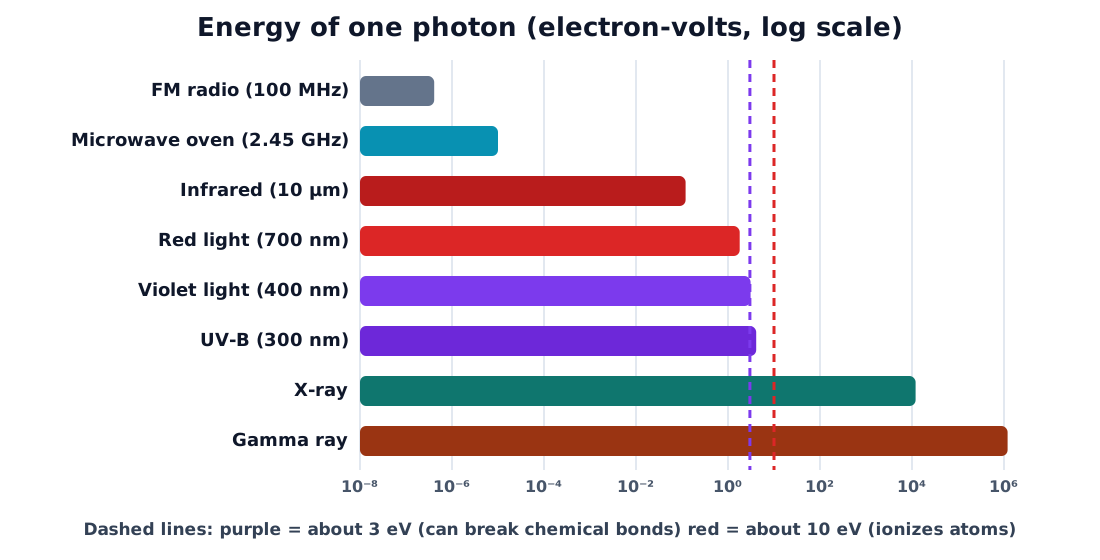
E = hf: photon energy depends only on frequency.
Brightness = number of photons. Frequency = energy per photon.
Ionizing (high UV, X-ray, gamma): can knock out electrons and damage DNA.
Non-ionizing (radio, microwave, infrared, visible): mainly heats or triggers gentle chemical changes.
Evaluate claims by source, evidence, physics (frequency), dose, and agreement.
Digital = samples stored as bits. Perfect copies, easy sharing — but easy to delete, hack, or steal.
Explore
Slide from radio waves to gamma rays and watch the energy of one photon change.
Change the samples and bits, then add noise and make copies.
Mixed Practice
Find the energy, in joules, of a photon with a frequency of 1.5 × 10¹⁵ Hz. Is it ionizing?
E = (6.63 × 10⁻³⁴)(1.5 × 10¹⁵) = 9.9 × 10⁻¹⁹ J ≈ 6.2 eV. This ultraviolet photon can break bonds in DNA but is below the ~10 eV needed to ionize most atoms.
Why can’t a very bright infrared heat lamp cause the same DNA damage as UV light?
Each infrared photon has far too little energy to break DNA bonds. More photons only means more heating, not more energy per photon.
A website selling an “anti-radiation pendant” says it protects you from Wi-Fi. Name two reasons to doubt the claim.
The seller profits (bias), and Wi-Fi photons are non-ionizing with no proven harm at normal levels; there’s no independent evidence the pendant does anything.
How many levels can 5 bits represent? Why does adding bits improve sound quality?
25 = 32 levels. More levels means each sample can be stored closer to its true value.
Give one advantage and one disadvantage of streaming music instead of buying CDs.
Advantage: instant access to huge libraries, nothing to scratch. Disadvantage: needs internet, songs can be removed, and your listening data can be collected.
Check Your Understanding
6 quick questions — pick an answer to see if you’re right.
1. Which change increases the energy of each photon?
2. Which radiation is non-ionizing?
3. A claim about radiation is most trustworthy when it
4. How many levels can 8 bits store?
5. Which is a disadvantage of digital information?
6. Why do digital signals resist noise better than analog signals?