Dispersion
How refraction separates white light into its component colors
| |






Check Your Understanding
5 quick questions — pick an answer to see if you’re right.
1. What is dispersion?
2. White light passes through a glass prism. Which color is bent the most?
3. Inside a glass prism, which color of light travels fastest?
4. A dispersive medium is one in which wave speed depends on frequency. Which of these is NOT dispersive for light?
5. A student says a prism adds colors to white light. What did Newton actually show?
Splitting White Light With a Prism
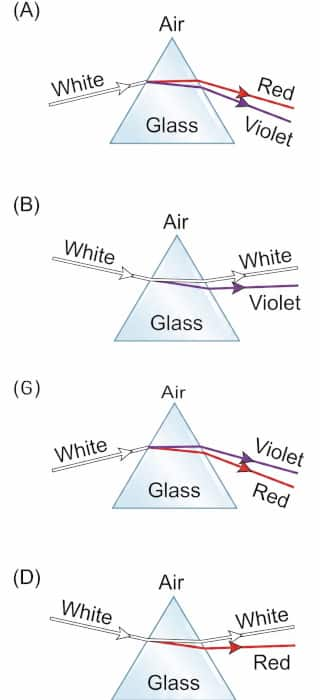
White light enters a glass prism. In this glass, the index of refraction is 1.51 for red light and 1.53 for violet light.
Which color is bent (refracted) the most, and why?
▶ Want a challenge? Open 6 more Regents-style questions (harder · mixed formats)
Challenge score: 0 / 6
C1. Which color travels fastest in the glass?
C2. Substitute numerical values into a mathematical representation that can be used to determine the speed of red light in this glass. Then calculate the speed.
C3. A student makes the following claim.
Place a check mark in either the Support or Refute box. Justify your response.
C4. Red light has a wavelength of 700. nm in air. Determine its wavelength inside this glass, in nanometers.
C5. Would a prism-shaped region of vacuum disperse white light?
C6. A simple glass camera lens produces colored fringes around objects because different colors focus at different distances. Explain how dispersion causes this, and identify one benefit and one drawback of fixing it by combining two lenses made of different types of glass.