The Expanding Universe
Redshift, Hubble’s discovery, and stretching space

Do Now: An ambulance siren sounds lower in pitch as it drives away from you. What do you think happens to light from a galaxy that is moving away?
Its waves are stretched to longer wavelengths, which shifts the light toward the red end of the spectrum. This is called redshift.
A. Spectral Fingerprints
Every element absorbs and gives off light at its own specific wavelengths. The pattern of dark lines in a spectrum is like a fingerprint.
Hydrogen always shows lines at 410, 434, 486, and 656 nm in a lab.
B. Galaxies Are Redshifted
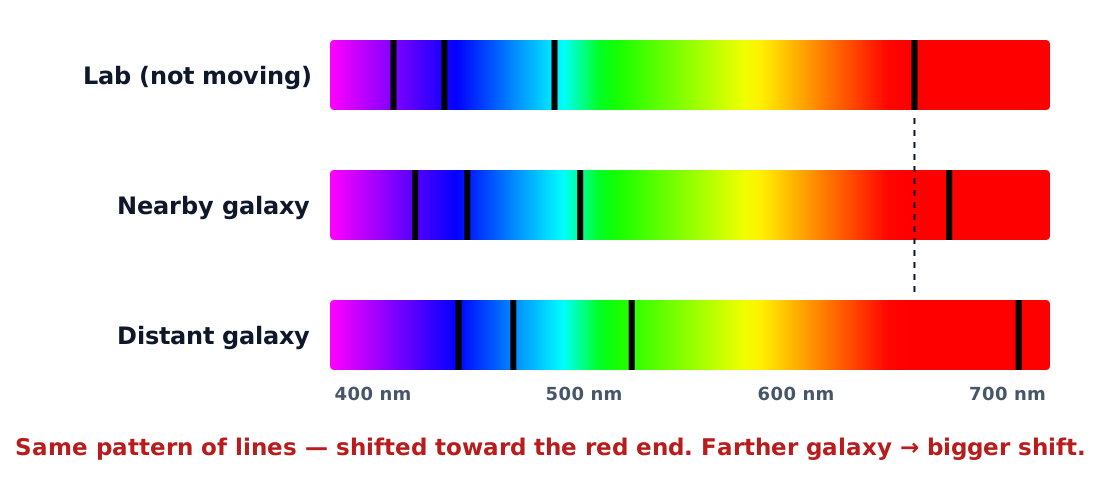
Redshift
Lines shift to longer wavelengths.
The source is moving away.
Blueshift
Lines shift to shorter wavelengths.
The source is moving toward us.
A few nearby galaxies, like Andromeda, are blueshifted — gravity is pulling Andromeda toward the Milky Way. But almost all distant galaxies are redshifted.
C. Hubble’s Discovery
In 1929, Edwin Hubble compared the distances of galaxies with how fast they were moving away (measured from their redshifts). He found a simple pattern:
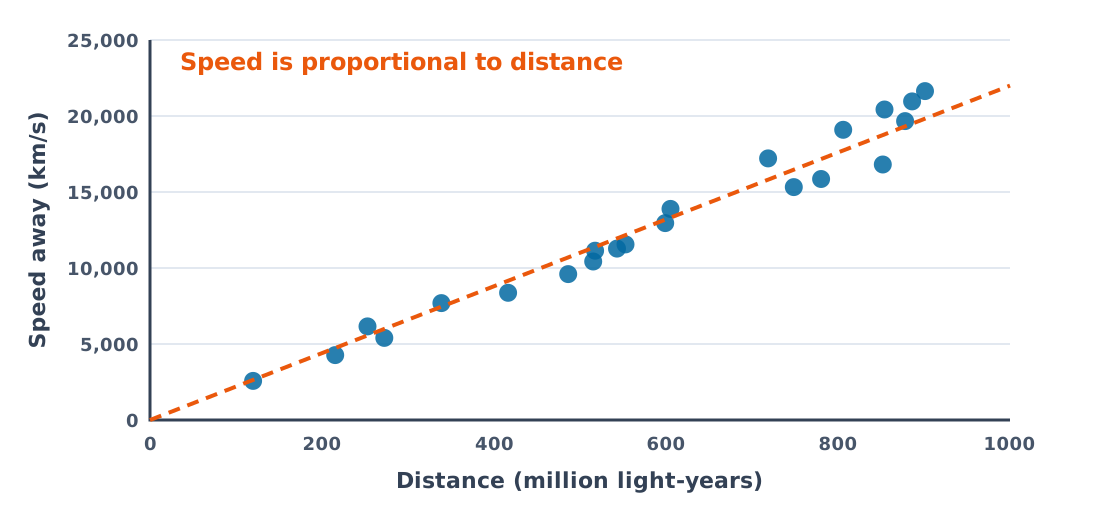
Today’s measurements give about 22 km/s for every million light-years of distance (about 70 km/s per megaparsec).
D. Space Itself Is Stretching
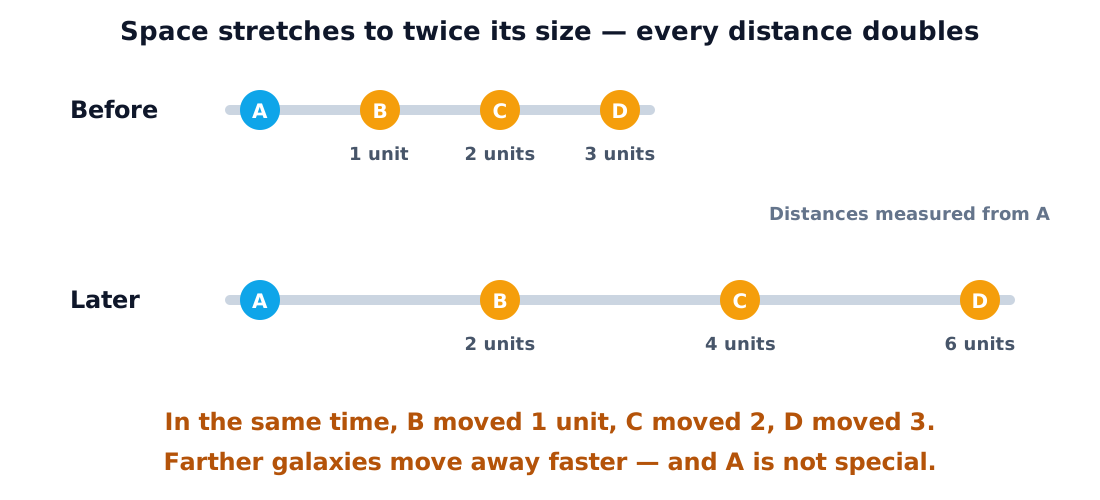
Raisin bread model: as the dough rises, every raisin moves away from every other raisin. Raisins that are farther apart separate faster.
No center: every galaxy sees all the others moving away. Our view is not special.
Run the movie backward: if everything is moving apart now, everything was once packed together in a hot, dense state — about 13.8 billion years ago.
The Big Bang was not an explosion into empty space — space itself expanded. And galaxies themselves are not growing: gravity holds each galaxy together while the space between galaxies stretches.
Explore: The Expanding Universe
Press Expand. Click any galaxy to make it the target and see its spectrum.
1. Click a nearby galaxy, then a far one. Which has the bigger redshift?
2. Look at the Hubble graph. What shape do the points make?
3. Click “Make the target my home.” Are you now at the center?
1. The far galaxy has the bigger redshift. 2. A straight line through the origin — speed is proportional to distance. 3. From the new home, every galaxy still moves away and the graph is still a straight line. There is no special center.
E. Going Further: How Fast?
(for speeds much less than the speed of light)
Hydrogen’s 656-nm line arrives from a galaxy at 663 nm. How fast is the galaxy moving away?
Δλ = 663 − 656 = 7 nm → v = 7656(3.00 × 10⁸ m/s) ≈ 3.2 × 10⁶ m/s (about 3,200 km/s)
Check Your Understanding
5 quick questions — pick an answer to see if you’re right.
1. The dark lines in a distant galaxy’s spectrum are shifted toward longer wavelengths. This shows the galaxy is
2. Hubble discovered that galaxies that are farther away
3. Galaxy X is twice as far from us as galaxy Y. Compared with galaxy Y, galaxy X is moving away about
4. Why does every galaxy see the others moving away from it?
5. If galaxies are moving apart today, then in the distant past they were