Design Challenge
Design, test, and refine an egg-drop device

The Challenge: Design a device that protects a raw egg dropped from 2.0 meters. Use physics to make the egg’s stop take as long as possible.
A. The Design Cycle
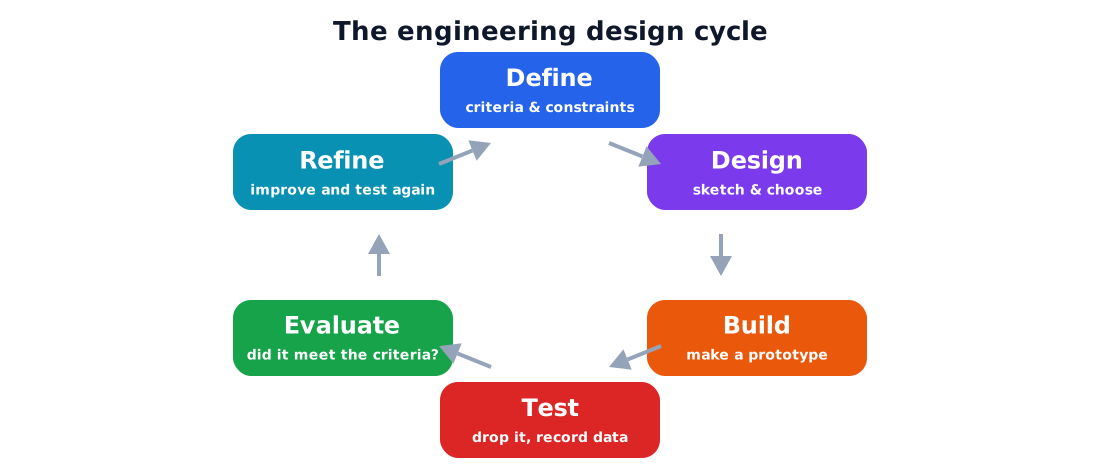
B. Define the Problem
Criteria (what it must do)
The egg survives a 2.0-m drop with no cracks
The device lands within 1 m of the target
Bonus: lightest successful device
Constraints (limits)
Materials: 10 straws, 1 m of tape, 2 sheets of paper, 4 rubber bands
Total mass under 100 g (not counting the egg)
30 minutes to build
C. Use the Physics
A 60-g egg dropped 2.0 m hits the ground at about 6.3 m/s. What is its change in momentum when it stops? If your device stops it in 0.050 s, what is the average force?
Δp = (0.060 kg)(6.3 m/s) ≈ 0.38 kg•m/s
F = 0.38 N•s0.050 s ≈ 7.6 N
Compare: stopping on the floor in about 0.002 s would be about 190 N.
Increase stopping time: crushable straws, springy rubber bands, folded paper.
Lower landing speed: a paper parachute or fins add air resistance, so there’s less momentum to lose.
Spread the force: cradle the egg so no single point takes the hit.
Keep it upright: a device that tumbles may land on its weakest side.
D. Test and Record
| Trial | Design Change | Device Mass (g) | Egg Result | What We Learned |
|---|---|---|---|---|
| 1 | ||||
| 2 | ||||
| 3 |
E. Evaluate and Refine
Your egg cracked. Name two changes that would increase the stopping time.
Add more crushable material (straws or folded paper) below the egg; suspend the egg with rubber bands so it can move and slow gradually.
Two designs both protect the egg. One weighs 40 g and one weighs 90 g. Which is the better design, and why?
The 40-g design — it meets the criteria while using fewer materials. Engineers look for designs that meet the criteria within the constraints at the lowest cost.
How is your design like a real car safety system?
Crushable straws act like a crumple zone; the rubber-band cradle acts like a seat belt; a paper cushion acts like an airbag. All increase stopping time to reduce the force.
Check Your Understanding
5 quick questions — pick an answer to see if you’re right.
1. In engineering, a constraint is
2. Which change would best reduce the force on the egg?
3. A parachute protects the egg mainly by
4. After a failed test, engineers should
5. A 0.060-kg egg moving at 5.0 m/s stops in 0.030 s. The average force is
Egg-Drop Lander Competition
Teams must design a lander that protects a raw egg dropped from 4.0 m. Criteria: the egg must survive, and the lander should be as light as possible. Constraints: total mass under 150 g, a budget of 20 straws and 1 m of tape, and no parachutes. Three teams tested their designs.
Table 1: Lander Test Results
| Team | Design | Mass (g) | Stop Time (s) | Egg Survived? |
|---|---|---|---|---|
| 1 | Straw cage | 90 | 0.008 | No |
| 2 | Straw cage + crumple cone | 120 | 0.030 | Yes |
| 3 | Bubble-wrap box | 170 | 0.045 | Yes |
Which team’s design best meets the criteria and constraints?
▶ Want a challenge? Open 6 more Regents-style questions (harder · mixed formats)
Challenge score: 0 / 6
C1. Team 1 wants to improve its design for the next round. Which revision is the best next step in the design cycle?
C2. Substitute numerical values into a mathematical representation that can be used to determine the speed of a lander when it hits the ground after falling 4.0 m from rest (neglect air resistance). Then calculate the speed.
C3. A team member makes the following claim.
Place a check mark in either the Support or Refute box. Justify your response using a mathematical relationship.
C4. A 0.060-kg egg reaches the ground at 8.9 m/s inside Team 3’s lander. Determine the magnitude of the average force that stops the egg, using Team 3’s stop time.
C5. Why should each team run several trials of its final design?
C6. Team 2 wants to make its lander lighter for the next round without the egg breaking. Propose one specific design revision, explain how it keeps the egg safe using impulse, and describe how the team should test it.