Safety Devices
Seat belts, airbags, crumple zones, and helmets

Do Now: Old cars were built rigid and strong, and barely dented in crashes. Modern cars crumple. Which is safer for the people inside? Why?
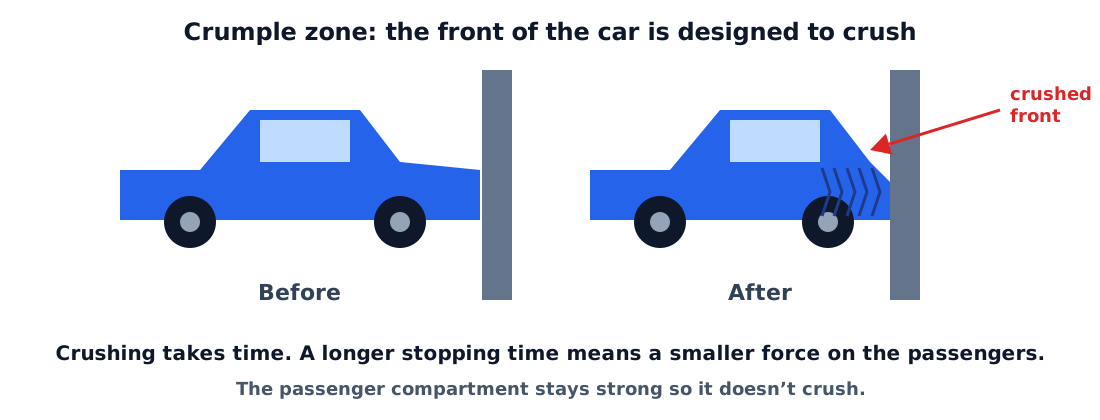
Modern cars. A car that crumples takes longer to stop, so the people inside feel a smaller force. A rigid car stops almost instantly.
A. Crumple Zones
B. Seat Belts and Airbags
Seat belts make you slow down with the car instead of flying forward and stopping suddenly against the dashboard or windshield. The belt stretches a little, adding stopping time, and spreads the force across your strong hips and chest.
Airbags inflate in a few hundredths of a second and then let gas out as you push into them. This adds stopping time and spreads the force over your head and chest.
Airbags work with seat belts, not instead of them. Without a belt, you can hit the airbag too fast or in the wrong position.
C. Helmets
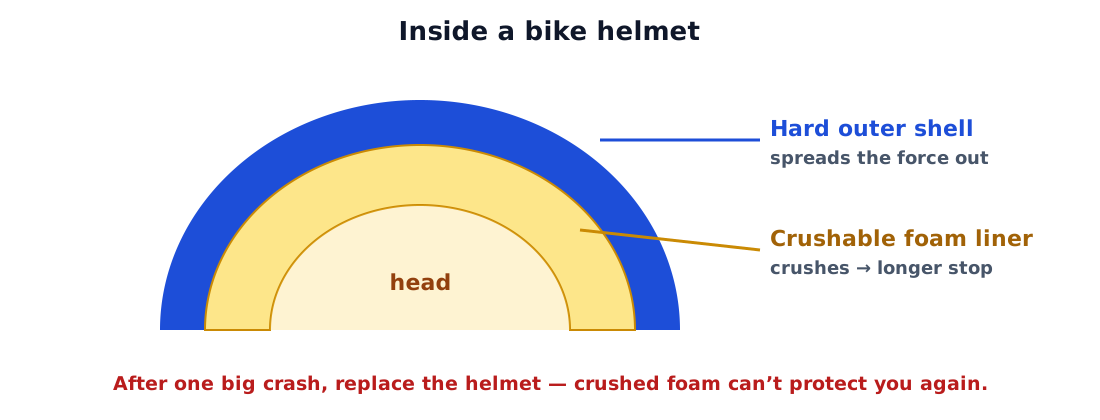
Increase time: the foam crushes, so your head stops over a longer time.
Spread force: the hard shell spreads the force over a larger area of your head.
D. Same Physics Everywhere
| Device | How It Increases Stopping Time |
|---|---|
| Crumple zone | The car’s front crushes gradually |
| Seat belt | Stretches slightly; keeps you slowing with the car |
| Airbag | Cushions and slowly deflates |
| Helmet | Foam liner crushes |
| Football pads | Foam compresses |
| Highway crash barrels | Sand-filled barrels spread a crash over a longer distance |
| Bending your knees | Your legs slow your body over a longer time |
| Parachute | Lowers your landing speed, so there’s less momentum to lose |
Explore: Crash Test Lab
Choose a speed and protection, then press Crash! Compare the force graph with the previous trial.
Find the combination of protection that gives the smallest force at 20 m/s. How many times smaller is it than no seat belt in a rigid car?
Crumple zone + seat belt + airbag gives the longest stopping time (0.18 s) vs 0.010 s with no belt — 18 times smaller force.
Check Your Understanding
5 quick questions — pick an answer to see if you’re right.
1. A crumple zone makes a car safer because it
2. Why should a bike helmet be replaced after a big crash?
3. Airbags reduce injuries by
4. Which does NOT reduce the force by increasing stopping time?
5. A seat belt helps mainly because it
Comparing Bicycle Helmet Liners
Engineers dropped a 5.0-kg head form wearing different bicycle helmets onto a steel anvil. The head form struck the anvil at 6.0 m/s each time and came to rest. Sensors measured the impact time.
Table 1: Helmet Liner Test Data
| Helmet | Liner Material | Impact Time (s) |
|---|---|---|
| W | No liner | 0.0030 |
| X | Thin foam | 0.0060 |
| Y | Thick foam | 0.012 |
| Z | Thick foam + air cells | 0.015 |
Which helmet exerts the smallest average force on the head form, and why?
▶ Want a challenge? Open 6 more Regents-style questions (harder · mixed formats)
Challenge score: 0 / 6
C1. An engineer makes the following claim.
Place a check mark in either the Support or Refute box. Justify your response using data from Table 1 and a mathematical relationship.
C2. A car’s crumple zone is designed to collapse during a collision. How does this protect passengers?
C3. Substitute numerical values into a mathematical representation that can be used to determine the magnitude of the average force on the head form with Helmet Y. Then calculate the force.
C4. Place a check mark in three boxes to indicate design features that would reduce the average force on a rider’s head in a crash at the same speed.
C5. How does the kinetic energy of the head form get transformed when it strikes Helmet Y?
C6. A safety standard requires that the average force on the head form stay below 3000 N in this test. Using data from Table 1, identify which helmets meet the standard, recommend one helmet for production, and state one trade-off that supports your choice.