Friction Relationships
Friction

Two bricks slide across the same table. One brick is 2 kg and the other has a mass of 4 kg. Which experiences a greater amount of friction?
The Power of the New York Times
Show Me The Physics
YouTube Channel
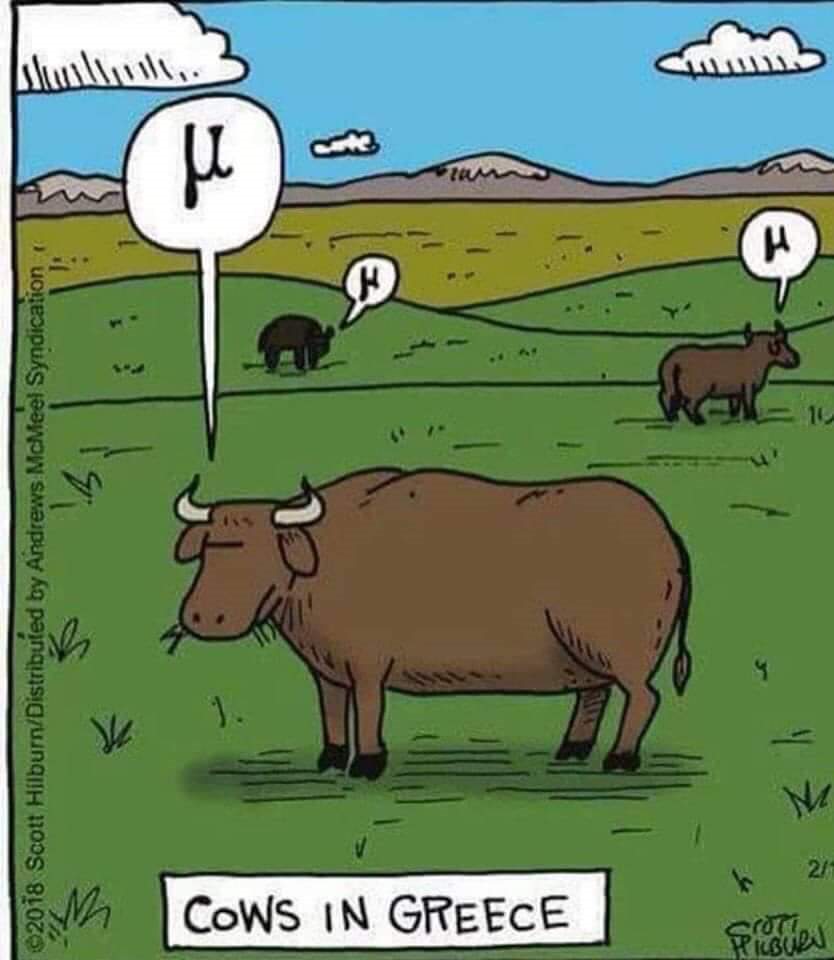
Kinetic Friction or Static?
Name two characteristics of this friction.
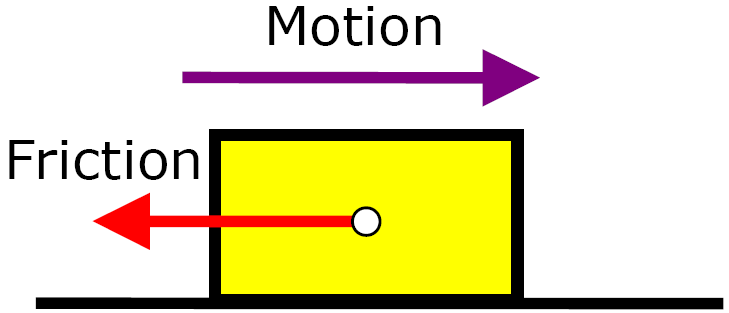

This object below is moving to the right. Describe its velocity.
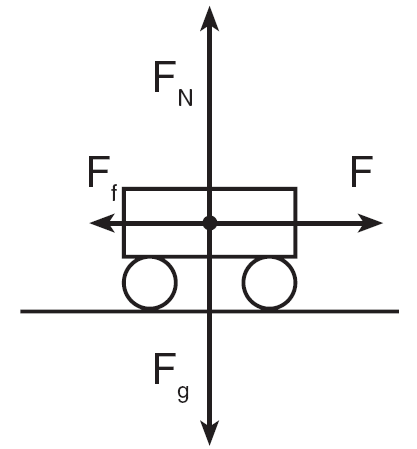
This object is moving. Describe its velocity. Which way is it moving?
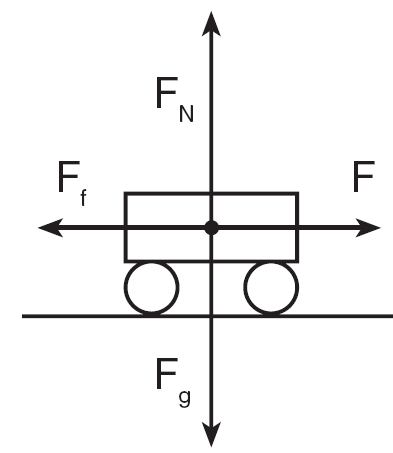
At Constant Velocity

When an object is moving on a horizontal surface, the normal force equals…
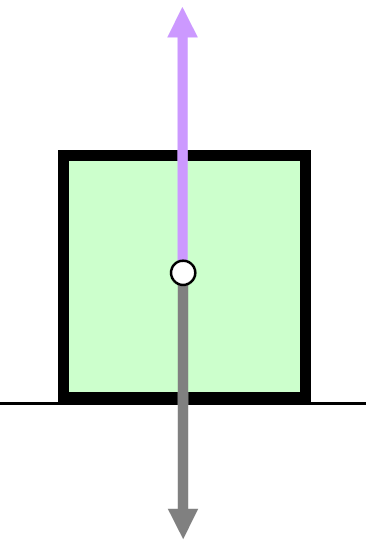
On a Horizontal Surface
Both blocks are being pulled at constant velocity. What is the reading on the force scale on the right?

Hint: fk = mgμk
f = 10 N,
m, g, μk don't change when blocks are stacked!
Ex 1) If an object is moving on a horizontal surface and you doubled the weight force on the object, how would that change the kinetic friction force?
(Hint: weight force = normal force on horizontal surface.)
On a Horizontal Surface
Static Friction equation
Kinetic friction equation
What would happen to the kinetic friction (fk) if:
a) μk (the roughness number) were halved?
b) tripled the weight force (F)?
c) turned the block on its side?
Check Your Understanding
5 quick questions — pick an answer to see if you’re right.
1. A block is pulled across a horizontal table at constant velocity with an applied force of 20 N. What is the friction force?
2. A block slides on a horizontal surface. If its weight is doubled, the kinetic friction force…
3. If the coefficient of kinetic friction μk between a block and a surface is halved, the kinetic friction force…
4. A brick sliding on its wide face is turned onto its narrow side and slid at the same speed. The kinetic friction force…
5. A 2 kg brick and a 4 kg brick slide across the same table. Which experiences more friction?
Testing Sneaker Treads
Students tested a new sneaker sole design. They placed the sneaker on a gym floor, added different masses inside it, and measured the horizontal force needed to drag it at constant velocity. The data are shown in Table 1.
Table 1: Sneaker Drag Test
| Normal Force (N) | 10. | 20. | 30. | 40. |
|---|---|---|---|---|
| Force of Kinetic Friction (N) | 4.0 | 8.0 | 12.0 | 16.0 |
What is the coefficient of kinetic friction between the sneaker and the gym floor?
▶ Want a challenge? Open 6 more Regents-style questions (harder · mixed formats)
Challenge score: 0 / 6
C1. Which graph best represents the force of friction versus the normal force for these data?
C2. Substitute numerical values into a mathematical representation that can be used to predict the force of kinetic friction on the sneaker when the normal force is 35 N. Then calculate the friction force.
C3. A student makes the following claim.
Place a check mark in either the Support or Refute box. Justify your response using a mathematical relationship.
C4. Place a check mark in two boxes to indicate variables the students needed to keep the same in every trial for a fair test of the sole design.
C5. The students notice that it takes more force to start the sneaker sliding than to keep it sliding. What does this show?
C6. The company wants to market the sole for basketball, where players stop and change direction quickly. Identify one benefit and one drawback of designing a sole with a much higher coefficient of friction.