Friction Questions
Practice Problems
Friction Relationships
Rank the friction on the 1.0 kg from greatest to least


Phonebook Friction
- Mythbusters
School Blocks YouTube?
Download the file below.
Friction Problems

*Remember
Fn = Weight = mg
on horizontal surface
Ex) A 5.0 kg Steel block is resting on a *horizontal table*. The coefficient of static friction (us) is 0.75 and the uk is 0.57.
a) What minimum force is needed to start this block moving (fs)?
fs = Fnus = Fgus = mgus
= 5.0 kg(9.8 m/s2)(.75)
b) What is the frictional force on this object as it moves?
fk = mguk
= 5.0 kg(9.8 m/s2)(.57)
c) What force must be applied to the object to keep it moving at constant velocity? (Hint: Fnet = 0)
At Constant velocity

F applied = friction force
Friction Questions
Coefficients of Friction & F = ma
Remember ...
Static Friction fs = UsFn
Kinetic Friction fk = UkFn

On Horizontal Surface
fs = usFg (force to start object moving)
fk = ukW AND W = mg
Example 1
A 1000. N car skids on a wet concrete road. If the road is horizontal, what is the friction force on the car?
w = 1000. N Uk = .58 fk = ?
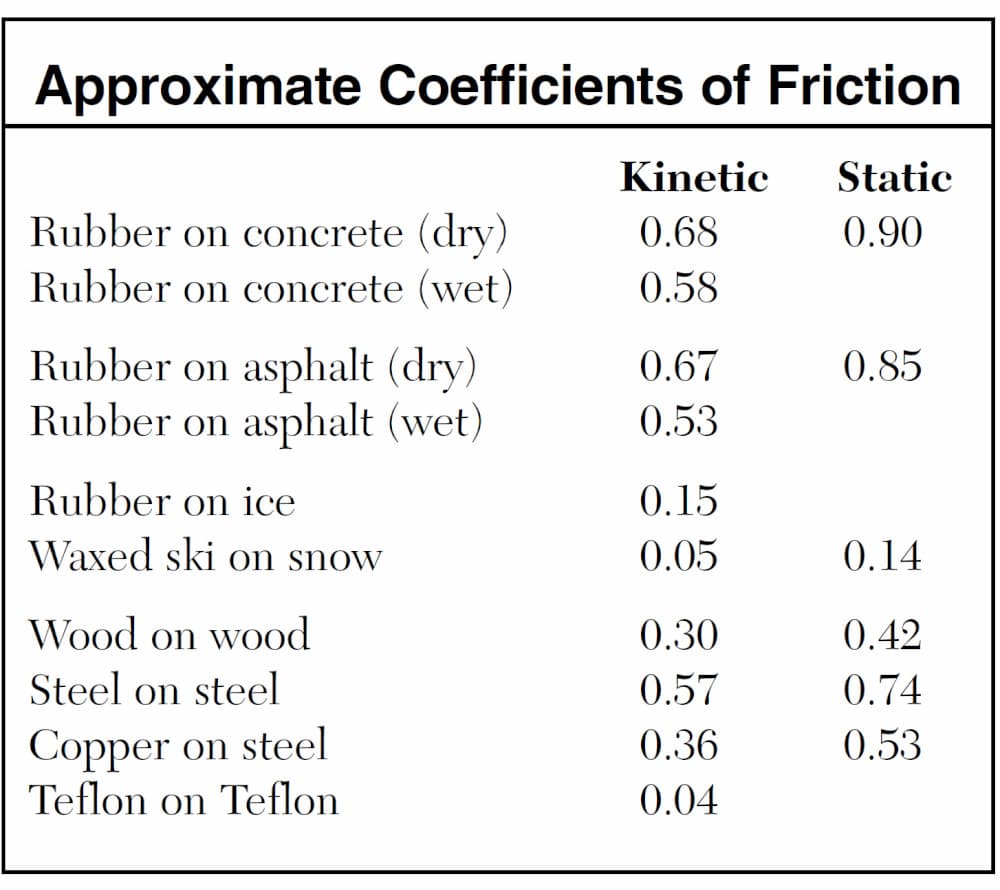
fk = UkFg = .58 x 1000. N
Example 2
A skier is being pulled along a horizontal surface at constant speed with a force of 50. N. What is the weight of the skier?
At constant speed:
fk = Applied Force
fk = 50. N w = ?
uk = .05
fk = ukFg
50. N = .05[Fg]
Example 3
A 10. kg block of wood sliding on a horizontal wooden table is brought to rest. What is the force on the block of wood that caused it to stop?
The force of kinetic friction
stops the block.
fk = ?
Uk = .30
fk = Fnuk = Fguk = mguk
= (10. kg)(9.8 m/s2).30
Example 4
A 53. kg block, slowed by friction, has an acceleration of -0.10 m/s2. What is the force of friction on the block?
m = 53. kg a = -.10 m/s2
fk = F = ma
fk = F = 53. kg(-.10 m/s2)
Example 5
A force of 8.0 N gives a 3.0 kg mass an acceleration of 2.0 m/s2 to the right. What is the friction on the block?
Fapplied = 8.0 N Right m = 3.0 kg a = 2.0 m/s2 Right

Fnet = ma = 3.0 kg(2.0 m/s2)
= 6.0 N
What friction force will produce a net force of 6.0 N?

Extension: Friction on a Ramp
How does the magnitude of the friction force on a box on a ramp change when the angle of the ramp increases?
Review - Which law of motion best explains this?
School Blocks YouTube? Download the file below.
Review
Friction Video
Georgia Pacific Broadcasting
Check Your Understanding
5 quick questions — pick an answer to see if you’re right.
1. A 5.0 kg block rests on a horizontal table with μs = 0.75. What minimum force is needed to start it moving? (g = 9.8 m/s²)
2. The same 5.0 kg block has μk = 0.57. What applied force keeps it moving at constant velocity? (g = 9.8 m/s²)
3. A skier is pulled along level snow at constant speed with a 50. N force. If μk = 0.05, what is the skier's weight?
4. An 8.0 N force gives a 3.0 kg block an acceleration of 2.0 m/s² to the right. What is the friction force?
5. A box slides down a ramp. As the ramp angle is increased, the kinetic friction force on the box…
Moving a Crate in a Warehouse
A worker pushes a 50.-kg wooden crate across a level concrete floor. The coefficient of kinetic friction between the crate and the floor is 0.30.
What is the magnitude of the kinetic friction force on the sliding crate?
▶ Want a challenge? Open 6 more Regents-style questions (harder · mixed formats)
Challenge score: 0 / 6
C1. A student makes the following claim.
Place a check mark in either the Support or Refute box. Justify your response using a mathematical relationship.
C2. The worker turns the crate onto a side with twice the contact area. Assuming the same surfaces, what happens to the friction force?
C3. The worker pushes horizontally with 250 N. Substitute numerical values into a mathematical representation that can be used to determine the crate’s acceleration. Then calculate the acceleration.
C4. The crate is sliding when the worker stops pushing. Determine the magnitude of the crate’s acceleration as friction slows it down.
C5. To make the crate easier to slide, the company is considering several changes. Which change would reduce the friction force the most?
C6. The worker can either push down on the crate at an angle or pull up on a rope attached to it at the same angle, using the same force. Explain which choice results in less friction, using the normal force in your answer.