Ohm's Law
The quantitative relationship among voltage, current, and resistance
|
Teachers - Need to use your overhead?
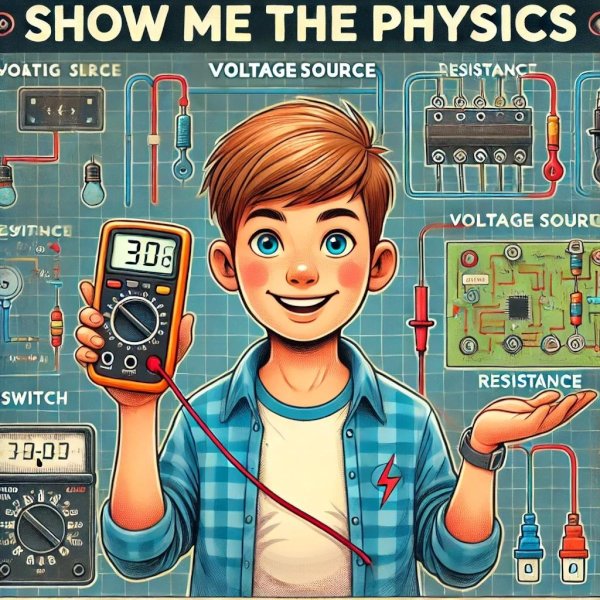
Show Me
The Physics
B) Resistance (Ohms) Symbol - Ω
School blocks flash? Click here - OhmsLawVideoQT.htm Full Size Current Video
Scientific Advisors: Dr. Saul Dushman; Dr. Roman
Smoluchowski; Dr. David Harker
[ HTML5 ]
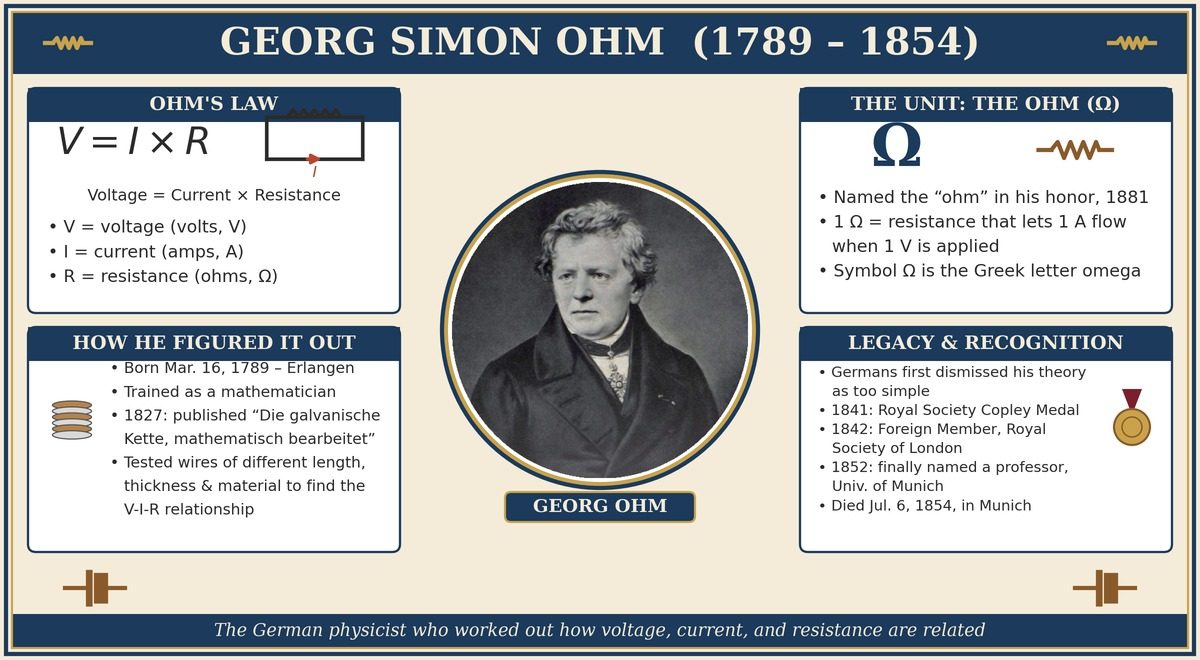
Meet Georg Ohm — the physicist behind the law
Ohm's Law
1) R = V/I (at constant T)
V - Potential difference (voltage) between ends of conductor (volts)
I - current (amperes)
Learning-Connections Clipart
Georg Ohm - (1789 - 1854) - German This image (or other media
file) is in the
public domain
Cross Multiply: V = IR
V directly related to I
Since ....
R = V/I
Slope of V, I plot = ???
Larger Version - Show Me The Physics
Plot of Current and R? R = V/I
Enrichment
Monterey Institute for
(Go to Lesson 3)
|
||||









Check Your Understanding
5 quick questions — pick an answer to see if you’re right.
1. Ohm's Law states that resistance equals:
2. A 12 V battery is connected across a 4.0 Ω resistor. What is the current?
3. A current of 2.0 A flows through a 6.0 Ω resistor. What is the potential difference across it?
4. For a resistor, voltage (V) is plotted on the y-axis and current (I) on the x-axis. The slope equals:
5. The voltage across a resistor at constant temperature is doubled. What happens to the current?
Testing an Unknown Resistor
Students connected an unknown resistor to a variable power supply and measured the current for several potential differences. The data are shown in Table 1.
Table 1: Resistor Test Data
| Potential Difference (V) | 0 | 1.5 | 3.0 | 4.5 |
|---|---|---|---|---|
| Current (A) | 0 | 0.050 | 0.10 | 0.15 |
What is the resistance of the resistor?
▶ Want a challenge? Open 6 more Regents-style questions (harder · mixed formats)
Challenge score: 0 / 6
C1. Which graph best represents potential difference versus current for this resistor?
C2. Place a check mark in two boxes to indicate the statements that are supported by the data in Table 1.
C3. The students set the power supply so that the current is 0.25 A. Substitute numerical values into a mathematical representation that can be used to determine the potential difference across the resistor. Then calculate the potential difference.
C4. A student makes the following claim.
Place a check mark in either the Support or Refute box. Justify your response using a mathematical relationship.
C5. For a light bulb filament, the V-vs.-I graph curves upward. What does this show?
C6. One student uses only the 1.5-V trial to find the resistance. Describe how the group could use all the data to determine the resistance more reliably, and identify one possible source of error that would make later trials give a different resistance.