Parallel Circuits
Current branches, shared voltage, and multiple conducting paths
|
Series or Parallel??
Dorling Kindersley Books Bozeman Science
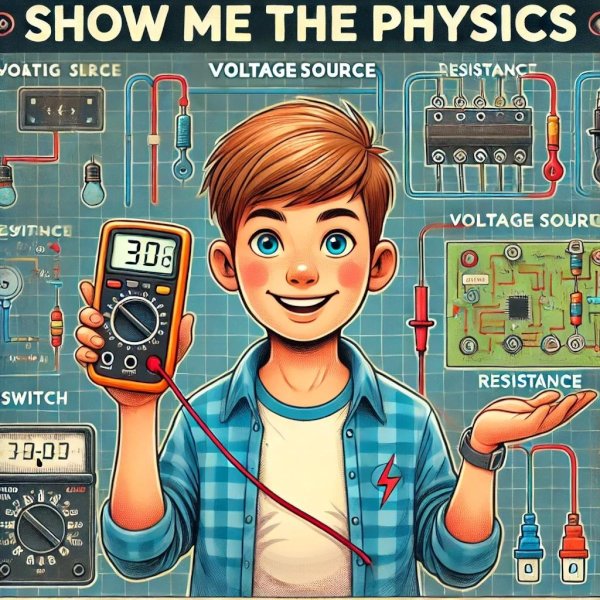
Show Me The Physics
2) Parallel Circuit - circuit in which each component has its own circular path back to the source.
Dorling Kindersley Books
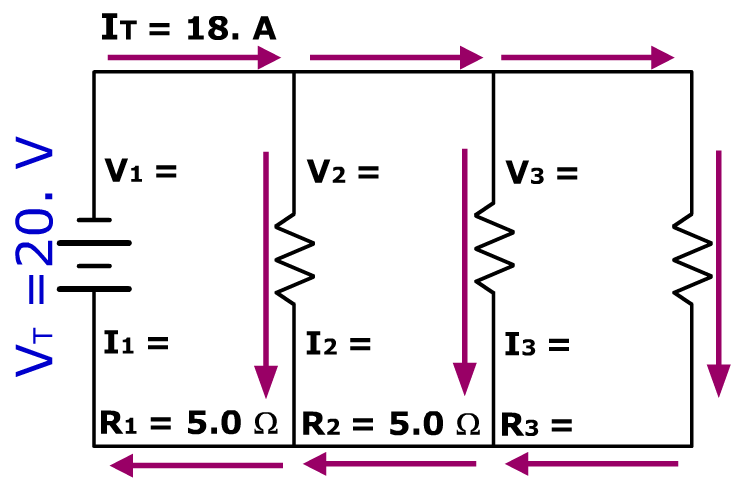
Ex 2)
a) IT = I1 + I2 + I3 + ...
For example:
If I1 = 2 amps, (ignore picture above)
Then ...
IT = 9 amps
b) The voltage drops across each component in parallel are equal
VT = V1 = V2 = V3
VT = Source Voltage
** Write in the correct voltages
c) V1 = I1R1
V2 = I2R2
V3 = I3R3 etc.
d) Current in 1st & 2nd resistor?
e) What’s R3?
|
|||||




Check Your Understanding
5 quick questions — pick an answer to see if you’re right.
1. A parallel circuit is one in which:
2. Three parallel branches carry 2 A, 3 A and 4 A. What is the total current from the source?
3. A 12 V battery is connected to three resistors in parallel. What is the voltage across each resistor?
4. A 4.0 Ω resistor is one branch of a parallel circuit with a 12 V source. What is the current in that branch?
5. In a home wired in parallel, one light bulb burns out. What happens to the other lights?
Wiring a House
Household outlets in the United States supply 120 V. A 60.-W lamp and a 1200-W microwave are plugged into the same circuit, connected in parallel.
Why are household devices connected in parallel rather than in series?
▶ Want a challenge? Open 6 more Regents-style questions (harder · mixed formats)
Challenge score: 0 / 6
C1. What is the total current drawn from the circuit with both devices on?
C2. A student makes the following claim.
Place a check mark in either the Support or Refute box. Justify your response using a mathematical relationship.
C3. Substitute numerical values into a mathematical representation that can be used to determine the operating resistance of the microwave. Then calculate the resistance.
C4. The lamp’s bulb burns out. What happens to the microwave?
C5. Place a check mark in two boxes to indicate the statements that are true while both devices are on.
C6. The lamp and microwave are on a circuit protected by a 15-A breaker. Someone also plugs in a 1500-W space heater. Describe what happens, and support your answer with a calculation.