Electric Potential
Electric potential energy, voltage, and work per unit charge
|
Electric Potential
Show Me The Physics Lesson
Show Me The Physics
Have a little Physics with your Pancakes
Review
I.) Electric Potential - work needed or energy acquired when a positive charge is moved from infinity to a certain point in an electric field.
II) Potential Difference (Voltage) potential energy difference between 2 points in an electric field per unit of charge
A) Potential Difference, Energy & Work As a charge moves through an
electric field
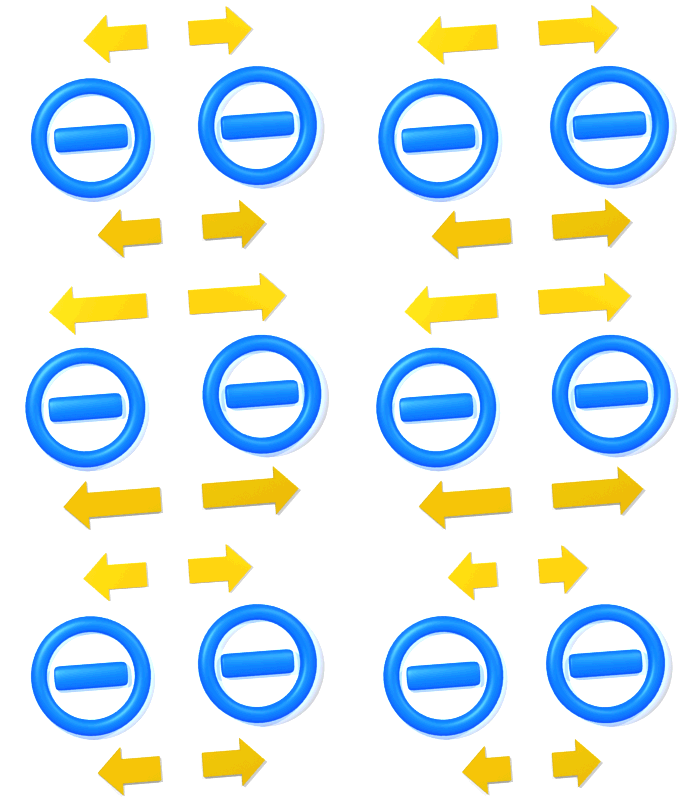
If "Opposites" move Closer 
Gain KE or PE?
They Gain KE
If 'Opposites' Separate Gain KE or PE?
They Gain PE
If "Likes" Separate
Gain KE or PE?
They Gain KE
If 'Likes' move closer
Gain KE or PE?
They Gain PE
1) Equation #1 Charge q moving between 2 points in a field
W = work done against field or energy acquired working with field (Joules or eV)
eV = electronVolts (small energy unit)
q
- amount of charge moving through field (Coulombs) V
- Potential Difference (volts)
Ex) It takes 6 Joules of work to move 2 coulombs of charge between 2 points in an electric field. What is the potential energy difference (voltage) between these 2 points?
V = 3 Volts or J/C
2) Potential difference Eq. #2
W = work done against field
or energy acquired working with field
(Electronvolts = Ev)
Electronvolt
q - amount of charge moving through field (# elementary charges)
V - Potential Difference (volts)
Ex) It takes 10 eV to move 2 elementary charges from one point to another in an electric field. Find the potential difference between these points.
V = 5 Volts
Ex) +2 elementary charges acquire 16 joules of energy when they move between 2 points in an electric field. What is the potential difference (voltage) between these two points in the field? Units don't match!!!
elementary charges, eV Joules/Coulombs
+2 elementary charges = 3.2 x 10⁻¹⁹ C
V = 5.0 x 10¹⁹ Volts
or J/C
W = 4.8 x 10⁻¹⁷ Joule V = ? q = ?
Hint: The charge in this problem is an electron
q = 1.6 x 10⁻¹⁹
C
V = 4.8 x 10⁻¹⁷ J / (1.6 x 10⁻¹⁹C)
a) 3.0 x 10² V
AP Physics
Electric Field - Parallel Plates
E = V/d = F/q
Conducting plates are 0.04 m apart, as shown
above. Point P is located 0.01 m above the lower plate. a. The electric potential at point P is (A) 10 V (B) 8 V
(C) 6 V (D) 4 V (E) 2 V
(A) 10 V (B) 8 V
(C) 6 V (D) 4 V
(E) 2 V
b. The magnitude of the electric field at point P is
Capacitance
Capacitor - a) Oppositely charged plates connected to a voltage source b) used to store charge c) once capacitor is charged, voltage source can be removed
Q = CV Q - charge V - Voltage C - Capacitance - Farads A = Area of each plate d - distance between plates E0 = epsilon (ref) = 8.84 x 10⁻¹² C/Vm
|
|||||||||||||||||||||||||||||||||||||||||||||||||||||||||||





Check Your Understanding
5 quick questions — pick an answer to see if you’re right.
1. What is potential difference (voltage)?
2. It takes 6 J of work to move 2 C of charge between two points. What is the potential difference?
3. It takes 10 eV to move 2 elementary charges between two points. What is the potential difference?
4. It takes 4.8 × 10⁻¹⁷ J to move an electron between two points. What is the potential difference? (e = 1.6 × 10⁻¹⁹ C)
5. Two like charges are pushed closer together. What do they gain?
The Electron Gun
Old TV tubes and modern electron microscopes use an “electron gun” that accelerates electrons through a potential difference between two plates. In one device, electrons start nearly at rest and are accelerated through 5000 V.
How much kinetic energy does each electron gain?
▶ Want a challenge? Open 6 more Regents-style questions (harder · mixed formats)
Challenge score: 0 / 6
C1. In the electron gun, the negative plate is on the left and the positive plate is on the right, 0.010 m apart, with 5000 V between them. Choose the direction of the electric force on an electron between the plates, and determine its magnitude.
●
C2. Which unit is equivalent to the volt?
C3. Each electron (mass 9.11 × 10⁻³¹ kg) gains 8.0 × 10⁻¹⁶ J of kinetic energy. Substitute numerical values into a mathematical representation that can be used to determine the speed of an electron leaving the gun. Then calculate the speed.
C4. A student makes the following claim.
Place a check mark in either the Support or Refute box. Justify your response using a mathematical relationship.
C5. The plates are 0.020 m apart with 120 V between them. What is the field strength between the plates?
C6. Engineers designing an electron microscope consider raising the accelerating potential difference from 5000 V to 50,000 V. Identify one benefit and one drawback of this design change.