Millikan’s Oil-Drop Experiment
Measuring the elementary charge and establishing charge quantization
|
Millikan
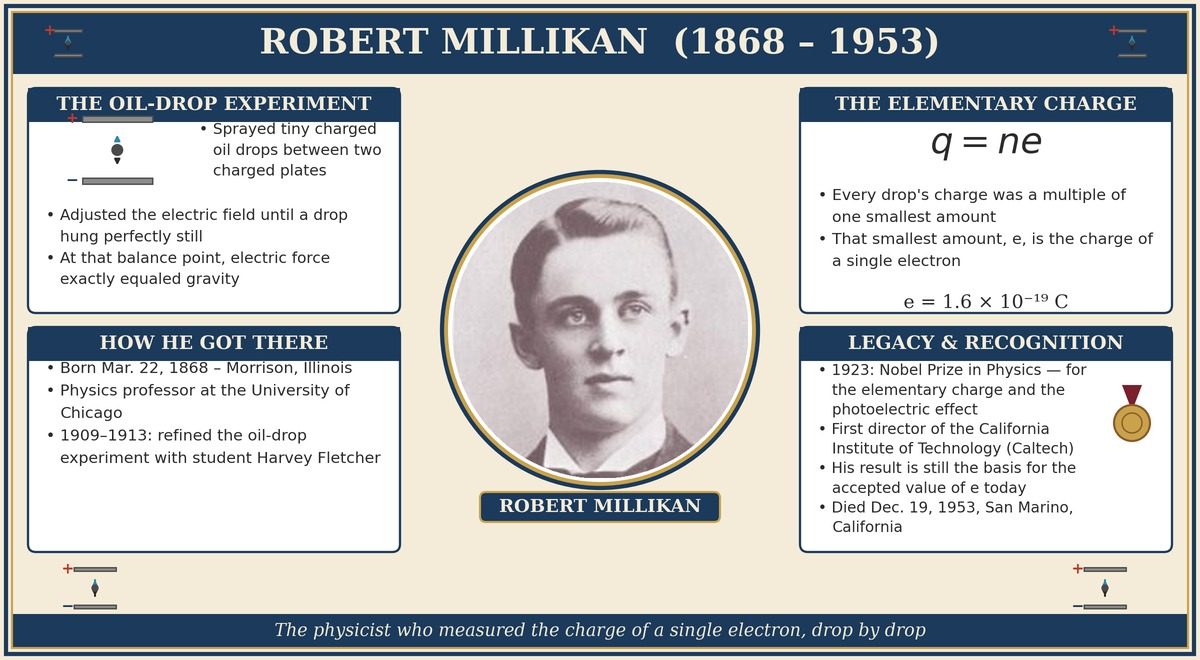
Meet Robert Millikan — the physicist behind the elementary charge
Millikan Experiment
Robert Millikan - American Physicist and Nobel Prize winner in Chemistry
This media file
is in the
public domain 1911
Millikan studied charges on oil drops in a uniform electric field.
Dr. Blair Jesse
He suspended the oil drops in the electric fields
chemtopics.com
School blocks YouTube?
Discovered:
1) Elementary Charge = 1.6 x 10⁻¹⁹ C
2) all the charges in nature must be a whole number multiple of 1.6 X 10⁻¹⁹ C
Millikan Oil (Plastic) Drop Experiment
Animations
[
HTML5 ]
Why does a charged balloon stick to a wall?
[
HTML5 ]
showmethephysics.com
Review
Show Me The Physics Review
Static Electricity Video
Unit Review
|
|




Check Your Understanding
5 quick questions — pick an answer to see if you’re right.
1. What did Millikan's oil-drop experiment measure?
2. How did Millikan study the charges on oil drops?
3. A body has a charge of 4.8 × 10⁻¹⁹ C. How many elementary charges is that?
4. Which charge could NOT be measured on an oil drop?
5. Besides its value, what else did Millikan's experiment show about charge?
Millikan’s Oil-Drop Experiment
In 1909, Robert Millikan sprayed tiny charged oil drops between two horizontal metal plates. By adjusting the electric field, he could make a drop hover at rest. One drop with a mass of 4.9 × 10⁻¹⁵ kg hovered in an upward-pushing electric force when the field strength was 1.0 × 10⁵ N/C.
Which statement describes the forces on the hovering drop?
▶ Want a challenge? Open 6 more Regents-style questions (harder · mixed formats)
Challenge score: 0 / 6
C1. Substitute numerical values into a mathematical representation that can be used to determine the magnitude of the charge on the hovering drop. Then calculate the charge.
C2. How many excess electrons does this drop carry?
C3. Millikan increases the field strength to 1.5 × 10⁵ N/C without changing the field’s direction. The drop’s charge is 4.8 × 10⁻¹⁹ C. Choose the direction of the net force on the drop, and determine its magnitude.
●
C4. A second drop with a mass of 8.2 × 10⁻¹⁵ kg hovers in a field of 1.0 × 10⁵ N/C. A student makes the following claim.
Place a check mark in either the Support or Refute box. Justify your response using a mathematical relationship.
C5. The drop is negatively charged and the electric force on it is upward. In which direction does the electric field point?
C6. Millikan measured the charges on hundreds of oil drops. Describe the pattern in his data that provided evidence that charge is quantized, and explain why measuring the charge on only one drop would not have been enough evidence.