
Equilibrium
∑Fy = 0
∑Fx = 0
Hanging Box - Center of Rope
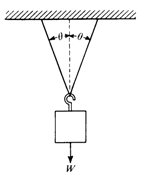
Find Rope Tension
∑Fy = 0
W - [TcosӨ - TcosӨ] = 0
W - 2TcosӨ = 0
T = W/2cosӨ
Hanging Box - Off center
Ex) A 10. kg box, two ropes at an angle of 45 and 30 degrees.
Which rope has more tension?
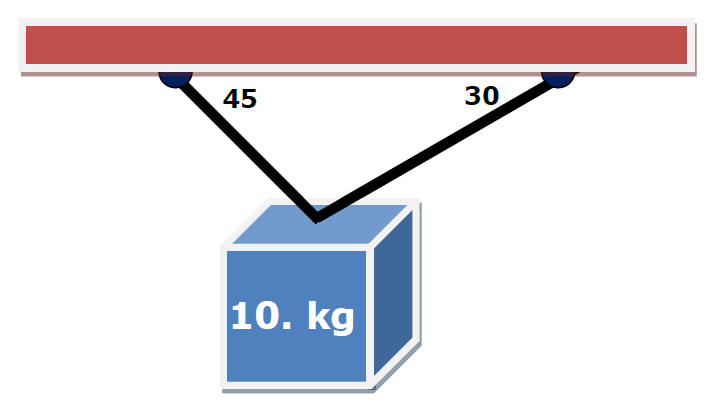
Rope on the left, more vertical
Find T1 and T2
Not drawn to scale
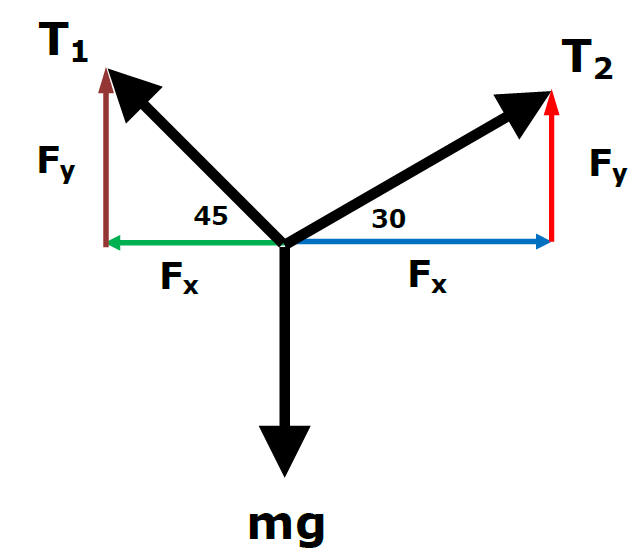
Not drawn to scale
Box at rest
∑Fy = 0
[T1y + T2y] = mg
T1sin45 + T2sin30 = 100 N
[T1sin45 + T2sin30] = 100N
∑Fx = 0
T1x = T2x
T1cos45 = T2cos30
T1 = 1.22T2
T1sin45 + T2sin30 100N = 0
[1.22T2]sin45 + T2sin30 100. N
= 0
.86T2 + .50T2 = 100 N
.86T2 + .50T2 = 100 N
1.36 T2 = 100 N
T2 = 74 N
T1 = 1.22T2
T1 = 1.22(74 N)
T1 = 90 N
Tony Mangiacapre.,
- All Rights Reserved [Home]
Established 1995
Use any material on this site (w/ attribution)