Word Problems
Solving With The GUESS Method

Word Problems — solving constant-acceleration problems with the GUESS method
Warm-Up
An object has a negative velocity and a positive acceleration. Is it speeding up or slowing down?
Video Instruction
showmethephysics.com
C. Solving Word Problems

A car accelerates uniformly from rest at a rate of +10 m/s². How far will the car travel in 4 seconds?
Step 1 — Read and underline all the important information
Step 2 — Turn all your information into letters
Step 3 — Substitute and Solve
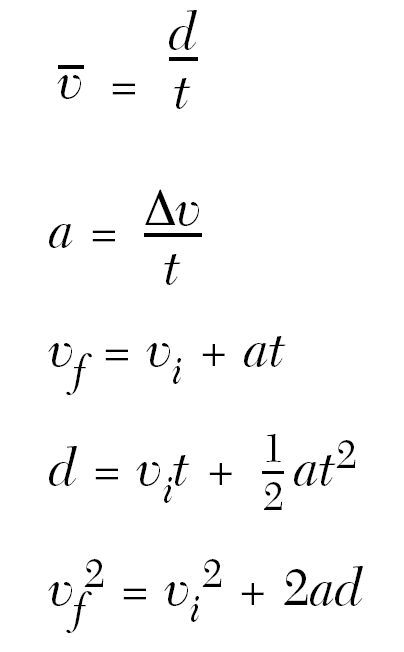
Δd = Vit + ½aΔt²
= 0 m/s(4 sec) + ½(10 m/s²)(4 sec)²
Δd =
Δd =
D. Deriving the 2nd Displacement Equation

A car with an initial velocity of +6 m/s accelerates at a rate of 2 m/s². Find the car's final velocity after it travels 7 m from its initial position.
Step 1 — Read and underline all the important information
Step 2 — Turn all your information into letters
Step 3 — Substitute and Solve
Vf² = Vi² + 2aΔd
= (6 m/s)² + 2(2 m/s²)(7 m)
Vf² = 36 + 4(7) = 64
Vf = 8 m/s
Check Your Understanding
5 quick questions — pick an answer to see if you’re right.
1. A car accelerates uniformly from rest at +4 m/s². How far does it travel in 5 s?
2. A car moving at +3 m/s accelerates at 2 m/s² over 4 m. What is its final velocity?
3. An object has a negative velocity and a positive acceleration. What is it doing?
4. In a word problem, "starts from rest" tells you that...
5. Which equation lets you find final velocity WITHOUT knowing the time?
Designing a Highway On-Ramp
Traffic engineers are designing an on-ramp so that cars can safely merge onto a highway where traffic moves at about 31 m/s. A typical car enters the ramp at 12 m/s and accelerates uniformly at 2.5 m/s² along a straight ramp that is 150 m long.
What is the car’s speed at the end of the ramp?
▶ Want a challenge? Open 6 more Regents-style questions (harder · mixed formats)
Challenge score: 0 / 6
C1. Place a check mark in three boxes to indicate the quantities that must be known to determine a car’s speed at the end of the ramp without knowing the time.
C2. How much time does the car spend on the ramp?
C3. Substitute numerical values into a mathematical representation that can be used to determine the acceleration a car needs to reach exactly 31 m/s by the end of the 150-m ramp. Then calculate the acceleration.
C4. A planner makes the following claim.
Place a check mark in either the Support or Refute box. Justify your response using a mathematical relationship.
C5. To save money, a planner suggests shortening the ramp to 100. m. Which evaluation is correct?
C6. The engineers are considering a ramp longer than 150 m. Identify one benefit and one drawback of this design change.

Bonus
Ever see an object roll UP hill?