Motion Equations
Problem Solving With Constant Acceleration

Motion Equations for problem solving with constant acceleration
Fill In The Blanks NotesWarm-Up
One of these things is not like the other!
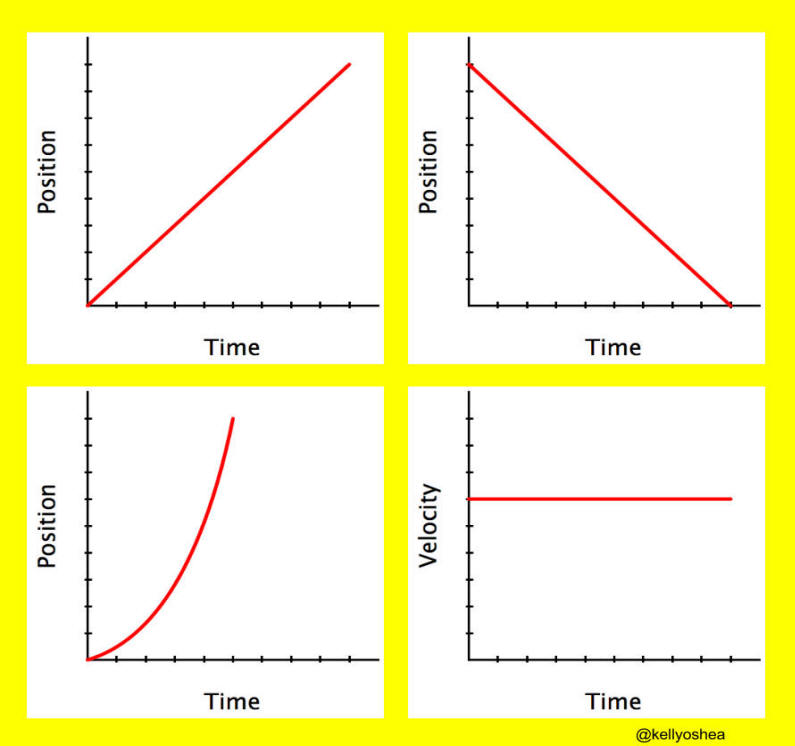
Review
Click on the button and play ...
Video Instruction
showmethephysics.com
IV. Motion Equations for Problem Solving
When an object is moving at a constant acceleration we can use the following equations to find motion information.
A. Constant Accel. Equations
(see Reference Table)
B. Additional Equations
Check Your Understanding
5 quick questions — pick an answer to see if you’re right.
1. The constant acceleration motion equations can be used only when...
2. A car's velocity goes from 4 m/s to 10 m/s with constant acceleration. What is its average velocity?
3. An object moving at 5 m/s accelerates at 3 m/s² for 4 s. What is its final velocity?
4. Starting from rest, an object accelerates at 2 m/s² for 5 s. How far does it travel?
5. You know Vi, a, and t and want the final velocity. Which equation fits best?
Skyscraper Elevator Ride
An elevator in a skyscraper starts from rest and moves straight up. Sensor data for one ride are shown in Table 1.
Table 1: Elevator Ride Data
| Stage | Motion | Time (s) |
|---|---|---|
| 1 | Speeds up from 0 at 1.5 m/s² | 4.0 |
| 2 | Constant speed of 6.0 m/s | 20. |
| 3 | Slows down to rest at 1.5 m/s² | 4.0 |
What is the elevator’s total displacement for the ride?
▶ Want a challenge? Open 6 more Regents-style questions (harder · mixed formats)
Challenge score: 0 / 6
C1. Substitute numerical values into a mathematical representation that can be used to determine the elevator’s displacement during stage 1. Then calculate the displacement.
C2. Which graph best represents the elevator’s velocity versus time?
C3. During stage 3, choose the direction of the elevator’s acceleration and determine its magnitude.
●
C4. An engineer makes the following claim.
Place a check mark in either the Support or Refute box. Justify your response using a mathematical relationship.
C5. Engineers want the same 144-m ride to take only 25 s, with the same top speed of 6.0 m/s and equal speeding-up and slowing-down times. What magnitude of acceleration is needed?
C6. The elevator is speeding up in stage 1 and slowing down in stage 3, yet its displacement is the same in both stages. Using the data in Table 1, explain why.