Acceleration
How Quickly Velocity Changes

Acceleration - time rate of change in velocity (how quickly velocity is changing)
Fill In The Blank NotesWarm-Up
What is the motion word that describes how quickly an object changes its velocity?

See Acceleration in Action
Distance and Motion - Flash [ HTML5 ]
Video Instruction
showmethephysics.com
Enduring Understanding
1. Acceleration is the time rate of change in velocity. Includes direction.
2. There are 3 ways to accelerate — speed up, slow down, and change direction.
Ranking Task
Rank the accelerations below from smallest to greatest.
| t (sec) | 0 | 1 | 2 | 3 | 4 | 5 |
|---|---|---|---|---|---|---|
| Car A | 70 m/s | 72 m/s | 74 m/s | 76 m/s | 78 m/s | 80 m/s |
| Car B | 0 m/s | 3 m/s | 6 m/s | 9 m/s | 12 m/s | 15 m/s |
| Car C | 90 m/s | 90 m/s | 90 m/s | 90 m/s | 90 m/s | 90 m/s |
| Car D | 100 m/s | 99 m/s | 98 m/s | 97 m/s | 96 m/s | 95 m/s |
2 Ways to Have Zero Acceleration
a) Remain at Rest

b) Constant Velocity

1. Equation
Ex 1

Starting Velocity: 5 m/s West
Final Velocity: 25 m/s West
Time: 5 sec
Ex 2

Starting Velocity: 20 m/s West
Final Velocity: 5 m/s West
Time: 5 sec

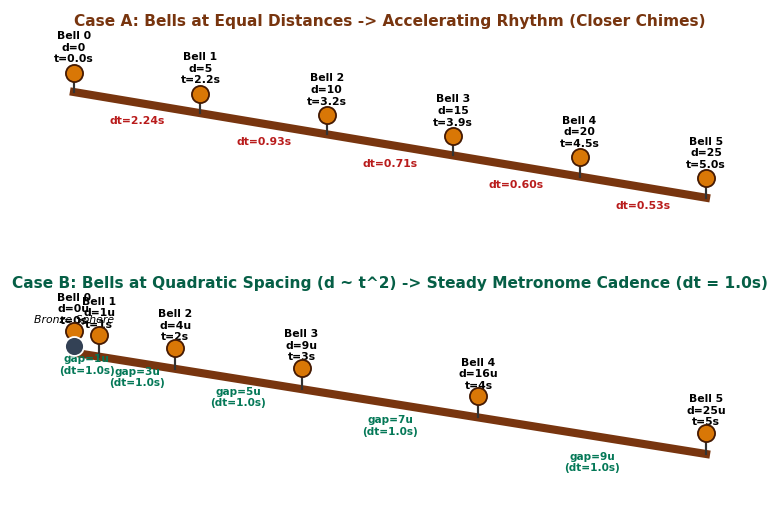

NYSSLS Reading Passage · 1D Motion
Galileo's Bells: Timing Gravity with a Tilted Ramp and a Musician's Ear
Open Reading Passage → Regents Practice Version →Check Your Understanding
5 quick questions — pick an answer to see if you’re right.
1. What is acceleration?
2. A car drives around a curve at a steady 20 m/s. Is it accelerating?
3. A car speeds up from 10 m/s east to 30 m/s east in 5 s. What is its acceleration?
4. A runner slows from 20 m/s west to 5 m/s west in 5 s. What is the acceleration?
5. A car's speedometer reads 90 m/s every second for 5 s while it drives in a straight line. What is its acceleration?
Electric vs. Gasoline Car Acceleration
A car magazine tested how quickly two cars could reach highway speed on a straight, level track. Each car started from rest. The results are shown in Table 1.
Table 1: Acceleration Test Results
| Car | Initial Speed (m/s) | Final Speed (m/s) | Time (s) |
|---|---|---|---|
| Electric car | 0 | 27 | 3.0 |
| Gasoline car | 0 | 27 | 9.0 |
Which statement correctly compares the average accelerations of the two cars?
▶ Want a challenge? Open 6 more Regents-style questions (harder · mixed formats)
Challenge score: 0 / 6
C1. After its test, the electric car (moving to the right) brakes from 27 m/s to rest in 4.5 s. Choose the direction of its acceleration while braking and determine its magnitude.
●
C2. Which velocity–time graph best represents both cars? (Solid = electric, dashed = gasoline)
C3. The gasoline car accelerated uniformly from rest. Substitute numerical values into a mathematical representation that can be used to determine the distance the gasoline car traveled during its test. Then calculate the distance.
C4. A student makes the following claim.
Place a check mark in either the Support or Refute box. Justify your response using a mathematical relationship.
C5. In which situation does the car have zero acceleration?
C6. Electric car makers advertise their large acceleration. Using data from Table 1, identify one benefit and one drawback of designing a car with a very large acceleration.