Motion Terms
Mechanics, Kinematics, and Average Speed

Average Speed - how much distance an object covers per unit time
Read What is Physics? and Answer These QuestionsSheldon from the Big Bang explains physics
from Alom Shaha on Vimeo.
Over-Arching Concept: If a mass speeds up, slows down or changes direction, a net Force must be present. — Newton
Video Instruction
showmethephysics.com
Enduring Understandings
1. Speed is the distance traveled per unit time.
2. Speed is measured in meters/sec.
3. A meter is about a yard.
4. Average walking speed is 1 m/s.
Unit I - Mechanics
Study of the relationship between force and motion

I. Kinematics
Mathematical methods of describing and predicting motion
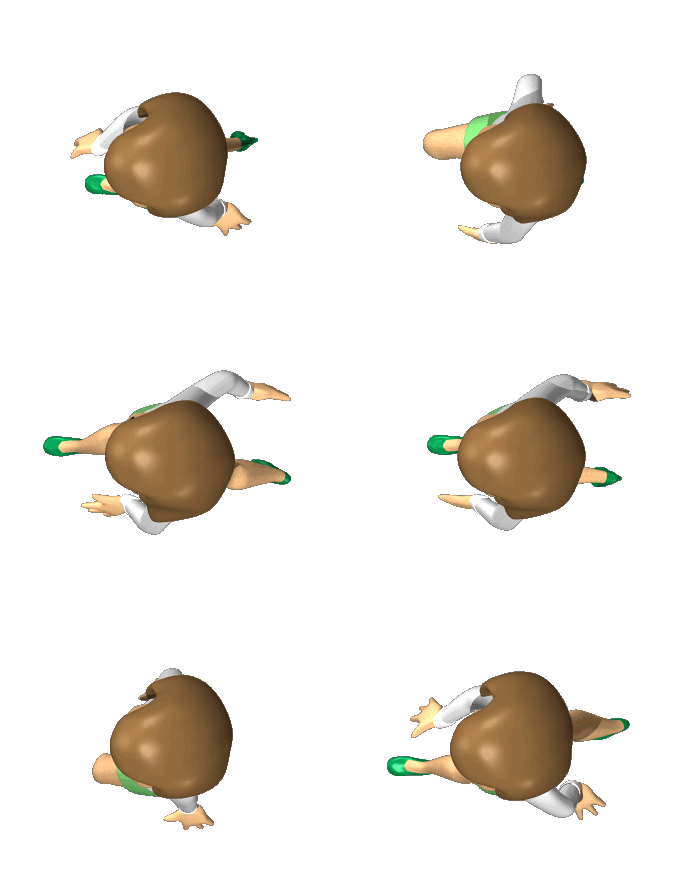
Describe motion by using:
A) Average Speed
Average Speed of 120 miles per hour can also be written ... 120 miles/hr
per = divided by
Could mean travelled 120 miles in one hour, OR ... 60 miles in 1/2 hour (30 minutes), 30 miles in 15 minutes, OR 15 miles in 7.5 minutes.
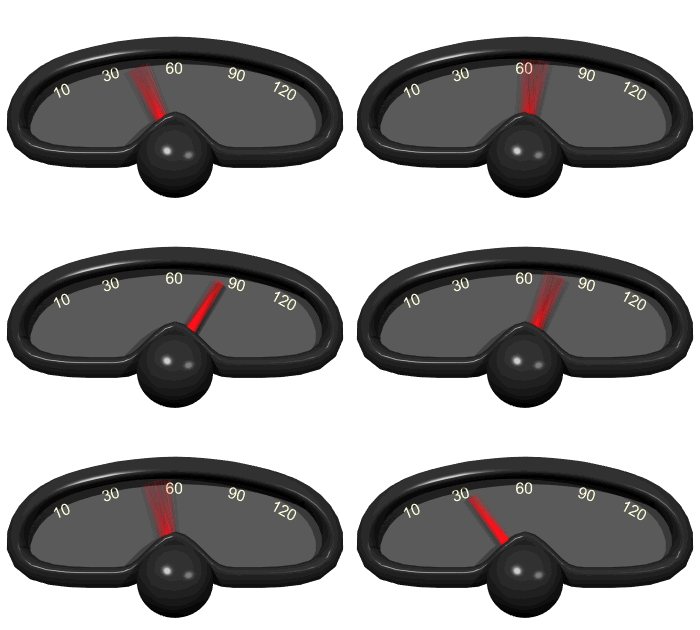
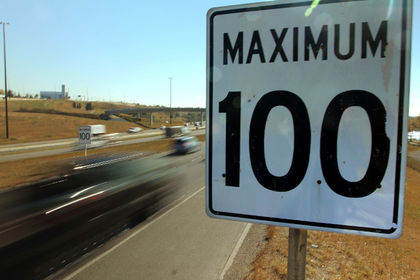
100 km/hr ≈ 60 mph
Avg. Speed - how much distance an object covers per unit time
1) Units: m/s, km/hour, miles/hour
Average Speed = Δd/Δt
Distance

(meter ≈ 1 yard)
(km ≈ .6 miles)
Time

secs, minutes, hours
Ex 1
An object travels 5.0 meters in 2.0 seconds.
Find: its speed.
Ex 2
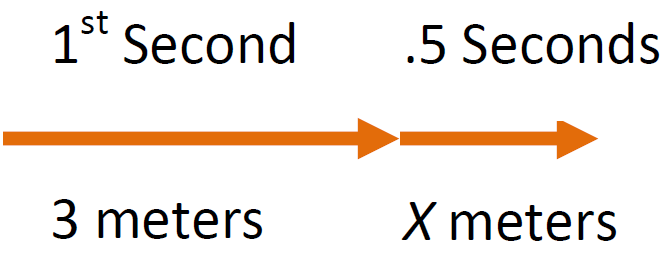
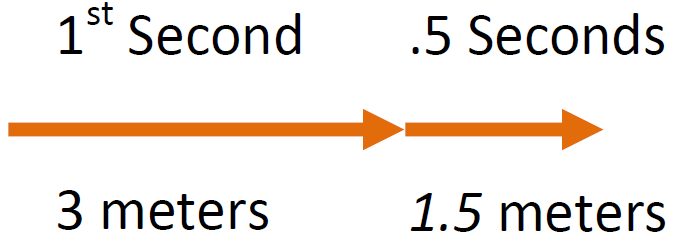
An object moves at a rate of 3.0 m/s for 1.5 seconds.
Find: how far did the object move?
Ex 3
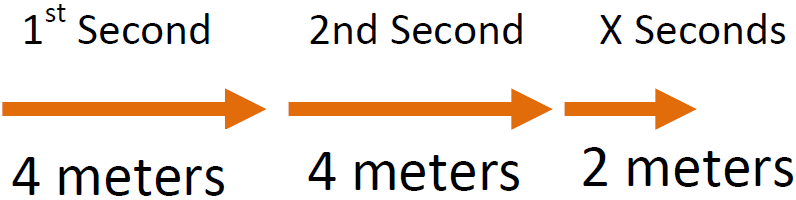
An object moves at a rate of 4.0 m/s over a distance of 10. meters.
Find: how long did it take to travel that distance? t = ?
Check Your Understanding
5 quick questions — pick an answer to see if you’re right.
1. What does average speed measure?
2. An object travels 12 m in 4.0 s. What is its average speed?
3. An object moves at 2.0 m/s for 6.0 s. How far does it travel?
4. An object moves at 5.0 m/s over a distance of 20. m. How long does the trip take?
5. Which is closest to the average walking speed of a person?
The Morning Commute
A student used a phone app to record her trip to school. She walked to a bus stop, waited for the bus, and then rode the bus to school. The data are shown in Table 1.
Table 1: Commute Data
| Part of Trip | Distance (m) | Time (s) |
|---|---|---|
| Walk to bus stop | 400 | 300 |
| Wait at bus stop | 0 | 120 |
| Bus ride | 3600 | 480 |
| Total | 4000 | 900 |
What was the student’s average speed for the entire trip?
▶ Want a challenge? Open 6 more Regents-style questions (harder · mixed formats)
Challenge score: 0 / 6
C1. Substitute numerical values into a mathematical representation that can be used to determine the student’s average speed while walking to the bus stop. Then calculate the average speed.
C2. The bus’s average speed was 7.5 m/s, but its speedometer read 0 m/s at stoplights and 12 m/s on open roads. Which statement explains this?
C3. A student makes the following claim.
Place a check mark in either the Support or Refute box. Justify your response using a mathematical relationship.
C4. One day the student misses the bus and walks the entire 4000 m to school at her walking speed from Table 1. Determine the time this walk takes.
C5. The school district wants every student’s total commute to take no more than 600 s. If this student’s walk and wait stay the same, what average speed must the bus have over its 3600-m route?
C6. The school suggests that the student ride a bike the full 4000 m at an average speed of 5.0 m/s instead of walking and taking the bus. Using data from Table 1, determine whether biking would make the trip shorter, and identify one drawback of this plan.