Conservation of Mass and Energy lesson illustration


What does each letter in E = mc2
stand for?


School blocks YouTube?
Use file below.

Black_hole


Mass/Energy Notes


Conservation Of
Mass
and Energy
-


Conservation of Mass and Energy lesson illustration 


Matter can’t be
 
Created or Destroyed
 
... but can be

 
converted into energy

 according to the formula ...


Conservation of Mass and Energy lesson illustration


Mass (kg) to Energy (J)

Conservation of Mass and Energy lesson illustration 

E

=

m

 c2

Units (J)


(Kg)

m/s


c - speed of light =
3.00 x 10⁸ m/s


Einstein talks
about E = mc2


Conservation of Mass and Energy lesson illustration

Nuclear Fireball

www.wpclipart.com


A neutron splits a uranium nuclei.
What is this nuclear reaction called?

Conservation of Mass and Energy lesson illustration

wpclipart.com


Fission - splitting of a large nuclei into 2 or nuclei


Conservation of Mass and Energy lesson illustration


www.wpclipart.com


Ex) ***Energy that can be obtained from converting 2.0 Kg to energy?


E

=

m

c2

Units (J)


(Kg)

m/s


E = 2.0 Kg(3.00 x 10⁸ m/s)2


 E = 1.8 x 10¹⁷ Joules


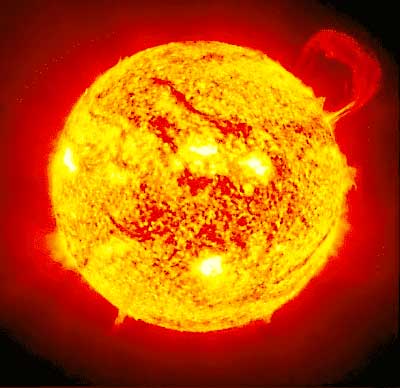
Our Sun

Conservation of Mass and Energy lesson illustration

wpclipart.com


To convert universal mass units
to energy in MeV

1 proton

(universal mass unit)

converts

to 9.31 x 10² Mev

or

931 MeV

(p. 1 Reference)


(Mass/Energy Relationship)


Typical Regents Question ...

Ex) How much energy can be generated when 2 universal mass units are completely converted into energy?


1 universal mass unit = 931 MeV


Answer: 1862 MeV
(each universal mass unit
 converted produces 931 MeV)


GPS and Relativity

Show Me The Physics
YouTube Channel


Enrichment

Conservation of Mass and Energy lesson illustration

The Elements:
Forged in Stars

NOVA

Elements Forged_in_Stars

Author - "Fusion, which occurs when atomic nuclei combine to form new elements, is extremely powerful. All the stars in the universe, including the Sun, are nuclear furnaces fueled by fusion. Through fusion, stars are responsible for forming all the naturally occurring elements heavier than hydrogen and helium -- before stellar nucleosynthesis, only the lightest elements existed in the universe. This video segment adapted from NOVA illustrates the critical role that stars play in creating the elements."


Finely_Tuned_Universe

creationofuniverse.com

A is for Atom

This movie is part of the collection:
Prelinger Archives

Producer: Sutherland (John) Productions
Sponsor: General Electric Company
Audio/Visual: Sd, C
Atomic-nuclear: Energy;
Physics; Animation

Creative Commons license:
Public Domain


Check Your Understanding

5 quick questions — pick an answer to see if you’re right.

1. According to conservation of mass and energy, matter…

2. How much energy is obtained by converting 2.0 kg of mass completely into energy? (c = 3.00 × 10⁸ m/s)

3. How much energy is released when 2 universal mass units are completely converted to energy? (1 u = 931 MeV)

4. A neutron splits a uranium nucleus into smaller nuclei. This reaction is called…

5. Why can a small amount of mass release a huge amount of energy?

NYSSLS Regents Practice · Modern Physics · E = mc²

Mass Into Energy

Einstein’s equation E = mc² shows that mass and energy are equivalent. (c = 3.00 × 10⁸ m/s; 1 u = 931 MeV)

How much energy is equivalent to 1.0 gram (0.0010 kg) of mass?

▶ Want a challenge? Open 6 more Regents-style questions  (harder · mixed formats)

Challenge score: 0 / 6

Multiple choice

C1. When a deuteron forms from a proton and a neutron, the deuteron’s mass is 0.0024 u less than the separate particles. How much energy is released?

Support or Refute · Justify

C2. A student makes the following claim.

Claim: When a hot cup of coffee cools down, its mass decreases slightly.

Place a check mark in either the Support or Refute box. Justify your response using a mathematical relationship.

Substitute values

C3. A nuclear power plant produces 1.0 × 10⁹ W of power for one day (8.64 × 10⁴ s). Substitute numerical values into a mathematical representation that can be used to determine the mass converted to energy in one day (assume 100% efficiency). Then calculate the mass.

m = ( × 109 W)( × 104 s)( × 108 m/s)2 = × 10−4 kg
Determine the value

C4. The mass of a helium-4 nucleus is 0.0304 u less than the total mass of its two protons and two neutrons. Determine the binding energy of the helium-4 nucleus.

Eb = MeV
Multiple choice

C5. An electron (rest energy 0.511 MeV) and a positron annihilate at rest. What total energy is released as photons?

Constructed response

C6. Burning 1.0 kg of coal releases about 3 × 10⁷ J, while fission of 1.0 kg of uranium-235 releases about 8 × 10¹³ J. Using E = mc2, compare the mass converted in each case, and identify one benefit and one drawback of nuclear power compared with coal.