Forces Inside the Nucleus lesson illustration


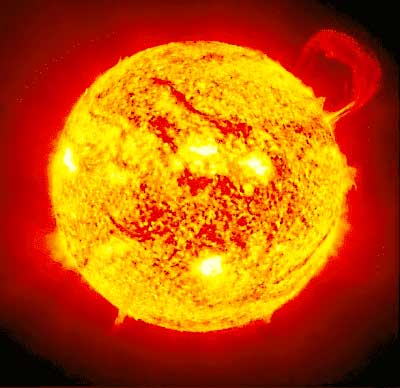
What is the name of the nuclear reaction that occurs in the sun?


Forces Inside the Nucleus lesson illustration


"Why don't the

protons in a nucleus

fly apart?"

Don't likes repel?"


cassiopeiaproject.com

School Blocks YouTube? Use the file below.

| Fission_and_Fusion |


Forces Inside the Nucleus lesson illustration 

"How can you possibly
learn about the parts of a nucleus when it's so small that you can't
even see it with
a microscope?"


Forces Inside Nucleus


1) Strong Nuclear Force

(A.K.A. 'strong force')


• Holds Nucleus Together - very strong, short range


• operates at distance < 10-13 m


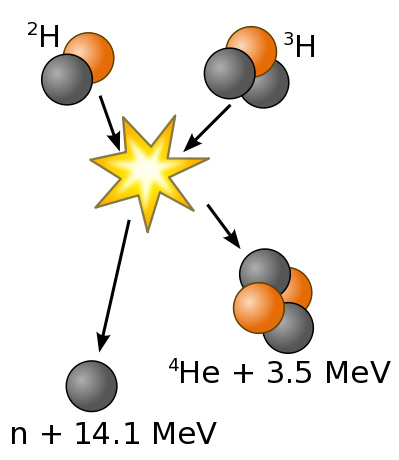
Two H nuclei fuse into a single helium atom.
What is this nuclear reaction called?

Forces Inside the Nucleus lesson illustration

wpclipart.com


Fusion - Uniting of small nuclei
 to form a larger nuclei


Our sun is large fusion 'bomb'.

Forces Inside the Nucleus lesson illustration

wpclipart.com


Forces Inside the Nucleus lesson illustration

A is for Atom

School Blocks YouTube? Use the file below.

BingEnergyFission.mp4

This movie is part of the collection: Prelinger Archives

Producer: Sutherland (John) Productions Sponsor: 
General Electric Company

Keywords: Atomic-nuclear: Energy; Physics; Animation

Creative Commons license: Public Domain


A) Binding Energy - amount of energy needed to separate nucleons (protons and neutrons) in nucleus.


Protons and neutrons in nucleus in large nuclei have slightly less mass than n and p in small nuclei


Mass of Assembled
Nucleus

<

Combined Mass of an
 Equivalent # of Nucleons.


Lost Mass
called Mass Defect


Mass Defect
 =
Binding Energy

(mass lost is
converted to energy)


Ex) If the mass defect is .1 universal mass units then the binding energy = ....


(p. 1 Reference)


1 Universal Mass Unit

converts to


9.31 x 10² Mev

(p. 1 ref)


9.31 x 101 Mev


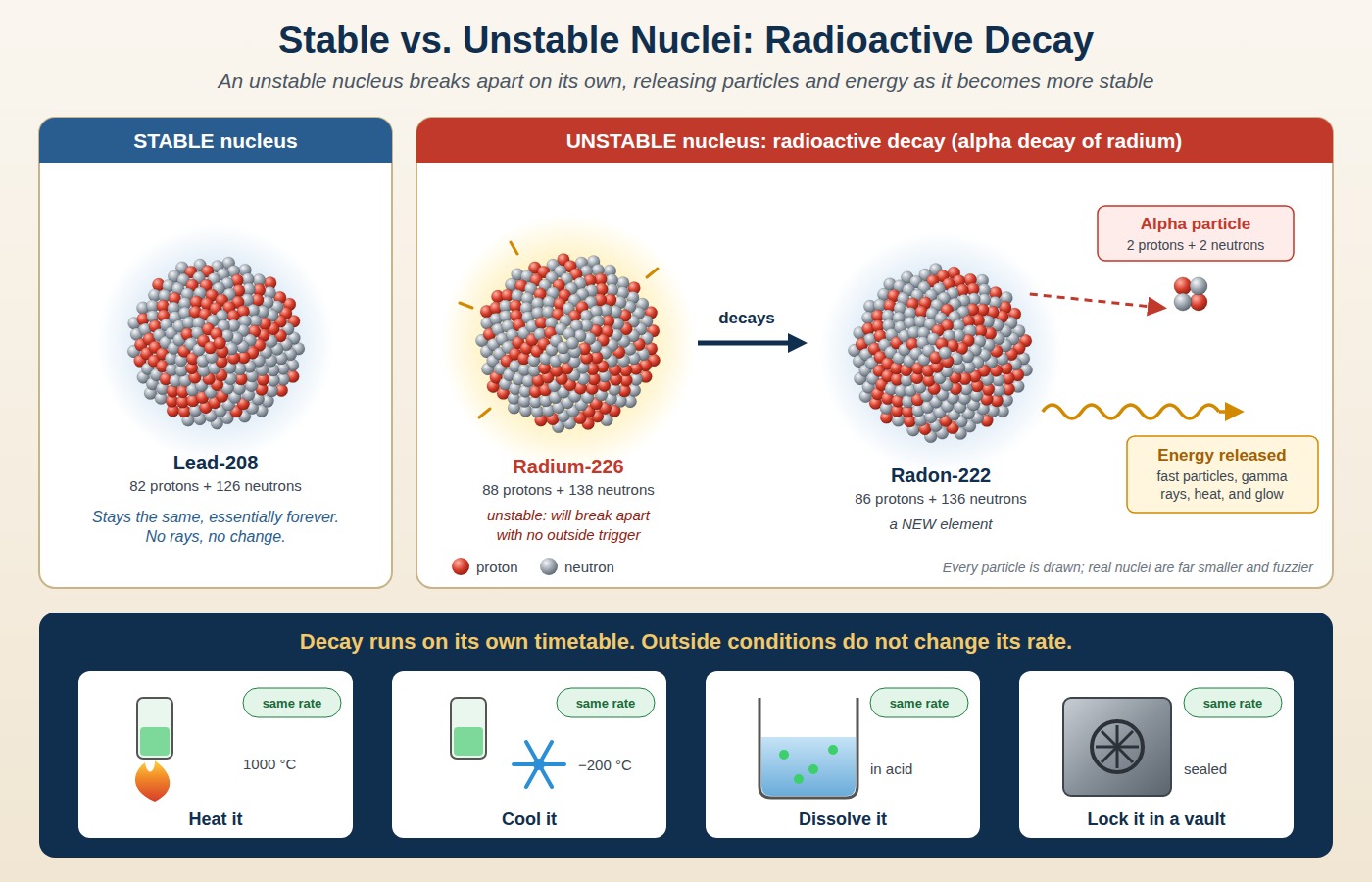
Stable lead-208 nucleus beside an unstable radium-226 nucleus that decays into radon-222, releasing an alpha particle and energy; heating, cooling, dissolving, or sealing the sample does not change the decay rate NYSSLS Reading Passage icon

NYSSLS Reading Passage · Modern Physics

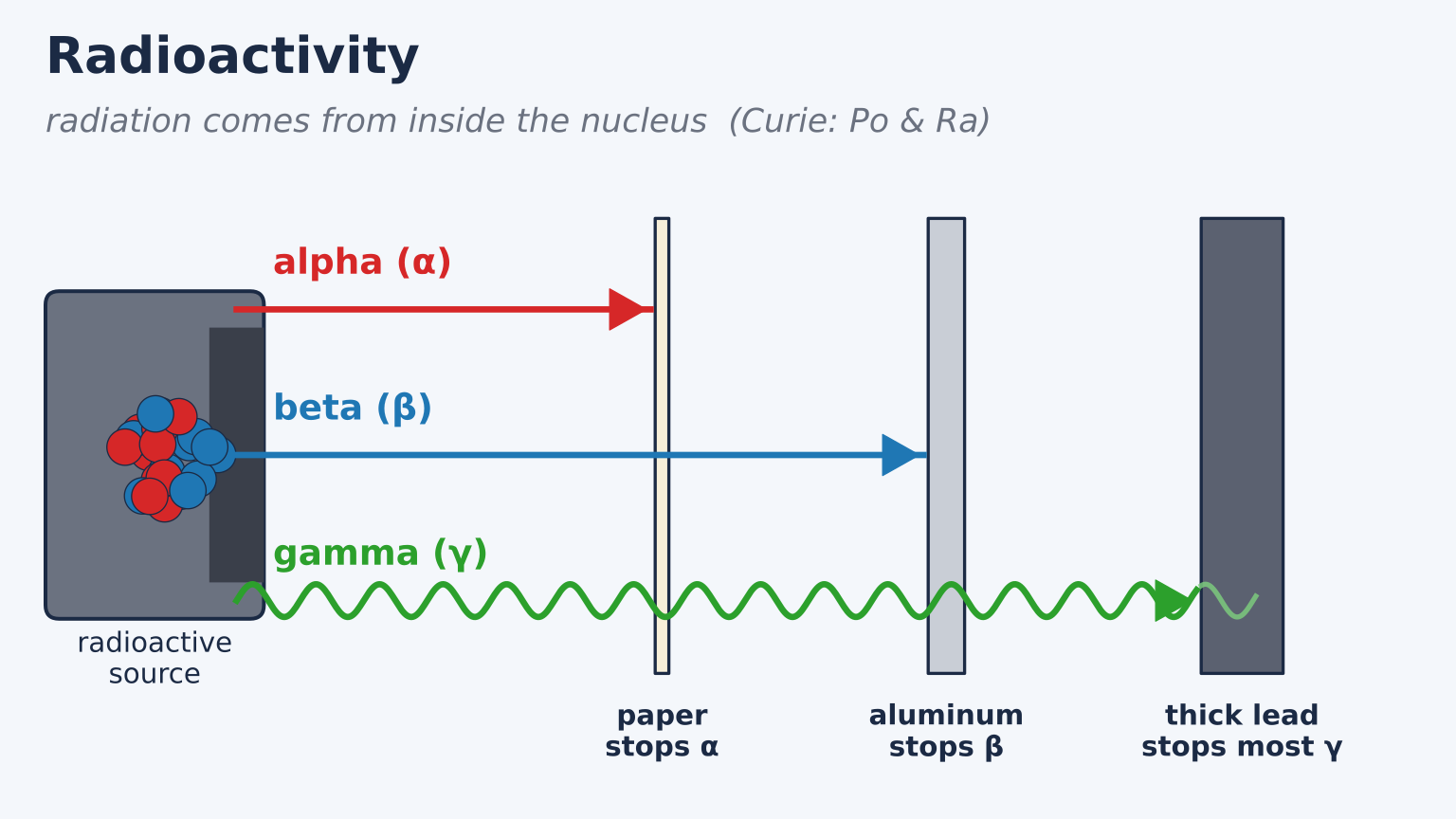
Glowing in the Dark: Marie Curie and the Atom That Wouldn't Sit Still

Open Reading Passage →
Marie Curie illustration

🎧 Podcast · 21 min

Marie Curie’s Radioactive Notebooks

More episodes →

Explore: When a Nucleus Is Unstable

Unstable nuclei change by giving off radiation.

Pick a starting nucleus and press a decay button. Watch the protons, neutrons, and notation change.

Try This

Start with Ra-226 (the radium on this page) and press Alpha. What does it become?

↓

It becomes radon-222: the mass number drops by 4 and the atomic number drops by 2.

More: Nuclear Physics lessons

Check Your Understanding

5 quick questions — pick an answer to see if you’re right.

1. Why don't the protons in a nucleus fly apart despite repelling each other?

2. Which describes the strong nuclear force?

3. Two hydrogen nuclei join to form helium, as in the Sun. This reaction is called…

4. A nucleus has a mass defect of 0.1 universal mass units. What is its binding energy? (1 u = 931 MeV)

5. Why does an assembled nucleus have less mass than its separate protons and neutrons?