Inside the Nucleus
Protons, neutrons, isotopes, and nuclear notation
Do Now: Protons are all positive, and like charges repel. So how can dozens of protons be packed together in a tiny nucleus without flying apart?
The strong nuclear force. At very short distances it pulls protons and neutrons together much harder than the electric force pushes protons apart.
A. Nuclear Notation
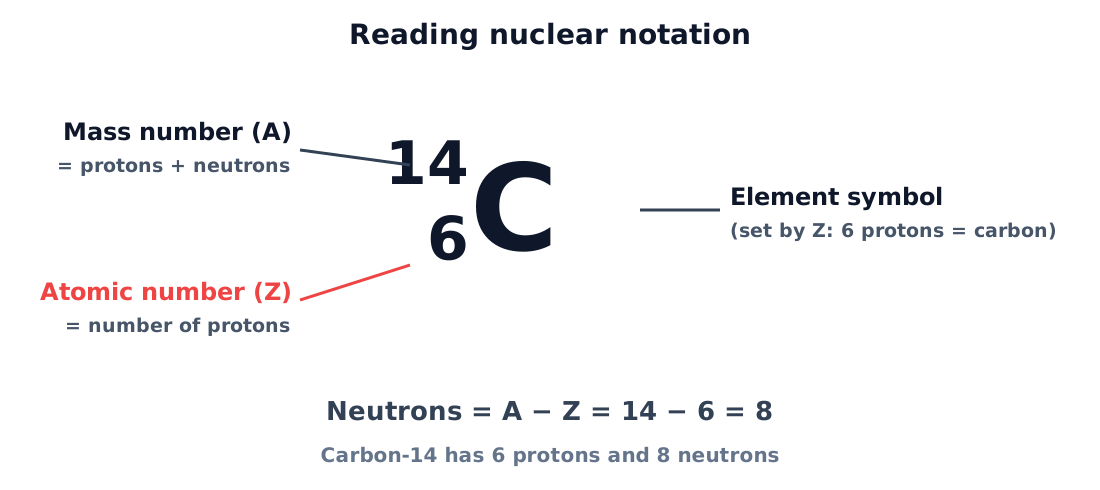
Nucleons = protons + neutrons (the particles in the nucleus).
Atomic number Z = protons. It decides which element it is.
Mass number A = protons + neutrons.
Neutrons = A − Z.
B. Isotopes
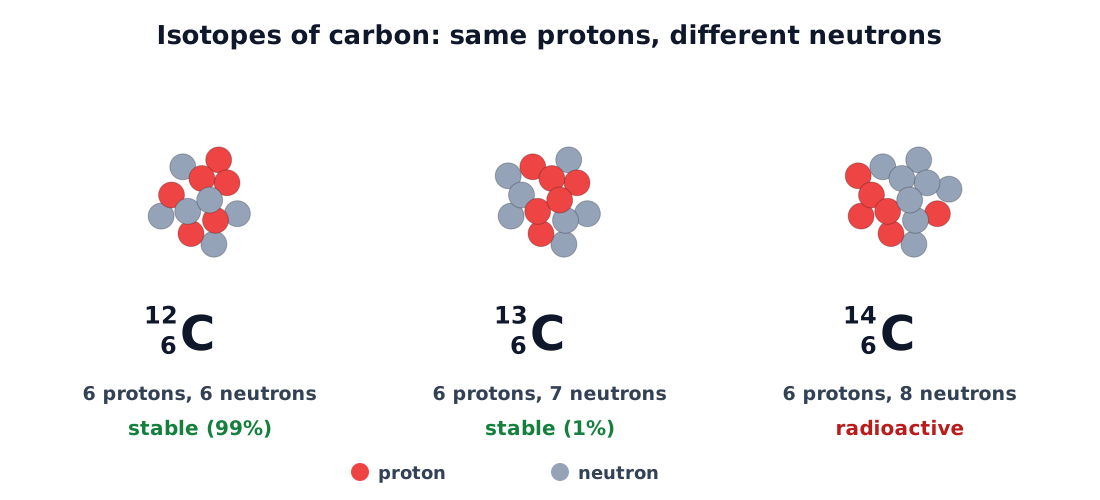
C. Stable or Unstable?
The strong force only reaches the nearest neighbors, but electric repulsion acts across the whole nucleus.
A nucleus with the wrong balance of protons and neutrons — or one that is simply too big — is unstable. It will eventually change by giving off radiation. This is radioactive decay.
Every element past bismuth (Z = 83) has no stable isotopes. Uranium, radium, and radon are all radioactive.
D. Practice
How many protons and neutrons are in 23892U?
92 protons and 238 − 92 = 146 neutrons.
An atom has 26 protons and 30 neutrons. Write it in nuclear notation. (Z = 26 is iron, Fe.)
A = 26 + 30 = 56 → 5626Fe
Are 3517Cl and 3717Cl isotopes? Explain.
Yes — both have 17 protons (chlorine), but one has 18 neutrons and the other has 20.
Which has more neutrons: 146C or 147N?
Carbon-14 has 8 neutrons; nitrogen-14 has 7. Carbon-14 has more, even though both have a mass number of 14.
Check Your Understanding
5 quick questions — pick an answer to see if you’re right.
1. The atomic number (Z) of a nucleus tells you the number of
2. How many neutrons are in 6027Co?
3. Isotopes of the same element have different numbers of
4. What holds protons and neutrons together in the nucleus?
5. Which element has no stable isotopes?