Why We Know Light Is a Wave
A visual summary of interference, diffraction, polarization, and Doppler shift
|
Light is a Wave
Light - Wave or Particle?
Video Instruction showmethephysics.com
Wave Nature of Electrons
Summary Why do we think
Diffraction - spreading out of light
Interference - Young's Double Slit Experiment
Interference Patterns for Light - 3 Factors
Interference Patterns for Light - 3 Factors.mp4
These patterns created by water and oil are created by interference patterns
Read about thin film interference here
Polarization and the Doppler Effect
Video Instruction showmethephysics.com
Polarization - filtering out of one orientation of light
BYU - Stokes
Polarizing
Lenses
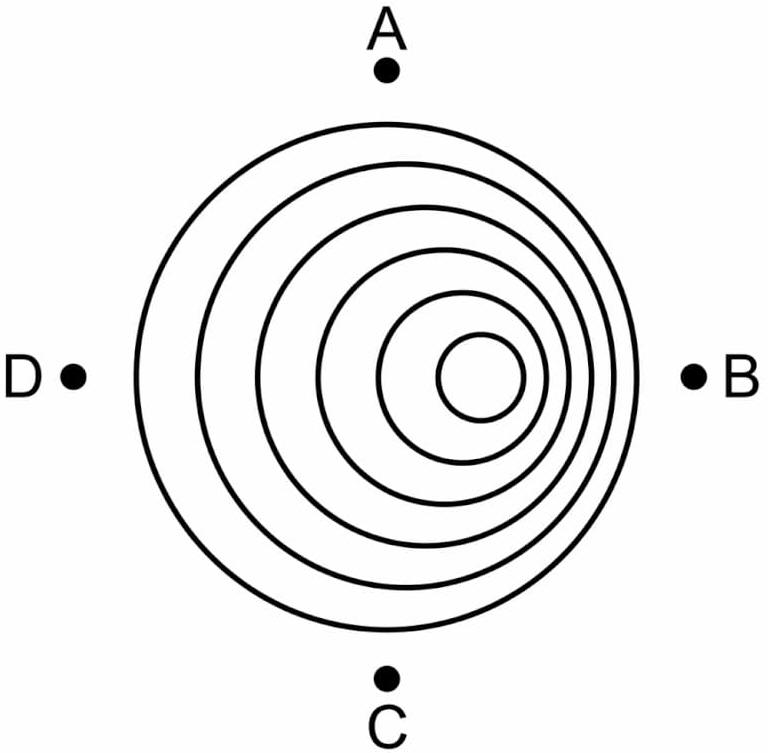
Doppler Effect
"Blue to", "Red Away"
Doppler Effect - Flash
[ HTML5 ]
Say Cheese!
Enrichment Light around a Guitar String
|
|




Check Your Understanding
5 quick questions — pick an answer to see if you’re right.
1. Which set lists four behaviors that show light is a wave?
2. Young's double-slit experiment is evidence of which wave behavior?
3. A thin film of oil on a wet road shows swirling rainbow colors. What causes this?
4. Polarization is the filtering out of one orientation of light. What does it show about light?
5. Using "blue to, red away," how does light from a star moving toward Earth appear?
Young’s Double-Slit Experiment
In 1801, Thomas Young shone light of a single color through two narrow, closely spaced slits. On a screen, instead of two bright lines, he saw a pattern of many alternating bright and dark bands.
Which conclusion did this evidence support?
▶ Want a challenge? Open 6 more Regents-style questions (harder · mixed formats)
Challenge score: 0 / 6
C1. Young repeats the experiment with red light instead of blue light. How does the pattern change?
C2. Place a check mark in three boxes to indicate the observations that are evidence supporting a wave model of light.
C3. Suppose Young’s light had a wavelength of 5.5 × 10⁻⁷ m. Substitute numerical values into a mathematical representation that can be used to determine the frequency of the light. Then calculate the frequency.
C4. A student makes the following claim.
Place a check mark in either the Support or Refute box. Justify your response.
C5. Later experiments (like the photoelectric effect) showed light also behaves like particles. How do scientists describe light today?
C6. Explain why a dark band forms at certain points on the screen, even though light from both slits reaches those points.