More Wave Behaviors of Light
Polarization and other behaviors that reveal the transverse nature of light
| |


Check Your Understanding
5 quick questions — pick an answer to see if you’re right.
1. What is polarization?
2. The fact that light can be polarized proves that light is
3. A picket fence can polarize a wave on a rope but cannot polarize light. Why?
4. Why do polarized sunglasses cut down glare?
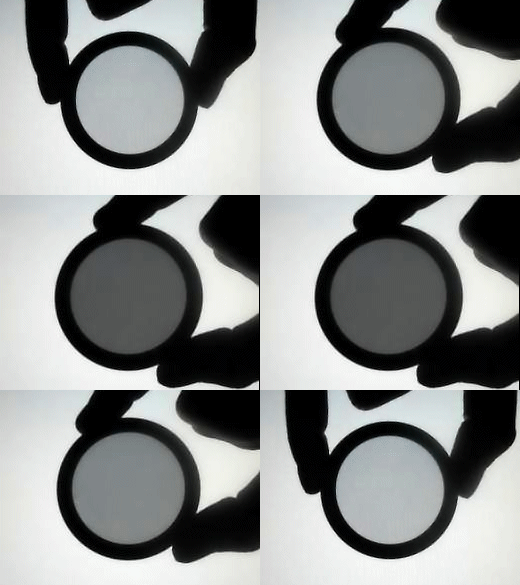
5. A laptop screen goes dark when viewed through polarized sunglasses tilted sideways. What does this show?
The Rainbow on a CD
When white light shines on the surface of a CD or DVD, you see bands of rainbow colors. The disc’s surface has thousands of closely spaced tracks that act like many tiny slits.
Which wave behaviors best explain the colors seen on a CD?
▶ Want a challenge? Open 6 more Regents-style questions (harder · mixed formats)
Challenge score: 0 / 6
C1. Why does a soap bubble show swirling colors?
C2. A student makes the following claim.
Place a check mark in either the Support or Refute box. Justify your response.
C3. A DVD player reads the disc with a laser whose wavelength is 6.5 × 10⁻⁷ m. Substitute numerical values into a mathematical representation that can be used to determine the frequency of the laser light. Then calculate the frequency.
C4. A ray of light strikes the shiny, flat surface of the CD with an angle of incidence of 35°, measured from the normal. Determine the angle between the reflected ray and the surface of the disc.
C5. A DVD stores more data than a CD by using tracks that are closer together, read by a shorter-wavelength laser. Why must the laser’s wavelength be shorter?
C6. Both a glass prism and a CD can separate white light into colors. Compare the wave behavior responsible in each case.