Lenses & Mirrors Review
Everything in one place, plus mixed practice
The Big Picture
| Shape | Light | Sign of f | Images It Can Make | |
|---|---|---|---|---|
| Plane mirror | Flat | — | — | Virtual upright, same size |
| Concave mirror | Caves in | Converges | + | Real inverted (object outside F) Virtual upright, larger (object inside F) |
| Convex mirror | Bulges out | Diverges | − | Virtual upright, smaller — always |
| Converging lens | Thick middle | Converges | + | Real inverted (object outside F) Virtual upright, larger (object inside F) |
| Diverging lens | Thin middle | Diverges | − | Virtual upright, smaller — always |
Principal Rays
| Ray | Mirrors | Lenses |
|---|---|---|
| 1. Parallel | Parallel in → out through F (or as if from F) | Parallel in → out through F (or as if from F) |
| 2. Focal | Through (toward) F → out parallel | Through (toward) F → out parallel |
| 3. Center | Through (toward) C → back on itself | Through the center → straight, no bending |
Explore Any Mirror or Lens
Drag the orange object. Turn rays on and off with the check boxes.
Mixed Practice
What kind of mirror or lens is this, and where is the object? Describe the image with L-O-S-T.
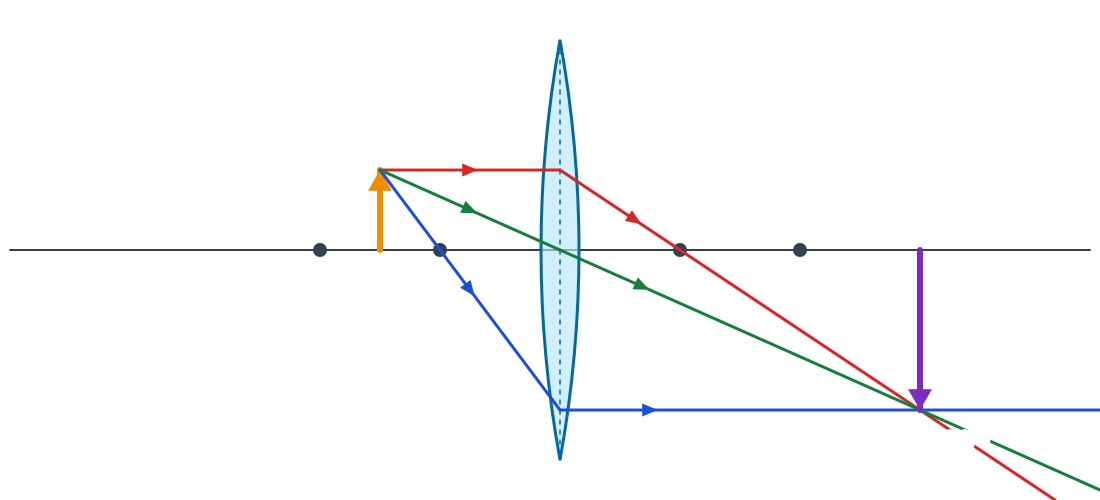
Converging lens, object between 2F and F. Image: beyond 2F on the other side, inverted, larger, real. This is how a projector works.
What kind of mirror or lens is this? Describe the image.
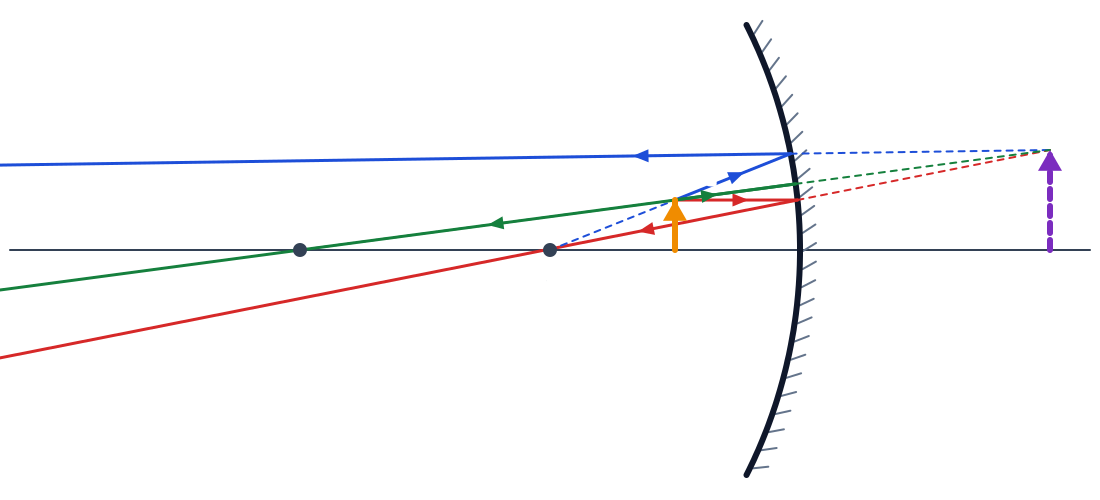
Concave mirror, object between F and the mirror. Image: behind the mirror, upright, larger, virtual. This is a makeup mirror.
A 4.0-cm-tall object is 30. cm from a converging lens with f = 10. cm. Find the image distance and image height.
di = +15 cm, M = −0.50, hi = −2.0 cm (real, inverted, 2.0 cm tall)
An object is 10. cm from a concave mirror with f = 25 cm. Find di and M, and describe the image.
di = −17 cm, M = +1.7 — virtual, upright, larger (the object is inside F).
A convex security mirror has a focal length of magnitude 30. cm. A shopper is 60. cm away. Find di and M.
di = −20. cm, M = +0.33 — virtual, upright, one-third the size.
You need a lens that makes a real image 3 times larger than the object on a screen 60. cm from the lens. How far from the lens is the object, and what focal length do you need?
M = −3 → do = 60/3 = 20. cm. 1/f = 1/20 + 1/60 = 4/60 → f = 15 cm (converging).
Check Your Understanding
6 quick questions — pick an answer to see if you’re right.
1. Which two devices can form a real image?
2. An image that is upright and smaller than the object could be made by
3. An object is at the focal point of a converging lens. The image
4. A real image is 12 cm from a concave mirror when the object is 12 cm away. The focal length is
5. Which statement about virtual images is true?
6. A 2.0-cm object makes an image with M = −1.5. The image is