Refraction
How waves change speed and direction when they enter a new medium
| |||||||||



Explore: Lenses Use Refraction
A lens is shaped so refraction bends light toward (or away from) a focal point.
Drag the orange object to see the image move. Switch between converging and diverging lenses.
Check Your Understanding
5 quick questions — pick an answer to see if you’re right.
1. What is refraction?
2. When light enters a new medium at an angle, what happens to it?
3. A light ray makes 40° with the normal in medium A and 25° with the normal in medium B. Which medium is faster?
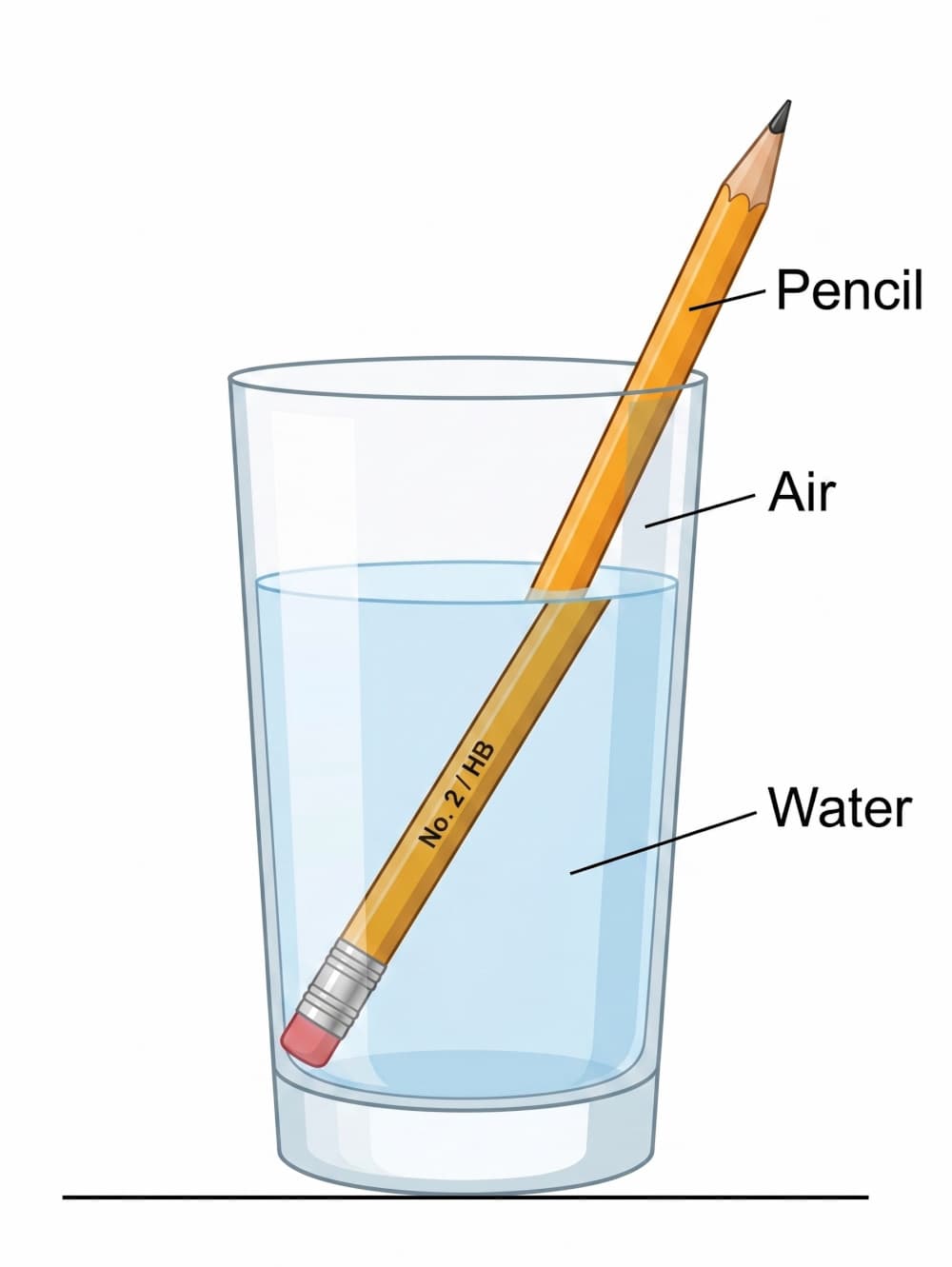
4. A pencil standing in a glass of water looks bent at the water's surface. This is caused by
5. Which device works mainly by refracting light?
The “Broken” Pencil
A pencil placed in a glass of water appears bent at the water’s surface. Water has an index of refraction of 1.33; air’s is about 1.00.
Which statement best explains why the pencil looks bent?
▶ Want a challenge? Open 6 more Regents-style questions (harder · mixed formats)
Challenge score: 0 / 6
C1. Substitute numerical values into a mathematical representation that can be used to determine the speed of light in the water. Then calculate the speed.
C2. Light travels from air into water at an angle. How does it bend?
C3. A student makes the following claim.
Place a check mark in either the Support or Refute box. Justify your response using a mathematical relationship.
C4. Place a check mark in two boxes to indicate the properties of the light that decrease when light passes from the air into the water.
C5. A fisher sees a fish in a pond and aims a spear directly at where the fish appears. What happens?
C6. A student replaces the water with vegetable oil (n = 1.47). Predict whether the pencil will appear more or less bent than in water, and explain your prediction using the speed of light in each material.