Refraction II lesson illustration


Review -
What Angle Never Produces Refraction?


Video Instruction

showmethephysics.com


Amazing Water Trick
- Amazing Science Tricks Using Liquid


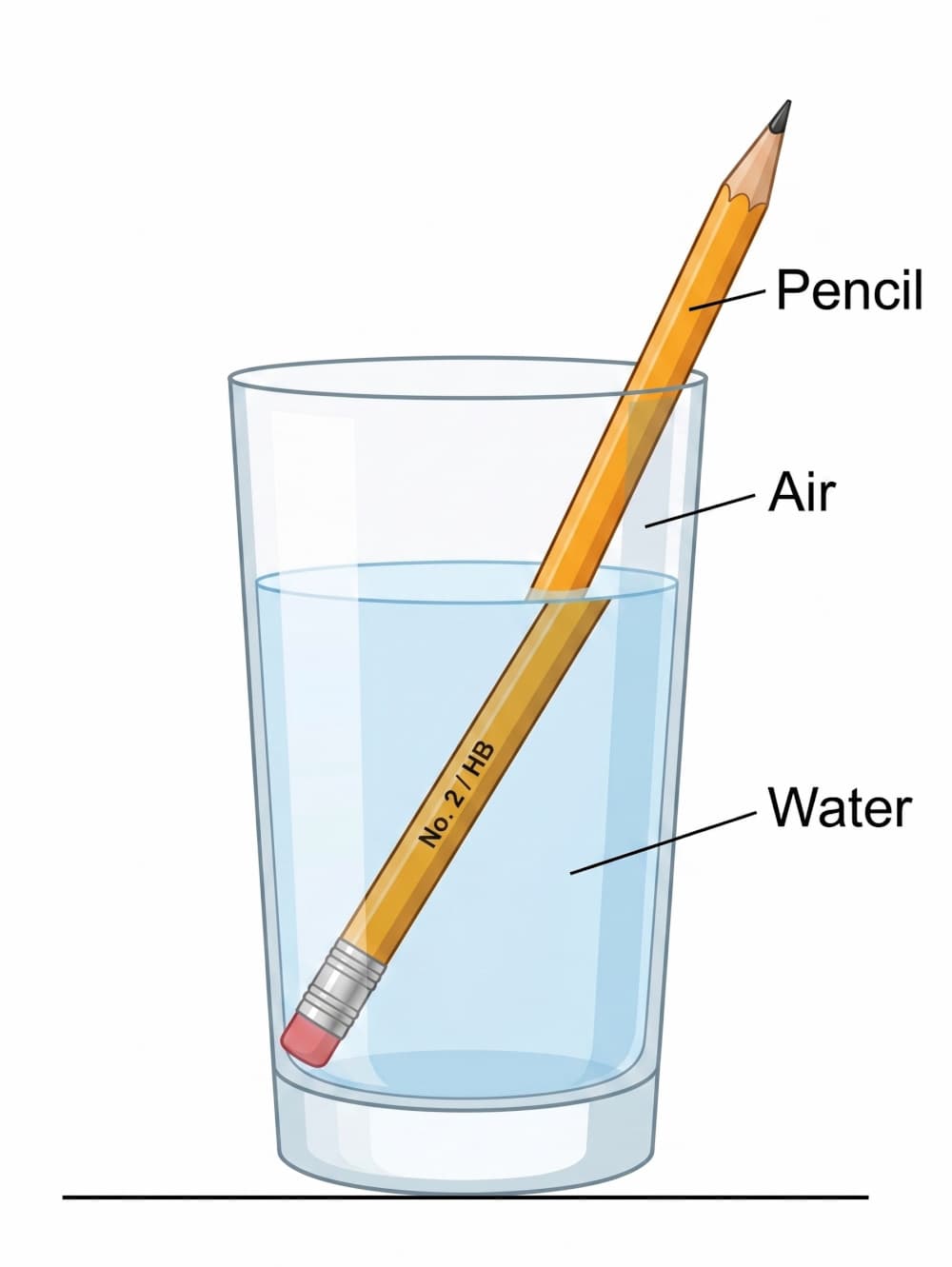
Pins viewed in the glass and outside the glass

Refraction II lesson illustration


Refraction II lesson illustration 


[ Flash ]


1. Refraction II lesson illustration Speed and Refraction Refraction II lesson illustration


a) If fused quartz is faster?

Refraction II lesson illustration


D

(angle of refraction < angle of incidence)

Refraction II lesson illustration


c) Fused quartz same speed as Medium X

Refraction II lesson illustration


C

(No bending)

Refraction II lesson illustration


d) This ray is not possible


Refraction II lesson illustration


A

(light always crosses over normal)

Refraction II lesson illustration


If Light goes from fast medium to slow, light bends toward the normal
 

Refraction II lesson illustration


Slow medium to fast,
light bends away from the normal


Refraction II lesson illustration  Light Ray leaving water
 and entering Air 


Velocity of Air > Velocity of Water


If θin = 0 degrees,


No Refraction


 Refraction II lesson illustration

(Light must come in at
an angle to be refracted)


Which medium is faster?

Refraction II lesson illustration


Medium A

(larger angle from normal)


REFRACTION IS ALWAYS
ACCOMPANIED BY REFLECTION

Refraction II lesson illustration


Refraction II lesson illustration

Find the missing ray in

the ray diagram below


Refraction II lesson illustration 


Refraction II lesson illustration

The reflected ray at

the glass/air boundary

 is  missing. 


Refraction -
David M. Harrison


Did you know....

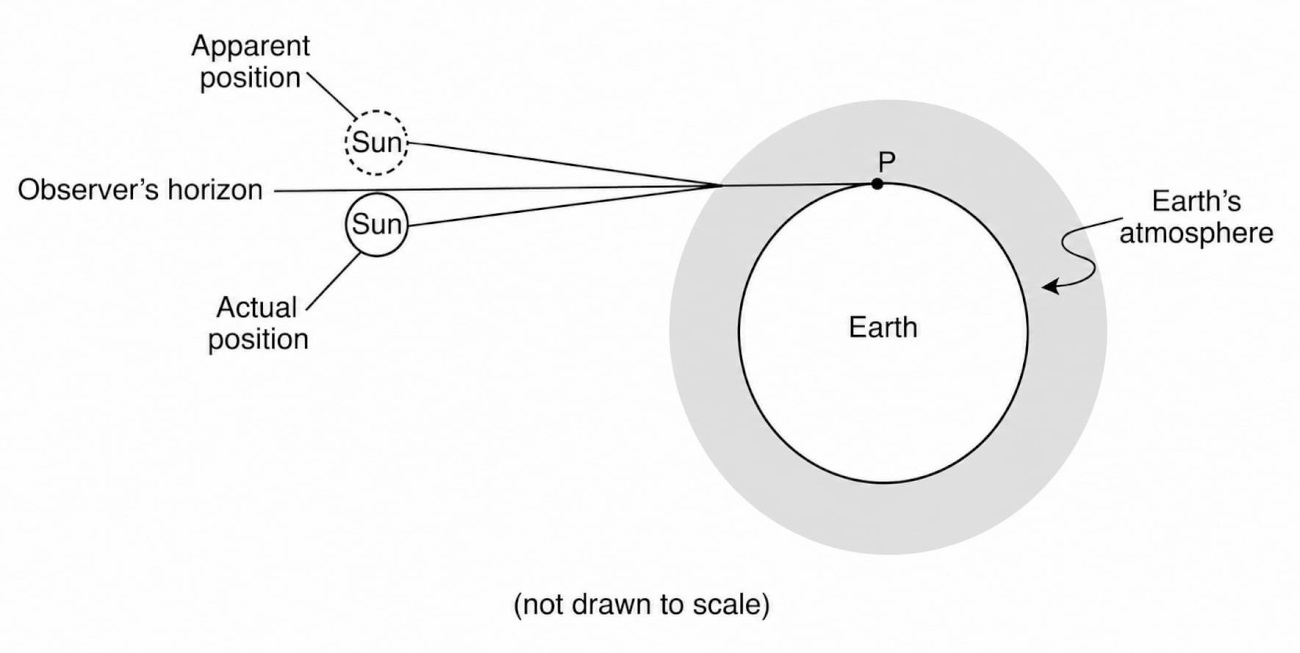
A sunset is an optical illusion !!!

Diagram showing atmospheric refraction making the Sun appear above its actual position after sunset


Refraction allows you
to see the sun
even after it has set. 


Which ray diagram is correct?


Refraction II lesson illustration


Choice 2

(Angle ray leaves air = Angle ray enters air)


At what angle will the ray reenter the air?


Refraction II lesson illustration 

June 2008 #72


35 degrees


What's wrong with this picture?

Refraction II lesson illustration


Air is faster than flint glass. second angle should be larger


A Flame that Burns Underwater!!

School blocks YouTube? Download link below

 Candle_Illusion.mp4


When a wave enters another medium,

part of the wave is transmitted,
part is reflected.


Review -
What Angle Never Produces refraction?


Enrichment

Refraction II lesson illustration

Science of Mirages

Robert Kampf  YouTube Channel


Check Your Understanding

5 quick questions — pick an answer to see if you’re right.

1. Light travels from a fast medium into a slow medium at an angle. How does it bend?

2. A light ray leaves water and enters air at an angle. Which is true?

3. Light hits a glass surface with an angle of incidence of 0°. What happens?

4. Light passes from air through a glass block with parallel sides, entering at 35°. At what angle does it leave the glass back into air?

5. You can still see the Sun for a few minutes after it has actually set. Why?

NYSSLS Regents Practice · Waves · Optical Materials

Why Diamonds Sparkle

A jeweler compares several transparent materials. Their indices of refraction are shown in Table 1.

Table 1: Indices of Refraction

MaterialIndex of Refraction
Water1.33
Crown glass1.52
Cubic zirconia2.17
Diamond2.42

In which material does light travel slowest?

▶ Want a challenge? Open 6 more Regents-style questions  (harder · mixed formats)

Challenge score: 0 / 6

Multiple choice

C1. Light passes from crown glass into water at an angle. How does it bend?

Substitute values

C2. Substitute numerical values into a mathematical representation that can be used to determine the speed of light in cubic zirconia. Then calculate the speed.

v = ( × 108 m/s)() = × 108 m/s
Determine the value

C3. Using Table 1, determine how many times faster light travels in water than in diamond.

vwater ÷ vdiamond =
Support or Refute · Justify

C4. A student makes the following claim.

Claim: A clear gem in which light travels at 2.0 × 10⁸ m/s must be cubic zirconia.

Place a check mark in either the Support or Refute box. Justify your response using a mathematical relationship.

Multiple choice

C5. Cubic zirconia is often used as an imitation diamond. Why does it look similar?

Constructed response

C6. A jewelry company considers using cubic zirconia instead of diamond in its rings. Using evidence from Table 1, identify one benefit and one drawback of this design choice.