Unit: Waves, Sound & Optics
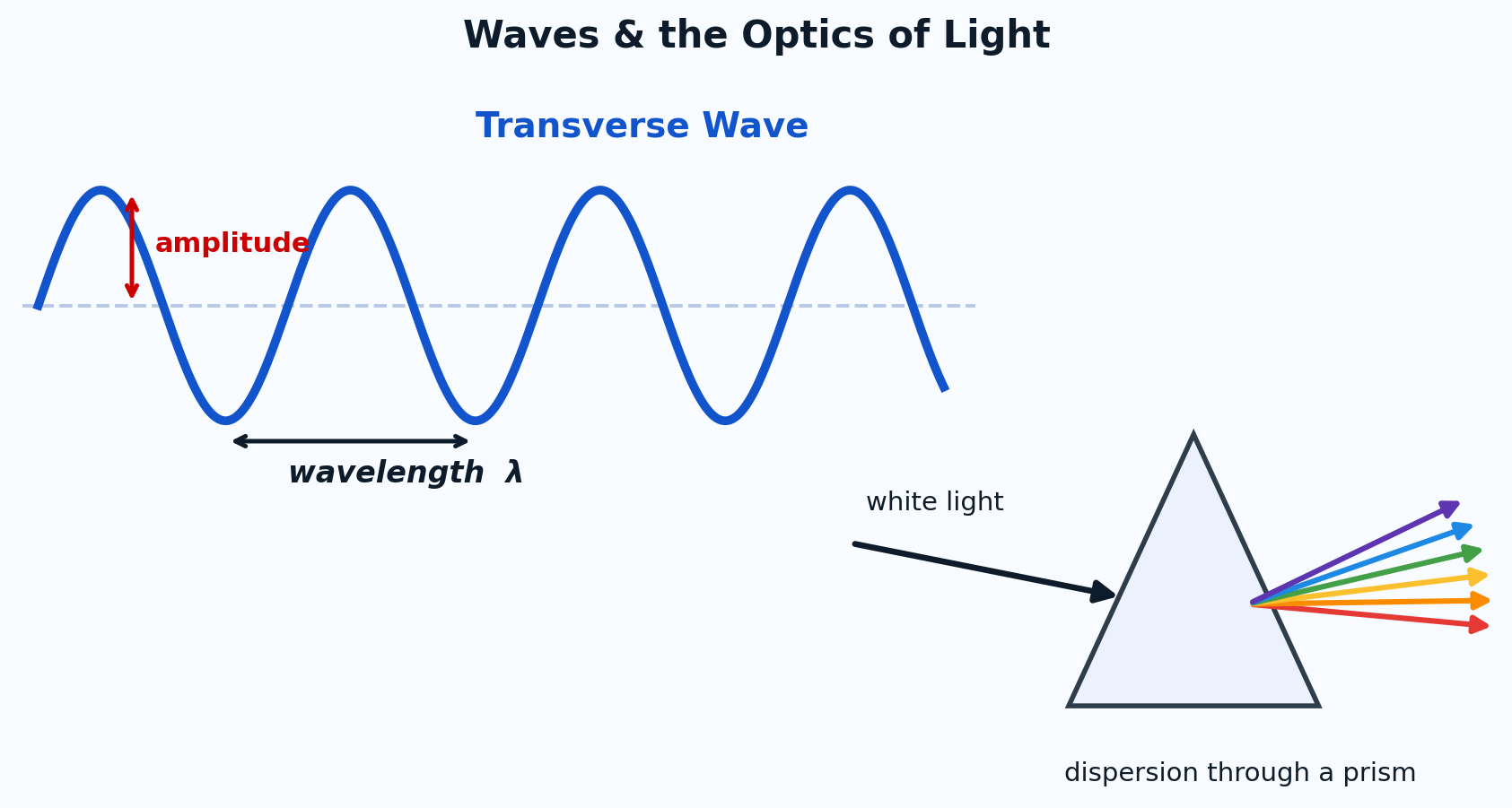
Every wave has an amplitude and a wavelength — and when white light passes through a prism, each wavelength bends by a different amount, splitting it into a spectrum.
Why It Matters
Sound, light, and water ripples are all waves carrying energy without carrying matter along with them. The same math that describes a guitar string resonating also describes why a prism — or a raindrop — can turn white light into a rainbow.
OpenStax AP Physics Chapter 17: Waves and Sound: Introduces longitudinal mechanical waves, frequency, amplitude, and acoustic resonance.
CYMATICS: Science Vs. Music: A visual spectacle mapping sound frequencies into complex standing wave patterns through various physical mediums.
How Speakers Make Sound: An animation detailing the conversion of electrical signals into mechanical vibrations to propagate sound waves.
Exploring Total Internal Reflection in Fiber Optics: Demonstrates Snell's Law and critical angles, essential for modern endoscopy and telecommunications.
How Do Blacklights Make Things Glow?: Discusses the electromagnetic spectrum, ultraviolet radiation, and the atomic excitation of phosphors.
How Do Rainbows Form?: A breakdown of the refraction, internal reflection, and dispersion of light through spherical water droplets.
Radar Detectors As Fast As Possible: An explanation of the Doppler effect and how detectors use electromagnetic wave frequencies to calculate vehicle speed.
Why Walls STOP Light Waves But Not Radio Waves?: Compares the wavelengths of visible light and radio waves to explain why one diffracts around obstacles and the other doesn't.
How Electromagnetic Waves Transmit Music, Messages, & More: Explains how information is encoded onto a carrier wave's amplitude or frequency to transmit signals through the air.
How does doppler radar work?: Uses the Doppler shift in reflected radio waves to measure the speed and direction of precipitation moving through a storm.
How Televisions Are Made | Biggest TV Factory In The World !!: A factory tour showing how millions of individual light-emitting pixels are assembled into the displays that form the images we see.
How Do Noise-Canceling Headphones Work?: Explains how destructive interference cancels unwanted sound waves by generating an inverted waveform in real time.
The Surprising Science Behind Noise-Cancelling Headphones: A behind-the-scenes look at the engineering that generates a mirror-image sound wave to physically cancel ambient noise before it reaches your ear.