Unit: Kinematics, Forces & Mechanics
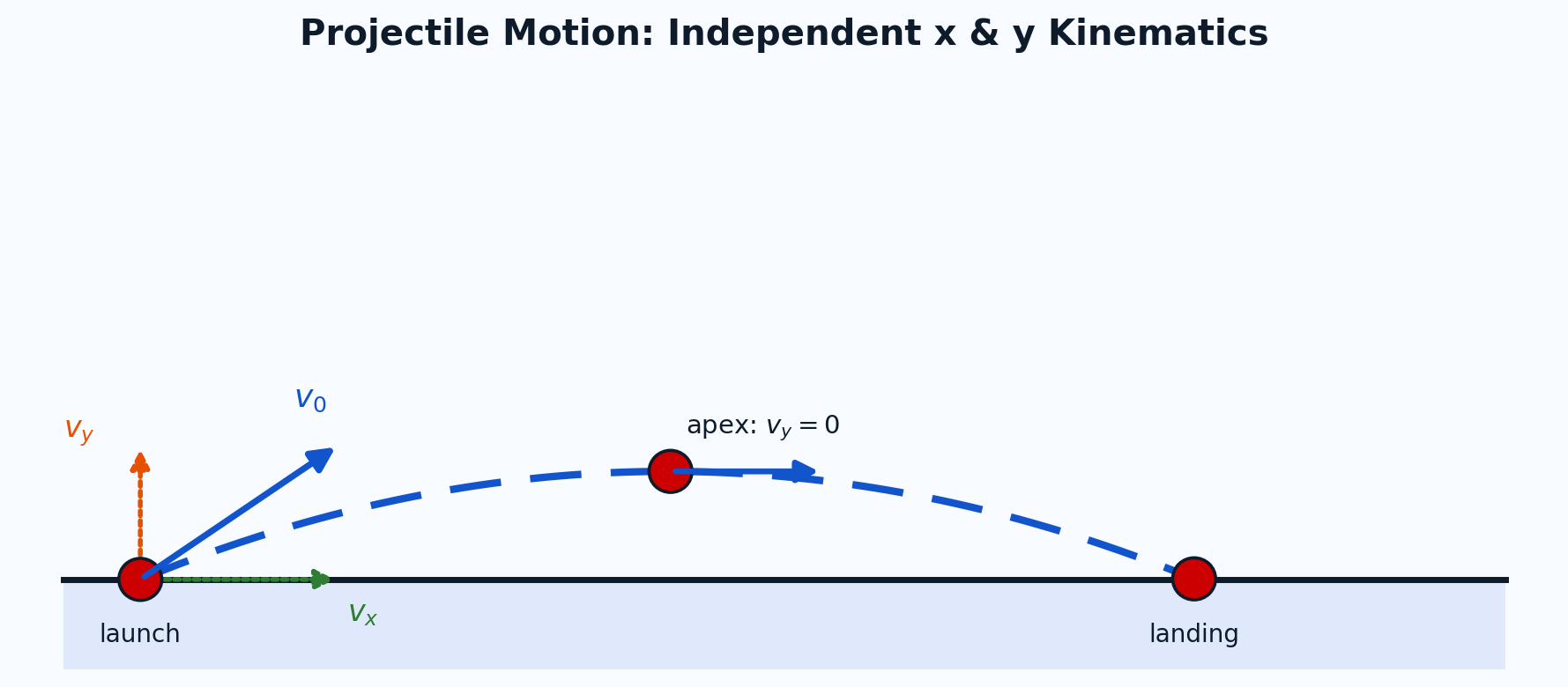
Projectile motion is really two motions happening at once: constant velocity horizontally, and free-fall acceleration vertically.
Why It Matters
Horizontal and vertical motion never affect each other — that's why a dropped ball and a launched ball hit the ground at the same time. It's the same idea behind Newton's Laws: forces change motion, and every force has an equal, opposite partner.
Terminal Velocity and Air Resistance: Analyzes the equilibrium state when drag force perfectly balances gravitational force during free fall.
How does my smartphone know which way is up?: Explores micro-electromechanical systems (MEMS), forces, and proper acceleration detected by internal accelerometers.
How does an Elevator work?: Explores the physical mechanics of counterweights, tension, and pulleys in modern hoist systems.
Collision Course | Newton's Third Law in Action: Shows how every collision exerts equal and opposite forces on both objects involved, regardless of how different their masses are.
Why Elon Musk is Really Building Starship: Explores the thrust, mass ratios, and Newtonian mechanics behind reusable rocket design and lowering the cost of orbital launch.
The Evolution Of The Boxing Glove: Traces how added padding increases the time of impact to reduce peak force, applying the impulse-momentum theorem to protect a boxer's hands.
I Jumped From Space (World Record Supersonic Freefall): A real-world demonstration of terminal velocity and air resistance during a record freefall that broke the speed of sound.
Seatbelt | How does it work?: Explains how a locking mechanism uses inertia and sudden deceleration to hold a passenger in place during a collision.
How Do Horizontally Launched Projectiles Behave? | Physics in Motion: Demonstrates that horizontal velocity and vertical acceleration act independently, producing the classic parabolic path of a projectile.
STEMonstrations: Newton's 2nd Law of Motion: A NASA astronaut demonstrates F = ma aboard the International Space Station, where mass and inertia are easier to isolate from friction.
Meet the Man Who Strapped Himself to a Rocket, For Science: The story of Col. John Stapp's rocket sled tests, which measured how much acceleration the human body can withstand.